
The Four Stroke Cycle Overview
Imagine you are pedaling a bicycle up a steep hill while pushing down hard on the pedals to gain speed. Your legs move in a repeating circle to turn the gears and move the bike forward across the pavement. A car engine works in a similar way by repeating a cycle of movements to create motion from burning fuel. This process happens inside metal tubes called cylinders where small explosions push parts to create rotation. Understanding how these steps repeat helps us see how a heavy vehicle moves with such power.
The Phases of Engine Motion
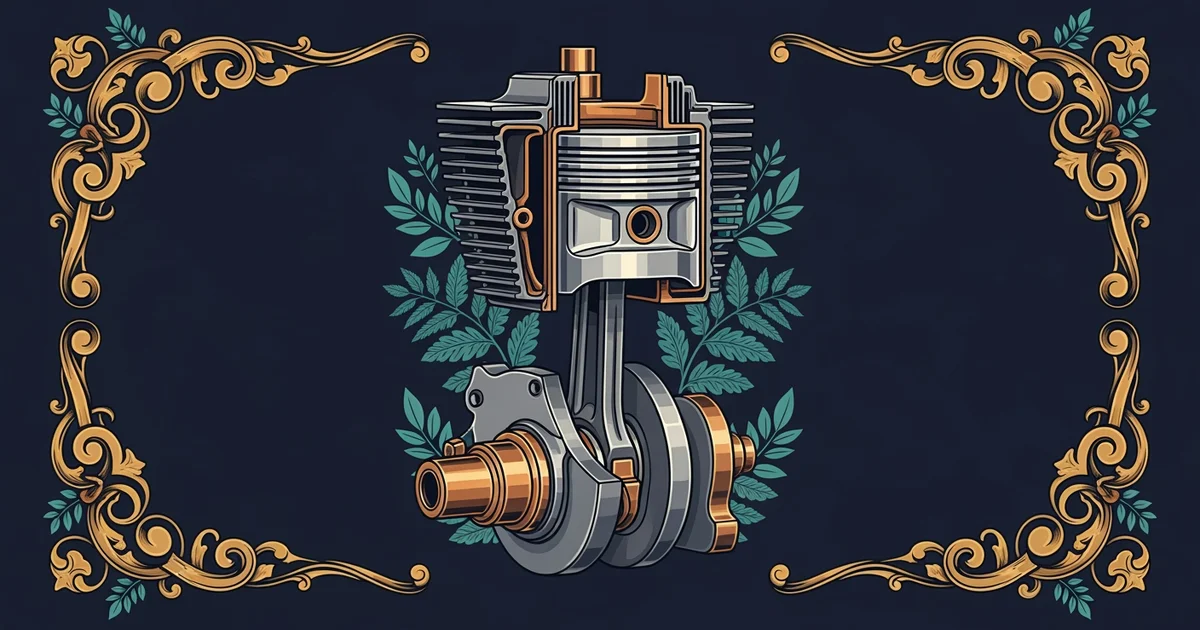
Modern car engines use a specific sequence known as the four-stroke cycle to turn chemical energy into physical force. Each stroke represents one full movement of a piston inside the cylinder as it travels up or down. The process begins with the intake stroke where the piston moves down to pull in a mixture of air and fuel. Once the cylinder is full, the compression stroke pushes the piston back up to squeeze that mixture into a tight space. This compression makes the fuel highly volatile so that it can release maximum energy during the next phase.
Key term: Piston — a sliding metal plug that moves up and down inside the engine cylinder to compress gases and transfer force.
After compression, the power stroke occurs when a spark ignites the fuel mixture to create a controlled explosion. This massive force drives the piston downward with great speed and energy to turn the engine crankshaft. Finally, the exhaust stroke pushes the piston back up to clear out the leftover gases from the burn. The engine then repeats this cycle thousands of times every minute to keep the vehicle moving smoothly along the road. Think of this cycle like a runner taking four distinct steps to complete a single stride forward.
Comparing the Engine Cycle Steps
The following table shows how each of the four strokes contributes to the overall goal of creating consistent vehicle power.
| Stroke Name | Piston Movement | Primary Action | Resulting Effect |
|---|---|---|---|
| Intake | Moving Downward | Pulls in fuel | Prepares the mix |
| Compression | Moving Upward | Squeezes gases | Increases energy |
| Power | Moving Downward | Ignites fuel | Creates movement |
| Exhaust | Moving Upward | Clears gases | Resets the cycle |
Each stage must happen in the exact order listed to ensure the engine runs without stalling or losing efficiency. If the timing of these strokes shifts even by a tiny fraction, the engine will fail to produce power. Engineers spend years designing the mechanical links that keep these four steps perfectly synced during high speed operation. You can imagine the engine as a team of four workers where each person has one job to finish before the next person starts.
If one worker fails to complete their task, the entire production line stops and the vehicle loses its ability to move. This rhythmic repetition is the secret behind how liquid fuel translates into the motion of a heavy car. By mastering these four steps, you can understand how every internal combustion engine functions regardless of its size or power. Each cycle acts as a tiny heartbeat for the machine that keeps the wheels turning on every journey you take.
The four-stroke cycle turns chemical energy into movement by repeating a precise pattern of intake, compression, power, and exhaust.
Now that we know how the cycle repeats, we should look at the specific parts that make this movement possible.