
Engine Geometry and Components
Imagine you are holding a heavy metal box that needs to move a car forward. You must find a way to turn small explosions into steady motion without shattering the box. This challenge defines the basic geometry of every internal combustion engine found on the road today. Engineers design these parts to handle extreme heat while maintaining precise movement at very high speeds. Understanding how these shapes fit together is the first step toward mastering automotive power and mechanical reliability.
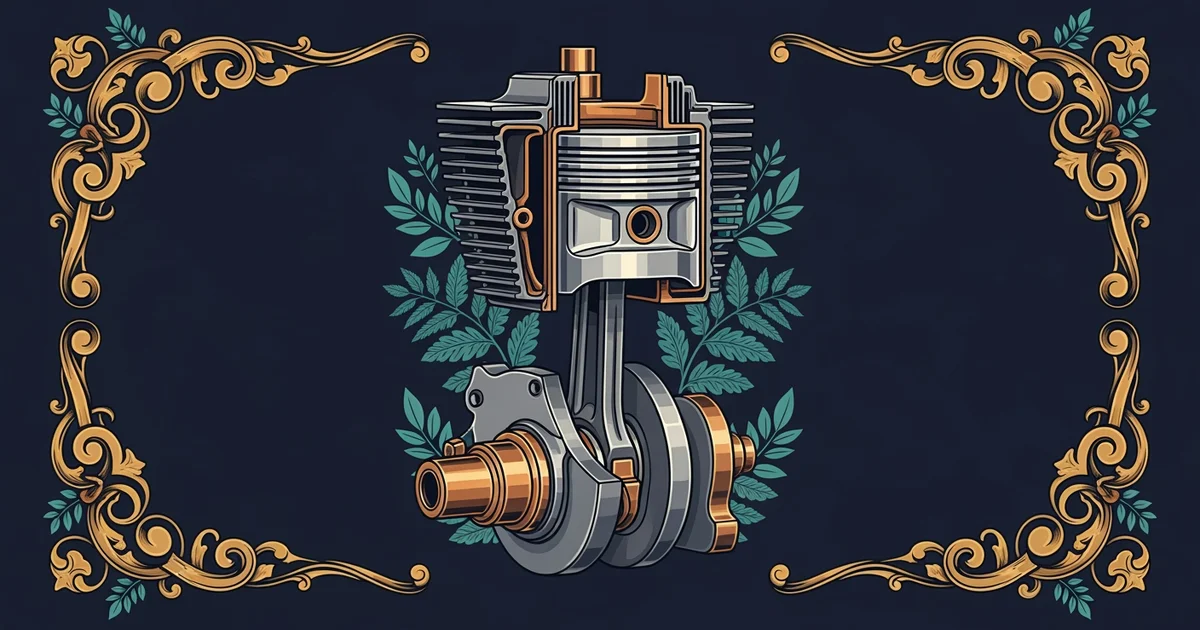
The Anatomy of Engine Motion
Inside every engine, the cylinder serves as the primary chamber where fuel burns to create force. Think of this component like a sturdy metal tube that traps expanding gases during the combustion process. The walls of this tube must be perfectly smooth to allow the internal parts to slide without friction. If the cylinder wall develops even a tiny scratch, the engine loses pressure and fails to run smoothly. This part acts as the foundation for all energy conversion within the entire engine block.
Inside each cylinder sits the piston, which is a movable plug that travels up and down constantly. This component captures the energy from burning fuel and transfers that force toward the lower engine parts. It acts like a runner pushing against a starting block to gain speed during a race. The piston must be light enough to move quickly yet strong enough to survive repeated impacts. It keeps the gases trapped in the top section while transmitting movement to the rest of the system.
Key term: Crankshaft — the rotating metal shaft that converts the linear, up-and-down motion of pistons into circular motion for driving wheels.
Geometry and Component Coordination
Connecting the piston to the rotating parts requires a specific set of mechanical linkages for power transfer. The following list describes how these parts work together to create the output we need:
- The piston rod connects the moving piston to the crankshaft, acting as a sturdy bridge for force transfer during the power stroke.
- The crankshaft uses offset journals to turn straight-line piston movement into the circular rotation required to turn the vehicle wheels efficiently.
- The engine block contains the cylinders and cooling channels, providing the rigid frame that keeps all internal components in perfect alignment.
To visualize how these parts coordinate, consider the relationship between your legs and a bicycle pedal system. Your legs act like the pistons moving up and down while the pedals represent the crankshaft rotating. If your legs move out of sync, the bike stops moving forward because the force is wasted. Engines require the same perfect timing to ensure that every explosion inside the cylinder contributes to rotation. When the geometry is correct, the engine produces smooth power that moves your vehicle across the road with ease.
| Component | Primary Function | Movement Type | Relationship |
|---|---|---|---|
| Cylinder | Contain combustion | Stationary | Houses the action |
| Piston | Capture pressure | Linear | Drives the rod |
| Crankshaft | Rotate wheels | Circular | Final power output |
This table highlights the transition of energy from trapped gas to the rotating motion of your tires. By converting linear movement into circular travel, the engine geometry ensures that heat energy turns into distance. Every part must fit within tight tolerances to prevent mechanical failure during high-speed operation. If one component fails to align, the entire sequence breaks down and the vehicle loses all forward momentum. Engineers spend years perfecting these shapes to maximize efficiency and ensure the machine lasts for many years.
Engine power relies on transforming the linear force of expanding gases into smooth circular motion through precise geometric alignment of internal parts.
Now that we understand how parts move, we must examine how the engine breathes by controlling intake and air flow dynamics.