
The Soil Food Web
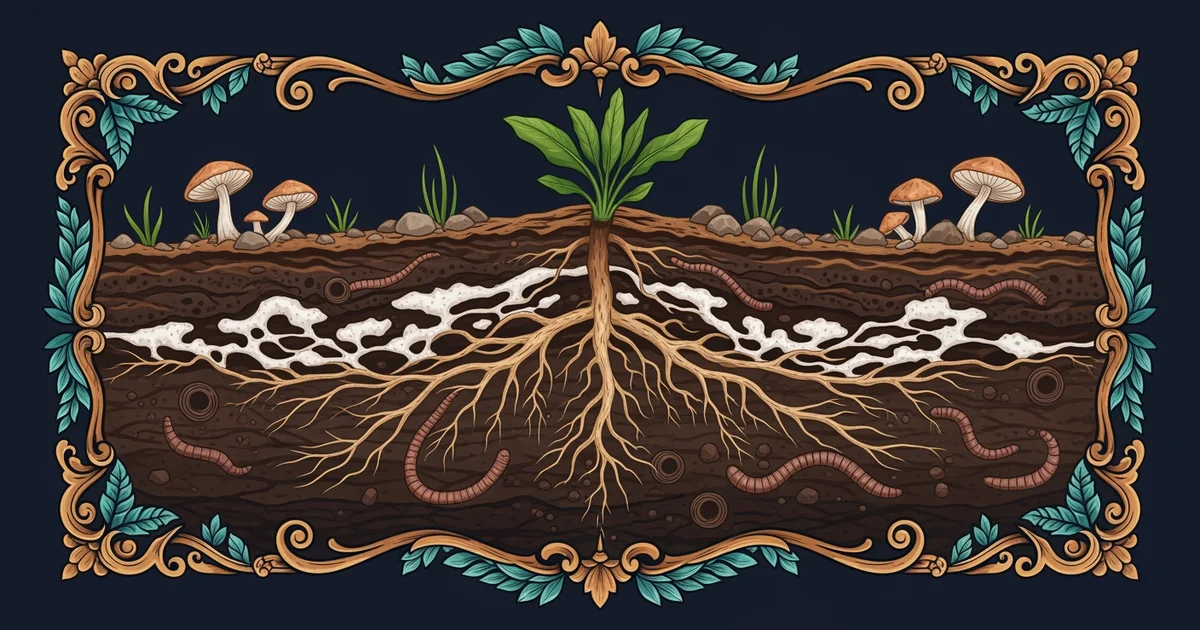
Imagine you are standing in a forest and see a massive oak tree towering above you. You might think the tree stands alone, but its true strength relies on a hidden workforce living right beneath your feet. This busy community of organisms acts like a bustling city infrastructure, constantly trading nutrients to keep the entire ecosystem alive and thriving. Without these tiny workers, the soil would quickly lose its ability to support plant life, leading to the collapse of the food systems we depend on every single day.
The Hierarchy of Soil Life
To understand this hidden world, we must look at how these organisms interact through the soil food web. This network functions like a complex economy where energy flows from one group to another in a series of levels. Plants capture sunlight to create sugars, which they then release into the soil to feed the smallest members of the community. These tiny organisms, including bacteria and fungi, act as the primary processors of the ecosystem. They break down organic matter into smaller pieces that other creatures can easily consume and redistribute throughout the earth.
Key term: Soil food web — the complex community of organisms living all or part of their lives in the soil.
Once the primary processors have established a base, larger organisms join the cycle to maintain balance. These secondary consumers, such as protozoa and nematodes, feed on the bacteria and fungi to keep their populations in check. Think of this like a busy kitchen staff where different roles ensure the meal is prepared correctly. The bacteria are the chefs chopping the ingredients, while the protozoa are the inspectors ensuring the quality remains high. If the inspectors vanish, the kitchen becomes chaotic, and the entire production line grinds to a halt.
Categorizing Soil Organisms by Function
We can organize these organisms by their trophic level, which describes their specific position within the energy transfer chain. Each level depends on the one below it to survive, creating a fragile but highly efficient system of interdependence. The following table highlights the key groups that keep the soil environment functioning at its peak performance level:
| Trophic Level | Primary Role | Examples | Impact on Soil |
|---|---|---|---|
| First Level | Photosynthesizers | Plants, Algae | Capture solar energy |
| Second Level | Decomposers | Bacteria, Fungi | Break down matter |
| Third Level | Shredders | Earthworms, Mites | Aerate the earth |
| Fourth Level | Predators | Spiders, Beetles | Control population |
Every organism listed above plays a vital part in the overall health of the ground beneath us. When these organisms shred decaying leaves, they create tiny tunnels that allow water and air to reach deep into the soil. These tunnels are essential because they prevent the ground from becoming compacted, which would otherwise suffocate the roots of plants. Additionally, the predators at the top of this chain ensure that no single group grows too large, which maintains a stable environment for all inhabitants. This natural regulation is the secret behind healthy fields that produce abundant crops year after year without needing constant human intervention.
When we disrupt this delicate balance through chemical use or heavy tilling, we effectively fire the staff of our underground city. The soil loses its ability to cycle nutrients, and plants begin to struggle because they can no longer access the food they need. By protecting the soil food web, we ensure that the natural economy of the earth continues to function properly. This commitment to soil health is the foundation of sustainable agriculture and the key to feeding a growing global population in the future.
Healthy soil relies on a complex network of organisms that recycle nutrients to sustain plant growth.
But what does it look like when we apply these principles to modern farming practices?