
Defining Living Soil
Imagine a handful of dark, crumbly earth from your garden or a local park. Most people see this material as simple, lifeless dirt that exists only to hold plants in place. This view misses the truth that soil functions as a complex, bustling city beneath our feet. Every teaspoon of healthy dirt contains more individual organisms than there are people living on our planet. We rely on this invisible workforce to cycle nutrients, purify our water, and sustain the global food supply chain. Without these tiny inhabitants, the natural world would stop functioning as we know it today.
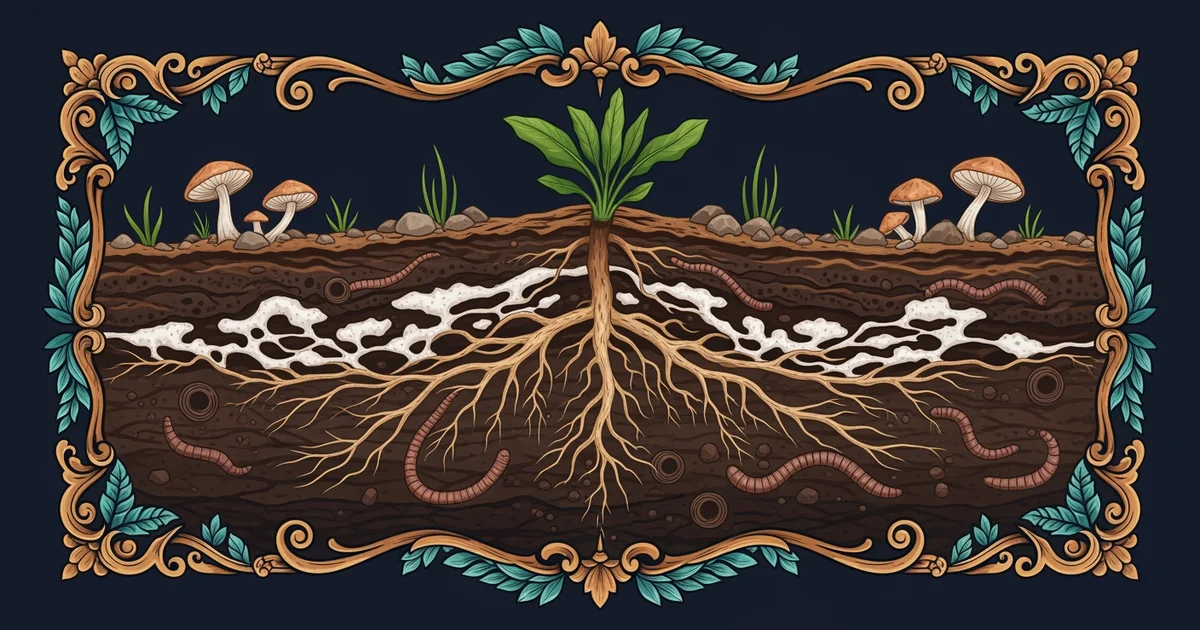
The Biological Engine of Soil
Soil acts like a massive, subterranean bank vault where nature stores its most valuable capital assets. Just as a bank relies on employees to process transactions, soil depends on microorganisms to manage the flow of nutrients. These tiny workers include bacteria, fungi, and protozoa that break down decaying organic matter into food for plants. When plants grow, they trade sugars produced through photosynthesis for the mineral nutrients these microbes unlock from the soil. This constant, silent exchange keeps our entire agricultural system running smoothly and efficiently year after year.
Key term: Microorganisms — the microscopic living entities such as bacteria and fungi that drive the chemical processes within the soil.
This biological engine requires specific conditions to remain productive, much like a factory needing a steady power supply. If we treat soil as a sterile medium, we starve the workers and disrupt the entire production line. Healthy soil maintains a balance of air, water, and organic matter to support this massive population of living things. When we add chemicals or compact the ground, we effectively shut down the factory floor and stop the nutrient cycle. Protecting this community ensures that our crops have the resources they need to thrive during every growing season.
Components of a Living Ecosystem
Beyond the smallest microbes, soil hosts a wide range of larger creatures that play critical roles in ecosystem health. These organisms create tunnels and channels that allow air and water to reach the roots of every plant. By moving through the earth, they mix organic materials into the deeper layers where they are most useful. We can categorize the main living components of healthy soil by the specific tasks they perform to keep the ground fertile and productive.
| Organism Type | Primary Function | Impact on Soil Health |
|---|---|---|
| Bacteria | Nutrient cycling | Converts nitrogen for plant use |
| Fungi | Root connection | Extends reach of plant root systems |
| Earthworms | Soil aeration | Creates tunnels for water and oxygen |
These organisms do not work in isolation, as they form a web of life that connects everything together. Fungi act like a massive underground internet, linking plants to distant nutrient sources that roots cannot reach alone. Earthworms serve as the heavy machinery of the soil, turning over deep layers and bringing fresh nutrients to the surface. Each member of this community plays a vital role in keeping the soil structure loose, airy, and full of life. When these creatures thrive, the soil remains resilient against drought, floods, and other environmental stressors that threaten our food crops.
Understanding this hidden world changes how we view the ground beneath our boots every single day. We are not just standing on dirt, but on a highly organized, living foundation that supports all human life. By nurturing the life within the soil, we ensure that future generations will have the fertile land needed to grow healthy food. This path will guide you through the physical and chemical secrets of the earth, eventually showing you how to manage soil for long-term ecological success.
Healthy soil functions as a living, breathing ecosystem where billions of microorganisms perform the essential work of recycling nutrients for all plant life.
This journey will show you how the mineral matrix and biological life combine to create the fertile foundation required for global food security.