
Nutrient Cycling Paths
Imagine a vast bank account that holds all the essential life-giving elements for the ocean. Every living organism in the sea makes constant withdrawals from this account to fuel their daily growth and survival. Without regular deposits of fresh resources, the entire marine economy would quickly collapse into a barren and empty void. This cycle of movement ensures that life persists even in the deepest corners of our blue planet.
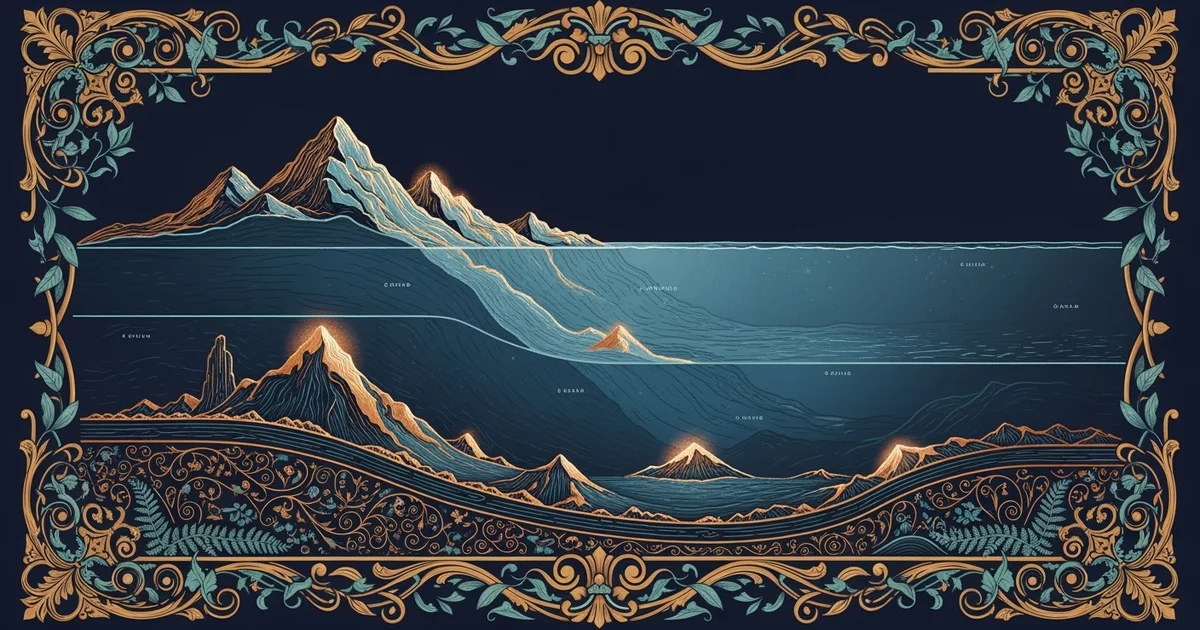
The Engine of Marine Productivity
Nutrient cycling describes how vital chemical elements move through the water column in a continuous loop. Plants like phytoplankton capture sunlight and absorb dissolved minerals to build their own organic structures. When these tiny organisms die, they sink toward the dark ocean floor where bacteria break them down. This decomposition process releases the trapped nutrients back into the deep water for future use. Think of this like a recycling center where old materials are broken down to create brand new products. The ocean relies on this internal trade to keep its massive ecosystem functioning across all depths.
Key term: Upwelling — the vertical movement of cold, nutrient-rich deep water toward the surface to replace warmer water.
This process of upwelling acts as the primary delivery service for the surface ocean. When wind patterns push surface waters away from the coast, deep water rises to fill the empty space. This deep water carries a massive supply of nitrogen and phosphorus that has been waiting on the seafloor. These nutrients act like high-quality fertilizer for the surface plants that need them to bloom. Without this vertical transport, the surface would remain empty because the sun cannot reach the bottom to release those stored assets.
Distribution Patterns of Essential Elements
Marine ecosystems depend on the predictable flow of these chemical deposits to maintain their population levels. The availability of nutrients often dictates which creatures can thrive in a specific region of the sea. Areas with strong consistent cycling support massive schools of fish and large marine mammals that feed on them. Regions without this active mixing remain biological deserts where life struggles to find enough energy to grow. The following table highlights the three primary nutrients that drive the biological productivity of our global oceans.
| Nutrient Type | Primary Source | Biological Role | Impact on Life |
|---|---|---|---|
| Nitrogen | Deep sea decay | Protein building | Growth speed |
| Phosphorus | Crustal erosion | Energy transfer | Cell division |
| Iron | Dust particles | Enzyme function | Oxygen transport |
These elements do not just sit in one place because they are constantly being moved by massive currents. The global conveyor belt moves water across the entire planet over hundreds of years. This long journey ensures that nutrients trapped in the deep ocean eventually return to the surface. It is a slow investment strategy that pays off for life on a massive scale. We see the results of this cycle whenever we observe vibrant coral reefs or busy fishing grounds.
- Biological uptake occurs when surface plants consume nutrients to build their tissues during the day.
- Downward transport happens as dead organisms fall into the abyss, effectively moving energy to the bottom.
- Decomposition releases the nutrients back into the water once the bacteria finish their work in the dark.
- Upwelling brings those recycled nutrients back to the surface to restart the cycle for another generation.
The balance of these steps determines the health of the entire marine food web. If one step in this long sequence fails, the entire system feels the pressure immediately. We must understand these paths to see how the ocean maintains its delicate status as a living system. Every single drop of seawater plays a part in this grand exchange of chemical wealth.
The survival of marine life depends on the continuous movement of nutrients between the dark seafloor and the sunlit surface waters.
But what does this constant cycling of resources look like when humans begin to alter the ocean environment?