
Aquifer Systems
Imagine you are holding a dry kitchen sponge under a running faucet. The water disappears into the tiny holes of the sponge until it can hold no more liquid. Beneath our feet, the ground behaves like that sponge, hiding vast amounts of water within layers of rock and soil. This hidden storage system sustains our world by acting as a giant, natural reservoir for all living things.
The Mechanics of Underground Storage
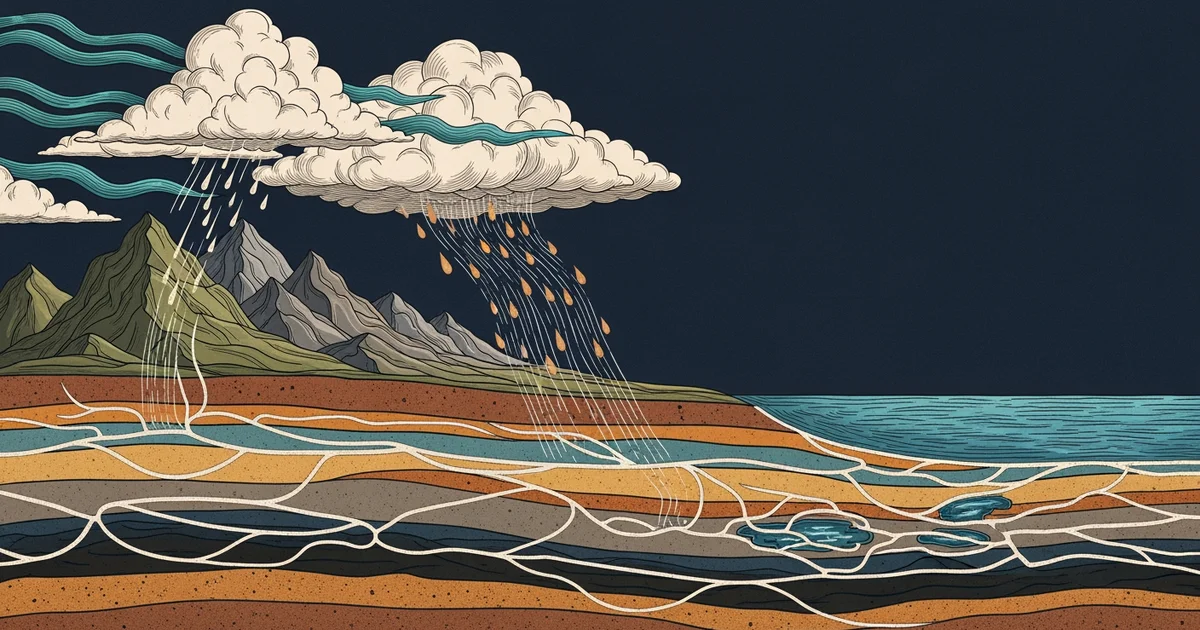
When rain falls on the earth, most of it does not simply sit on the surface. Much of the water travels downward through the soil until it hits a layer of solid rock. This process creates an aquifer, which is an underground layer of water-bearing permeable rock or gravel. Think of the aquifer as a bank account for our planet. Just as you deposit money into a bank to save it for later use, the earth deposits water into these rocky layers. The water stays there for years, or even centuries, until humans or natural springs draw it out for use. When the rock has high permeability, the water moves through the cracks easily, filling the entire space like a sponge soaking up a spill. If the rock is dense and lacks gaps, the water stays trapped, creating a barrier that forces the liquid to move in a different direction.
Key term: Porosity — the measure of the void spaces in a material, representing the total amount of water that a rock can hold.
Why Porous Rock Holds Water
Water storage depends entirely on the physical structure of the earth beneath us. Some rocks have small, connected holes that allow water to flow freely through the entire system. Other materials, like clay, have tiny pores that hold onto water tightly, making it very difficult for the liquid to move. We can compare this to a crowded theater where people move through the aisles. If the aisles are wide and open, everyone moves quickly to their seats. If the aisles are narrow and blocked, movement stops, even if the room is full of people. This movement is essential for the water cycle to function properly. Without these porous layers, water would wash away into the oceans immediately after a heavy storm. Instead, the ground slows this process down, filtering the water as it passes through layers of sand and stone. This natural filtration process cleans the water, making it safer for plants and animals to consume when it eventually reaches the surface again.
To understand how different materials hold water, consider the following characteristics:
- Sandstone contains large, connected gaps that act like highways for water, allowing it to travel quickly through the underground system.
- Shale consists of flat particles that stack together tightly, creating a seal that prevents water from moving through the rock layer.
- Limestone often contains large cracks and tunnels that form over time, which can store massive volumes of water in deep chambers.
These differences determine how much water we can access in any given area. When geologists study these layers, they look for specific signs of permeability to estimate how much water is available. If the rock is too dense, the water cannot recharge, leading to dry wells and stressed ecosystems. When the rock is porous, the aquifer remains healthy and provides a steady supply of water for the surrounding land. This balance is vital for maintaining the health of our local environment and ensuring that life persists during long dry seasons.
The capacity of an aquifer to store and release water depends on the size and connection of the tiny spaces within the rock layers.
But how do we manage these underground water resources once we understand their physical structure?
Want this with sources you can check?
Premium Learning Paths for Earth Sciences & Geography are researched against open-access libraries — PubMed, arXiv, government databases, and more — with their distinctive claims cited to real sources and independently checked.
See what Premium includes