
The Global Water Budget
Imagine you have a single gallon of water to last your entire life on a desert island. You would carefully manage every drop to ensure you never run out of vital resources. Earth operates much like this island because our planet holds a fixed amount of water that constantly moves around. This closed system means the water you drink today is the same water that existed millions of years ago. Understanding how this supply stays balanced is the first step in seeing how our world supports all living things.
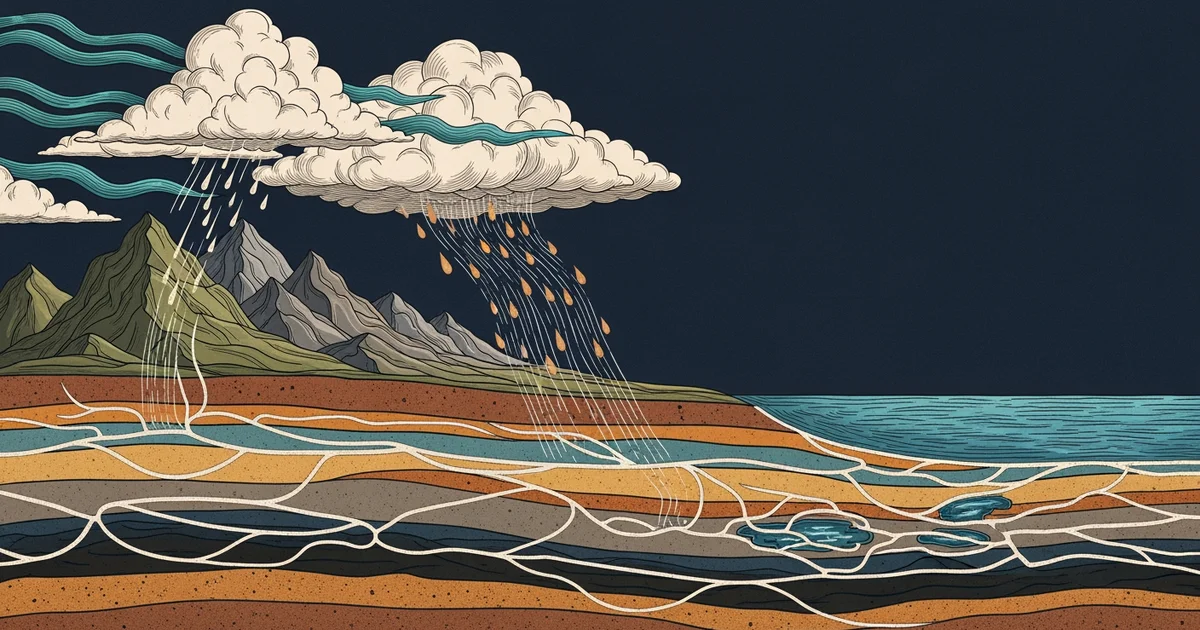
The Distribution of Planetary Water
Most people assume water is everywhere, yet the vast majority of it remains locked away from human use. While oceans cover most of the planet, this saltwater is far too salty for drinking or growing food. We must rely on a tiny fraction of total water that exists as fresh liquid. This fresh supply hides in underground pockets or flows through rivers and lakes across the continents. If you think of Earth as a giant bank account, the ocean is the massive vault that holds almost all the currency. Unfortunately, you cannot spend that money because it stays locked in a vault you cannot open.
Key term: Hydrosphere — the total amount of water on a planet, including the water on the surface, underground, and in the air.
We can organize this water supply by looking at where it stays for long periods of time. This distribution determines how easily plants, animals, and humans can access the hydration they need to survive. The table below shows the main places where water resides on our planet today.
| Water Source | State of Matter | Accessibility Level |
|---|---|---|
| Oceans | Liquid Salt | Very Low |
| Glaciers | Solid Ice | Low |
| Groundwater | Liquid Fresh | Moderate |
| Surface Water | Liquid Fresh | High |
Managing the Global Water Budget
Water moves between these storage areas through a process that keeps the total amount stable over time. Even though water changes its state from ice to liquid or gas, the total volume remains constant across the globe. This balance acts like a household budget where you cannot spend more money than you earn each month. Nature manages this budget by shifting water between the atmosphere and the surface to ensure no region stays dry forever. When the sun warms the surface, water turns into vapor and rises into the sky to form clouds.
Eventually, this vapor cools down and falls back to the ground as rain or snow to replenish the land. This cycle ensures that water reaches deep inland areas far away from the massive saltwater oceans. Without this constant movement, the land would turn into a barren desert because local supplies would quickly dry up. Plants and animals rely on this predictable delivery system to stay hydrated throughout the changing seasons of the year. By studying these patterns, we learn how human activity might impact the delicate balance of our natural water systems.
- Evaporation turns surface water into gas to move it away from the oceans.
- Condensation changes gas back into liquid droplets that gather to form heavy clouds.
- Precipitation releases that stored water back onto the land to refill our rivers and lakes.
- Collection gathers the runoff into basins where it waits to start the cycle all over again.
This continuous loop sustains life by recycling the same molecules over and over across many different landscapes. Every drop of rain you see outside has participated in this journey for countless generations of life on Earth. Understanding this movement helps us appreciate how precious our fresh water truly is for our future survival.
The global water budget represents a closed system where a finite supply of water is constantly recycled to sustain life across the planet.
By mastering the basics of how water moves, you will soon discover how solar energy acts as the primary engine that drives this entire planetary system forward.