
Porosity and Permeability
Imagine you are trying to pour water through a dense brick versus a pile of loose sand. You will notice that water flows through the sand almost instantly while it pools on top of the brick. This simple difference reveals how the structure of the earth beneath our feet dictates the movement of life-sustaining water. The earth acts like a complex filter that manages our global water supply. Understanding how this process works requires looking at two distinct physical properties of soil and rock layers.
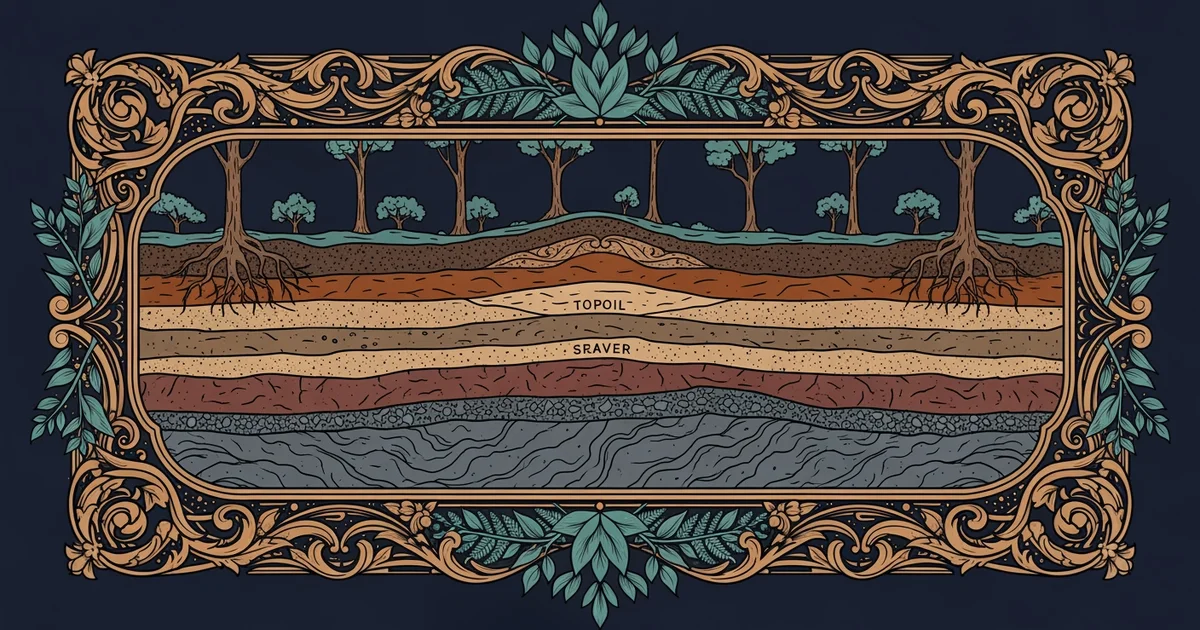
Understanding Soil Structure
To grasp how water moves underground, we must first examine porosity. This term describes the total volume of empty space within a specific soil or rock sample. Think of these empty spaces as tiny storage units waiting to be filled with water or air. If a material has high porosity, it possesses a large capacity to hold fluids. Imagine a sponge that is full of holes. Even if the holes are not connected, the sponge can still hold a significant amount of water. Soil with high porosity acts like a massive underground reservoir that buffers the environment against sudden changes in climate. It keeps water available long after the last rainfall has ended.
Key term: Porosity — the measure of the void spaces in a material that determines how much water or gas it can hold.
While porosity tells us how much water a material can hold, it does not explain how easily that water moves. This is where we must define permeability. This property measures the ability of a material to transmit fluids through its interconnected pores. If the pores are blocked or isolated, the water remains trapped, even if the material is highly porous. Think of a crowded hallway where everyone is standing still. Even if there is plenty of room to move, nobody can actually get anywhere because the path is blocked. Permeability is the measure of how clear that path is for moving water. High permeability means the water can travel quickly through the soil layers to reach deep aquifers.
Comparing Earth Materials
Different types of ground materials offer varying levels of efficiency for fluid movement. We can compare these materials based on their ability to store and transmit water effectively. The following table highlights how particle size influences these two critical properties in common earth materials.
| Material Type | Porosity Level | Permeability Rate | Water Movement |
|---|---|---|---|
| Coarse Sand | Moderate | Very High | Rapid flow |
| Silt | High | Low | Slow seepage |
| Solid Clay | High | Extremely Low | Nearly blocked |
As you can see, clay presents a unique case in geological studies. It has very small particles that create many tiny spaces, resulting in high porosity. However, those spaces are so small that water cannot easily pass through them. This makes clay a poor transmitter of water. In contrast, coarse sand has larger, well-connected spaces that allow for rapid movement. This relationship is vital for managing groundwater recharge and preventing floods in urban areas. Without these natural filters, our water systems would not function as they currently do in nature.
Applying Geological Principles
When we look at the ground, we are seeing a complex system of filters. If the soil is too dense, water runs off the surface and causes erosion instead of soaking into the ground. If the soil is too loose, water might drain away too quickly for plants to use it properly. Scientists measure this flow using hydraulic conductivity. This calculation helps us predict how fast water moves through specific soil types under gravity. By balancing these factors, the earth regulates the water cycle and supports diverse ecosystems across the globe. We rely on these natural processes to keep our water clean and accessible for all living things.
The physical arrangement of empty spaces in the ground determines both the storage capacity and the flow rate of our vital water resources.
The next Station introduces weathering rates, which determines how chemical and physical processes break down rock into the soil we study.