
Soil Mineralogy
Imagine you are holding a handful of garden soil and wondering why some dirt feels sticky while other types crumble apart in your hands. This simple texture difference reveals the hidden world of soil mineralogy, the study of how tiny mineral particles create the physical foundation for every plant on our planet. These microscopic building blocks dictate how water moves through the ground and how nutrients are held for roots to absorb. By understanding these tiny structures, we gain insight into how the Earth sustains life beneath our feet.
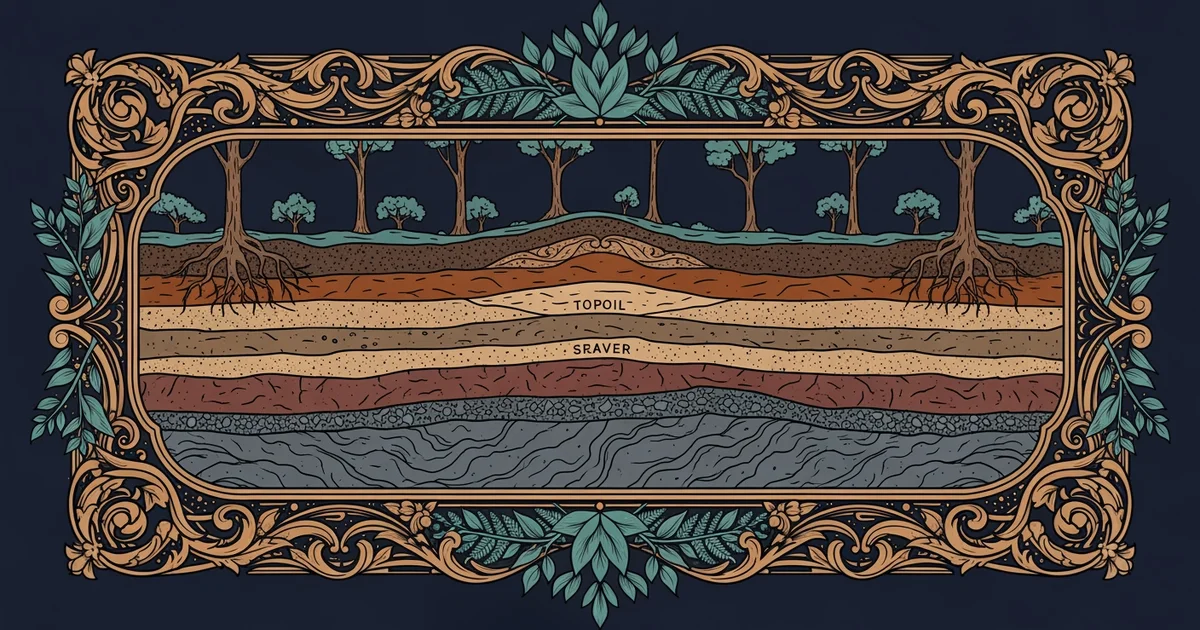
The Architecture of Clay Minerals
Because soil particles are too small to see with the naked eye, scientists use specialized tools to study their layered atomic structures. These layers are like a stack of paper sheets, where each sheet is made of silicon and aluminum atoms bonded together tightly. Some clays have two layers, while others have three, and this difference changes how they react to water and nutrients. Think of these clay minerals like a sponge that changes size depending on how much water it absorbs from its environment. This ability to expand and contract determines if a soil stays healthy during a drought or becomes waterlogged during a heavy rainstorm.
Key term: Soil mineralogy — the scientific study of the chemical and physical properties of the inorganic mineral components that make up the soil matrix.
When we look at how these minerals function in nature, we can compare them to a busy city’s storage warehouse system. Just as a warehouse organizes goods for later distribution, clay minerals store essential plant nutrients like calcium and potassium on their surfaces. If the warehouse is too small or poorly organized, the city cannot function efficiently during times of high demand. Similarly, if the soil lacks the right mineral structure, plants will struggle to find the nutrients they need to grow, even if the soil looks dark and rich to the human eye.
Categorizing Primary Soil Minerals
These mineral structures fall into specific groups based on their layer arrangements and their overall electrical charge. The way these particles interact with the world around them depends on their specific internal geometry and surface area. We can categorize these minerals to understand their unique contributions to the soil environment:
- Kaolinite consists of a simple two-layer structure that does not expand, making it very stable but less capable of holding onto large amounts of nutrients for plant roots.
- Illite features a three-layer structure held together by potassium ions, which creates a stable but limited capacity for nutrient exchange compared to more reactive soil minerals.
- Montmorillonite possesses a highly expansive three-layer structure that traps water and nutrients between sheets, acting as a massive reservoir that supports plant life in diverse climates.
These differences are not just academic details because they dictate how farmers manage their land and how forests survive changing weather patterns. A soil dominated by one mineral type will behave differently than a soil dominated by another, even if they share the same climate. By analyzing the composition of these particles, we can predict how a landscape will respond to environmental stress over many decades. This deep understanding allows us to protect our global water supply and keep our ecosystems functioning even when the climate shifts unexpectedly.
| Mineral Type | Layer Structure | Expansion Ability | Nutrient Capacity |
|---|---|---|---|
| Kaolinite | Two-layer | None | Low |
| Illite | Three-layer | Low | Moderate |
| Montmorillonite | Three-layer | High | High |
Understanding these mineral types helps us see that soil is not just dead dirt, but a complex, reactive chemical system. Each layer of these minerals works to balance the chemistry of the earth so that life can thrive above. As we move forward, we will see how these physical structures provide the stage for invisible biological processes to occur.
The specific arrangement of atomic layers within soil minerals determines how effectively the earth stores water and essential nutrients for plant growth.
The next Station introduces microbial interactions, which determine how life forms utilize the nutrients stored within these mineral structures.