
Latent Space Exploration
Imagine you are standing in a massive library where every single book is arranged by its specific topic rather than by title. You can walk through this space to find books about history near other history books, while science books cluster together in a different corner. This is exactly how computers organize complex data when they build a latent space to represent information. By mapping thousands of individual features into a shared mathematical coordinate system, the computer creates a map where similar items naturally sit close to one another. When you move through this digital landscape, you are actually exploring the hidden relationships that define how a machine understands the world around us. This process allows computers to generate new ideas by finding gaps between existing points in this high-dimensional mathematical map.
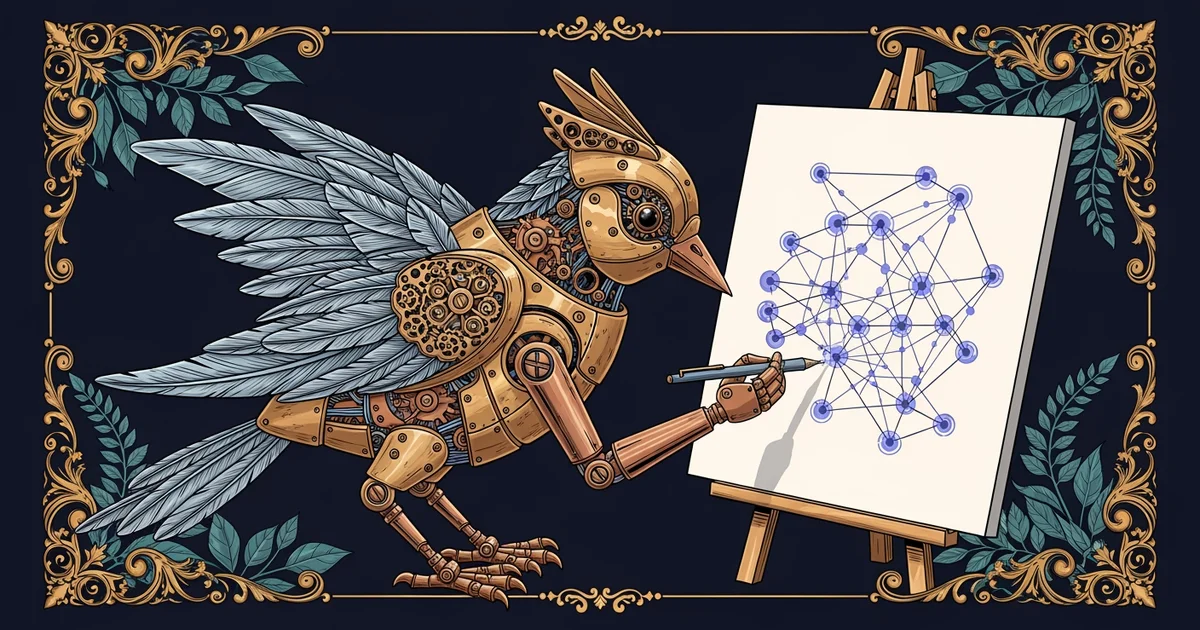
Navigating The Mathematical Map
To build this map, the computer must first translate raw data like images or words into long lists of numbers. These lists are called vectors, and they act like GPS coordinates for each piece of information within the system. If the computer processes thousands of cat photos, it will eventually group all the images of long-haired cats in one specific sector of the space. Short-haired cats will appear in a nearby sector, while dogs will reside in a completely different neighborhood of the coordinate system. By organizing data this way, the machine learns the underlying patterns that make a cat look like a cat without needing human instructions. This mathematical structure serves as the foundation for modern creative tools that can synthesize new images from scratch.
Key term: Latent space — a compressed mathematical representation where similar data points are clustered together to reveal hidden patterns.
When we explore this space, we are essentially performing a digital version of mixing paint colors on a palette. If you take the vector for a picture of a sunny day and add it to the vector for a rainy day, the machine calculates a new point that sits between those two concepts. This new location might represent a cloudy day or a light drizzle because the computer understands the mathematical distance between those weather patterns. You can think of this like a map of a city where the distance between two points represents how much they have in common. Moving from one point to another allows the computer to blend features, creating a bridge between distinct ideas that might seem unrelated at first glance.
Visualizing The Vector Relationships
Understanding how these points relate to one another requires us to look at the geometry of the system. The following table illustrates how different objects might be positioned relative to each other based on their shared visual characteristics within the coordinate grid.
| Object Pair | Distance | Reason for Proximity |
|---|---|---|
| Golden Retriever and Labrador | Very Close | Similar shape and fur texture |
| Golden Retriever and Sports Car | Very Far | No shared features in the model |
| Sports Car and Race Car | Very Close | Similar mechanical structure and speed |
This table shows that the computer does not see objects as physical things, but as collections of mathematical properties. Because the computer calculates these distances, it can navigate the space to find the perfect middle ground between two distinct concepts. This ability to interpolate between points is what gives artificial intelligence its apparent creativity when generating new content for users. By exploring these empty gaps, the system creates something that feels original while remaining grounded in the data it has learned during training. The machine is not just following rigid rules but is instead finding the most logical path through a complex web of possibilities.
- The machine converts raw data into numerical vectors to establish a starting position for every concept.
- It maps these vectors into a high-dimensional space where distance reflects the similarity between different data points.
- The system calculates the mathematical path between two points to blend features and generate entirely new outputs.
This process of navigation ensures that the computer can produce results that are both unique and relevant to the user request. Every time you ask a computer to create something new, it is essentially walking to a specific coordinate in its latent space to see what exists there. If the coordinate is empty, the computer uses its internal logic to predict what should be present based on the surrounding neighborhood. This predictive capability is the engine behind modern generative technology, allowing machines to mimic the creative process by exploring the vast, invisible map of human knowledge.
Generating new content works by calculating the mathematical distance between existing data points to discover the hidden patterns that connect different concepts.
But what does it look like in practice when we try to guide this exploration through specific instructions?
Want this with sources you can check?
Premium Learning Paths for Computer Science & AI are researched against open-access libraries — PubMed, arXiv, government databases, and more — with their distinctive claims cited to real sources and independently checked.
See what Premium includes