
Historical Roots of AI Art
Imagine staring at a blank canvas while a machine moves a brush to create a masterpiece. You might wonder if the machine understands beauty or if it simply follows a set of rigid rules. Artists and engineers have explored this curious tension for decades by using basic logic to generate visual patterns. These early experiments did not rely on modern neural networks or massive data sets. Instead, they used simple mathematical formulas to dictate where lines should go and how colors should blend. This process mirrors a chef following a recipe to bake a cake, where the quality of the final dish depends on the accuracy of the steps. By breaking art down into measurable coordinates, early pioneers proved that computers could produce complex imagery through precise instructions.
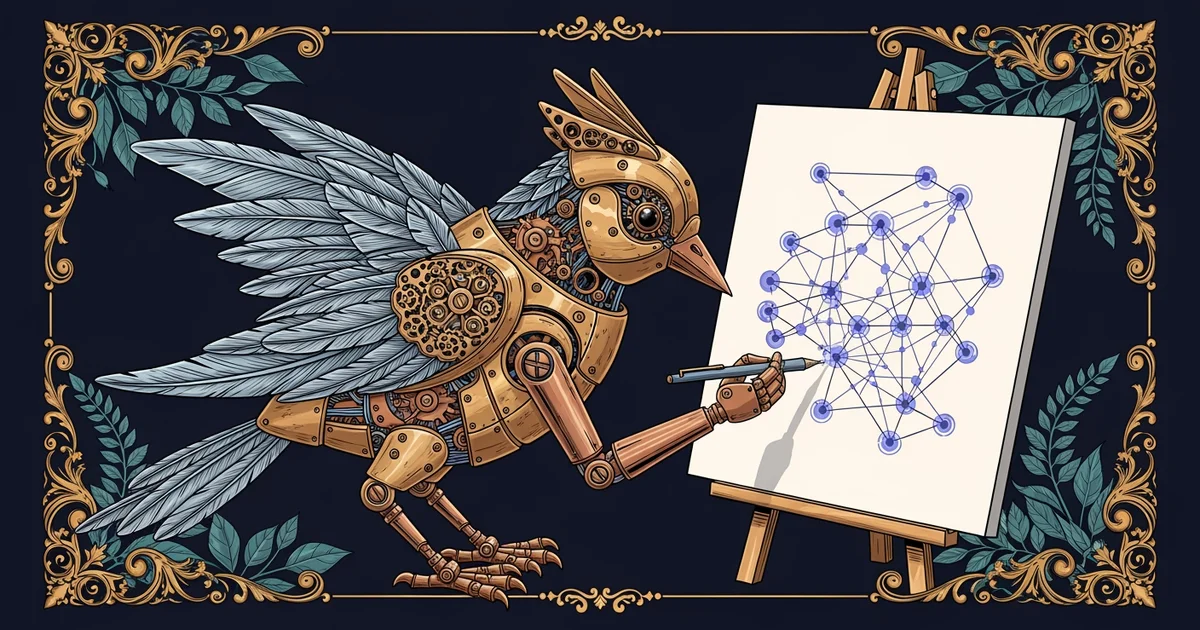
The Dawn of Algorithmic Drawing
Early creators viewed the computer as a tool for extending human precision rather than replacing the artist. They wrote short programs that instructed a mechanical arm to draw lines on paper with extreme accuracy. These machines operated by reading coordinates from a list, much like a traveler follows a map to reach a specific destination. If the coordinates were slightly off, the drawing would change, showing how sensitive the system was to the initial input. This connection between math and aesthetics allowed artists to explore patterns that were too repetitive for human hands to draw perfectly. By automating the mechanical aspects of art, these thinkers shifted their focus toward the design of the rules themselves.
Key term: Algorithmic Art — a creative practice where images are generated by a set of well-defined rules or mathematical instructions.
These pioneers often struggled with the same questions we face today regarding the nature of creativity. They had to decide if the art belonged to the human who wrote the code or the machine that executed the movements. Most concluded that the human designer remained the true artist because the machine lacked intent. The computer acted as a medium, similar to how a painter uses a brush to apply pigment to a canvas. This perspective helped stabilize the field by framing computation as a sophisticated extension of traditional artistic tools. It also highlighted that the beauty of the output was a direct result of the logic built into the system.
Evolution Through Mechanical Logic
As technology advanced, the methods for creating digital imagery became more complex and refined. Artists began using random variables to introduce variety, ensuring that every output looked unique despite following a shared logic. This addition of chance made the results feel more organic, moving away from the cold rigidity of early geometric shapes. The following table illustrates how different inputs influence the final visual output in these systems:
| Input Variable | Influence on Art | Resulting Aesthetic |
|---|---|---|
| Fixed Coordinates | Predictable paths | Geometric precision |
| Random Noise | Varied spacing | Organic movement |
| Iterative Loops | Repeated patterns | Complex fractals |
By manipulating these inputs, creators could simulate natural phenomena like the growth of plants or the flow of water. This transition from simple lines to complex simulations marked a major shift in the history of computational creativity. It proved that machines could handle the heavy lifting of repetitive tasks while humans focused on the conceptual framework. This partnership between human vision and machine speed remains the foundation for all modern digital design tools. It forces us to reconsider if art is defined by the final product or the process of creation.
True artistic agency in computation resides in the design of the rules rather than the execution of the output.
Moving forward, we will investigate how specific aesthetic rules allow computers to mimic complex artistic styles.