
The Master Clock
Imagine waking up at the exact same time every single day without an alarm clock. Your body feels alert and ready to start the day before the sun even rises. This internal precision relies on a hidden command center that keeps your biological systems running on time. Just as a city needs a central power station to keep the streetlights and traffic signals synchronized, your brain houses a tiny regulator that manages your daily rhythm. Without this internal rhythm, your body would struggle to know when to rest or when to stay awake.
The Anatomy of the Internal Clock
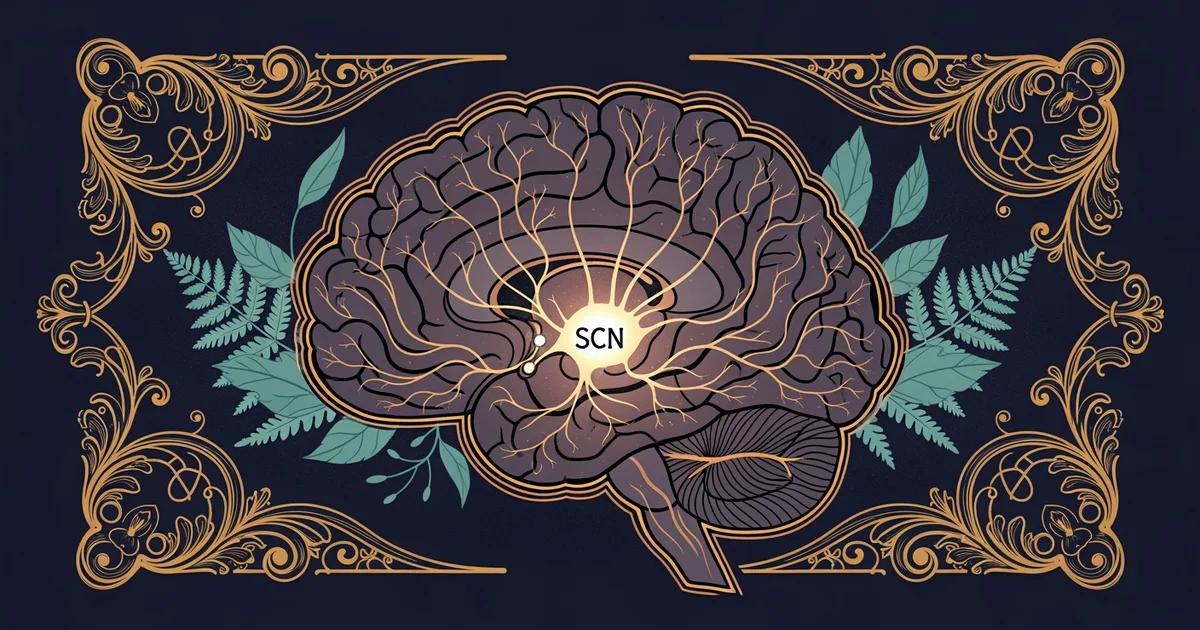
Deep within the base of your brain, you have a specialized cluster of nerve cells known as the suprachiasmatic nucleus. This region acts as the primary controller for nearly every rhythmic process in your body. It sits directly above the point where your optic nerves cross, allowing it to receive direct light data. When sunlight hits your eyes, the signal travels instantly to this master regulator to reset your daily cycle. This ensures your internal time matches the external world, keeping your energy levels aligned with the rising and setting of the sun.
Think of this master clock like the conductor of a massive, complex symphony orchestra. Every organ and cell in your body acts like an individual musician playing a specific instrument at a set time. If the conductor stops waving the baton, the musicians will continue to play, but the music will quickly lose its harmony. The rhythm becomes chaotic because no one knows when to start or stop their specific part. Similarly, your organs rely on the signals from this center to stay in tune with each other.
How Signals Travel Through the Body
Once the master clock receives light data, it sends out a series of chemical messages to the rest of the body. These signals travel through your nerves and bloodstream to reach distant organs like the liver, heart, and lungs. These organs contain their own local clocks that listen for updates from the master regulator. If the master clock detects a change in the environment, it broadcasts a correction to keep every organ synchronized. This process prevents your internal systems from drifting apart over time.
| Signal Type | Primary Function | Destination Organ |
|---|---|---|
| Electrical | Rapid adjustment | Nearby brain areas |
| Hormonal | Sustained timing | Liver and kidneys |
| Metabolic | Energy pacing | Muscles and lungs |
These signals ensure that your digestion, heart rate, and body temperature all shift in unison throughout the day. When you travel across time zones, your master clock takes a few days to adjust to the new light cycle. During this transition, your organs receive conflicting messages, which leads to the temporary fatigue known as jet lag. Your body is essentially waiting for the conductor to regain control of the tempo so the orchestra can play in harmony once again.
Key term: Suprachiasmatic nucleus — the tiny region of the brain that uses light signals to synchronize all internal biological rhythms.
Because this master regulator relies on light as its primary input, it is incredibly sensitive to modern lighting environments. If you stay up late using bright screens, you trick your brain into thinking it is still daytime. This delay forces the master clock to push back your internal schedule, making it harder to wake up the next morning. By maintaining a consistent sleep schedule and limiting artificial light at night, you help your master clock function with maximum efficiency and clarity.
The master clock acts as the ultimate biological conductor that synchronizes the diverse timing needs of every organ in your body.
The next Station introduces cellular oscillators, which determine how individual cells maintain their own rhythmic cycles.