
Evolutionary Origins
Imagine a world where your alarm clock never rings because the sun dictates your schedule. Ancient life forms lived this reality by syncing their internal systems to the planet's rotation. These organisms did not need watches to know when the sun would rise or set. They developed a deep, internal rhythm that matched the predictable cycle of light and dark. This biological heritage remains hidden within your cells today, guiding your energy and your rest. Understanding these origins helps us see why modern life often clashes with our ancient biology.
The Dawn of Biological Timing
Early life on Earth faced a constant challenge from the rising and setting of the sun. Organisms that could anticipate these changes gained a massive survival advantage over their slower peers. Imagine a factory that schedules its power usage to match the cheapest electricity rates available. These early cells did the same thing by saving energy during the dark hours. They prepared their internal machinery before the sun hit the horizon to maximize their growth. This process required a molecular mechanism that could track time without any external input. Over millions of years, these tiny systems became the foundation for all complex life forms.
These ancient rhythms provided a framework for survival that persists in modern organisms across the globe. We can categorize these early adaptations into three primary functional groups that helped species endure:
- Metabolic preparation allows organisms to shift their chemical processes to match the expected onset of daylight. This ensures that essential proteins are ready for the day before the sun actually appears.
- Predator avoidance helps smaller creatures hide during the times when their hunters are most active. By syncing their activity to safer windows, they significantly increase their chances of living longer.
- Resource optimization ensures that organisms only forage when food is most abundant in their local environment. This prevents the waste of energy during times when searching for food is fruitless.
Evolution of the Internal Clock
Once these simple rhythms took root, they became a permanent feature of the genetic code for many species. Evolution favored organisms that maintained a steady internal beat even when the sky remained cloudy. This reliability meant that the clock was not just a reaction to light. It became an autonomous system that could run independently for several days at a time. Think of it like a high-quality watch that keeps perfect time even when you are away. This internal clock operates on a cycle that is roughly twenty-four hours in total length. If the external environment changes, the clock resets itself to stay in sync with the planet.
Key term: Circadian rhythm — the internal, self-sustaining biological process that oscillates on a cycle of approximately twenty-four hours.
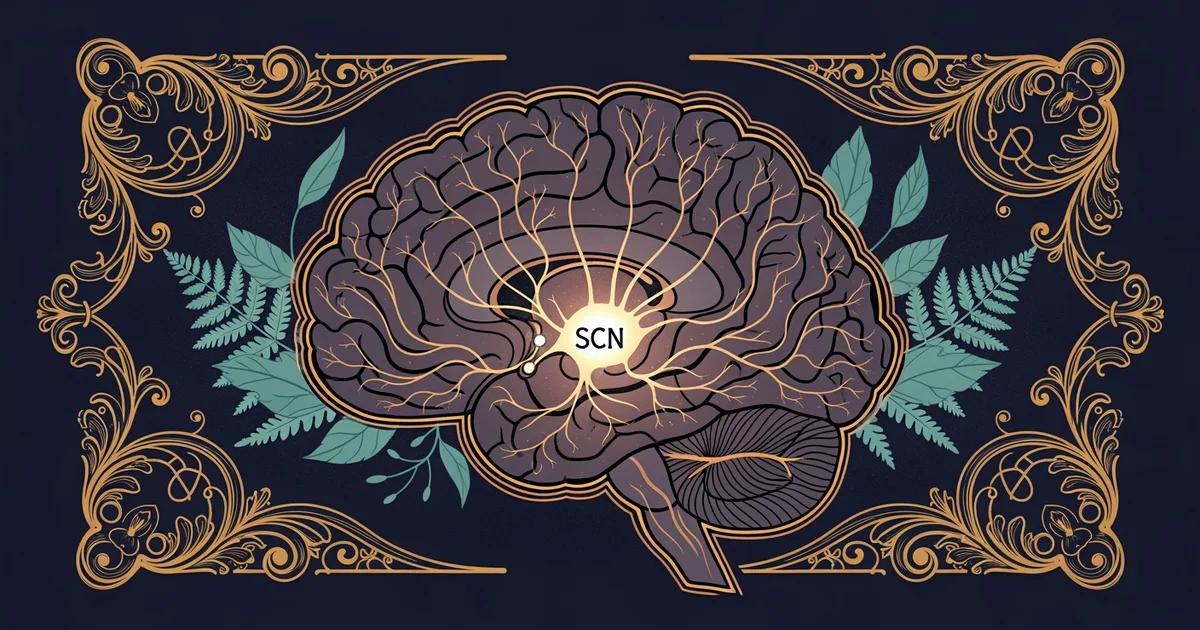
This system is so robust that it exists in almost every cell within the human body today. Every organ has its own local clock that manages its specific tasks throughout the day. These local clocks communicate with a master controller located deep inside the brain. This master controller acts like a conductor for an orchestra, keeping every musician in perfect time. If the conductor loses the beat, the entire performance suffers from confusion and lack of coordination. This explains why your body feels strange when you travel across many time zones quickly. Your internal orchestra is still playing to the old rhythm while the world has moved on.
We now understand that these ancient systems are not just relics of a distant, simpler past. They are active managers of our health, dictating everything from our mood to our digestion. When we ignore these rhythms, we create a disconnect between our biology and our environment. This friction is a hallmark of modern life, but it is also a solvable problem. By learning how these clocks began, we gain the tools to improve our daily performance. We are essentially tuning an instrument that has been playing for billions of years without rest.
The biological clocks that govern our modern lives are ancient survival tools evolved to synchronize internal processes with the planet's predictable light cycles.
Next, we will explore how light and dark cycles specifically influence the master controller in your brain.