
Water Transport Mechanics
Imagine a giant redwood tree drawing water from the soil up to its highest needles. Gravity pulls everything down, yet these plants move fluid against that force without a heart. This process relies on tiny, invisible physical properties that act like a solid chain. Plants do not use mechanical pumps to move their internal fluids around their vast structures. Instead, they harness the energy of the sun to drive a passive system of evaporation.
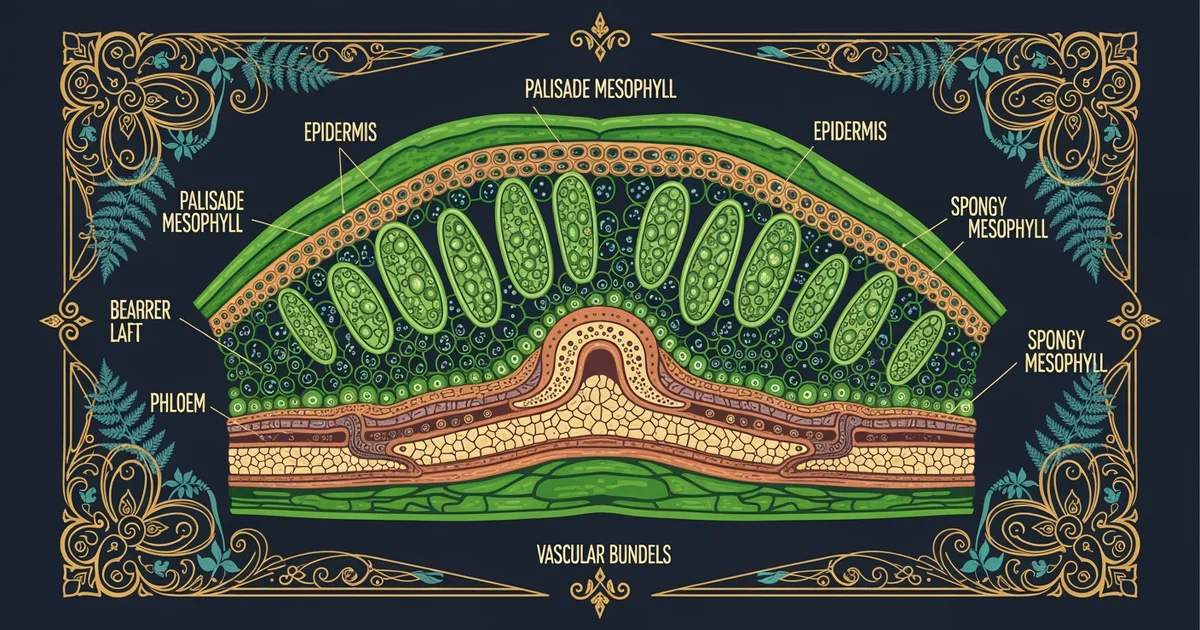
The Mechanism of Cohesion and Tension
Water molecules possess a unique ability to stick together through a property known as cohesion. This happens because water molecules are polar, meaning they have slight positive and negative ends. These ends attract each other like small magnets, forming strong bonds between individual water droplets. When water evaporates from the leaves, it creates a negative pressure that pulls on the water column below. Think of this like drinking through a very long straw where the liquid stays connected. If the suction is strong enough, the entire column moves upward as one continuous, unbroken piece.
Key term: Transpiration — the process where water vapor escapes from plant leaves into the atmosphere, creating the pull for internal water movement.
This system functions much like a supply chain in a large business where orders drive movement. When a customer buys a product, it triggers a chain reaction that pulls stock from the warehouse. In the plant, the sun causes water to leave the leaves through small pores. This loss creates a space that must be filled by water from deeper within the plant. Because of cohesion, the water in the stem follows the water that left the leaf. This pull continues all the way down to the roots, drawing new water from the soil.
Vascular Structures and Flow Dynamics
Plants use specialized tissue called xylem to transport this water from the roots to the leaves. These tubes are hollow and rigid, allowing water to flow with minimal friction against the cell walls. The movement is entirely passive, meaning the plant does not spend metabolic energy to move the water. It only spends energy to build the structures that allow the process to happen. The speed of this flow changes based on how much sunlight hits the plant each day.
To understand how different factors influence the rate of this water movement, consider these primary variables:
- Humidity levels affect the rate of evaporation because air that is already wet slows down water loss.
- Wind speed increases the rate of transpiration by removing the thin layer of moist air near leaves.
- Soil moisture availability determines if the plant can replace the water lost during the daytime hours.
- Light intensity drives the opening of leaf pores, which directly controls the speed of the water pull.
The following table shows how environmental changes impact the movement of water through the plant structure.
| Environmental Factor | Impact on Flow | Reason for Change |
|---|---|---|
| High Temperature | Increased Flow | Faster evaporation rate |
| High Humidity | Decreased Flow | Slower evaporation rate |
| Strong Wind | Increased Flow | Faster moisture removal |
When the soil becomes too dry, the plant must close its pores to save water. This stops the transpiration pull, which halts the movement of water from the roots. If the tension becomes too great, the water column might break, causing a blockage within the xylem. Plants have evolved various ways to manage this tension to ensure they survive even during dry periods. They balance the need for carbon dioxide with the risk of losing too much internal water. This delicate balance determines how fast a plant can grow and how tall it can eventually reach.
Water transport relies on the sun to create a continuous pull that moves liquid through plants via molecular attraction.
But how do plants manage these internal pressures when they encounter nutrient-rich soil or changing chemical environments?
Want this with sources you can check?
Premium Learning Paths for Biological Sciences are researched against open-access libraries — PubMed, arXiv, government databases, and more — with their distinctive claims cited to real sources and independently checked.
See what Premium includes