
Historical Biogeography
Imagine finding a seashell on a high mountain peak where no ocean exists today. This strange discovery tells a story about how our planet changes its shape over time. We look at the past to understand why animals live where they do right now. By reading the history written in rock, we see how the world once looked. This method helps us track how species moved across the globe long ago. We use these clues to map out the lives of creatures from the past.
Uncovering Ancient Biological Patterns
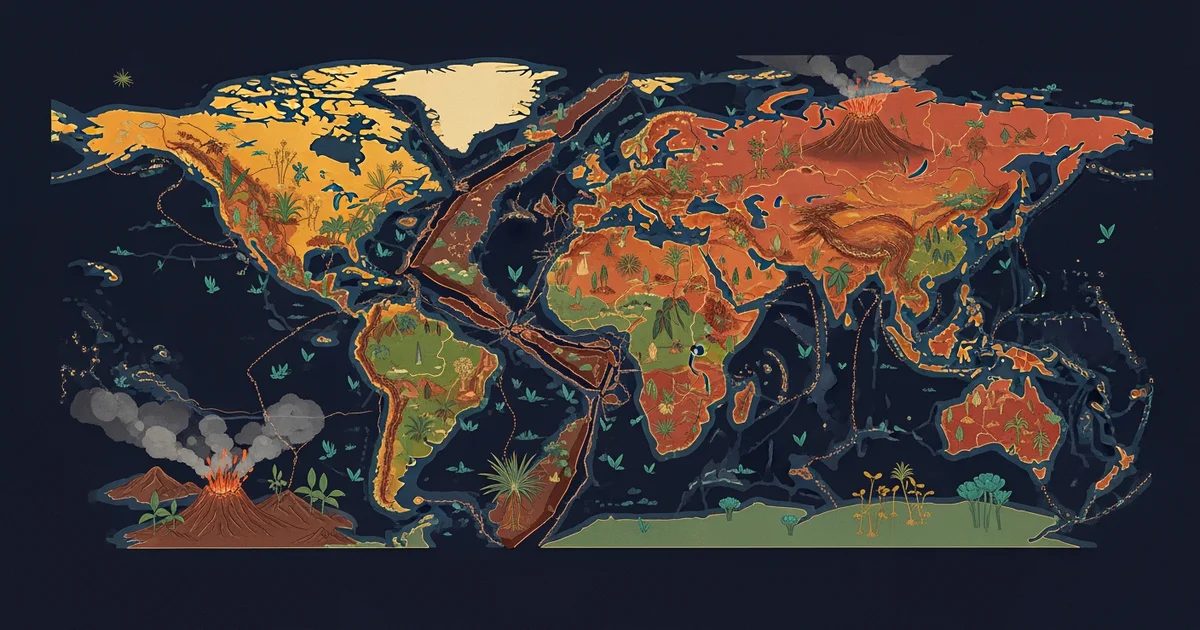
When we study historical biogeography, we examine how the earth shifted and moved over millions of years. This field looks at the patterns of life and links them to major geological events. Think of the earth as a giant, slow-moving puzzle that changes its picture every few million years. As the pieces drift apart or crash together, plants and animals get trapped or find new paths. We study the remains of these creatures to see their old homes. These records act like a map that shows us where life started and how it spread out. Without these records, we would have no way to know why similar species live on different continents today. Understanding these movements explains the current distribution of life across our vast, changing world.
Key term: Historical biogeography — the scientific study of how geological processes and environmental changes shape the distribution of species throughout Earth's history.
We often compare the movement of animals to a person moving into a new house. When you move, you take your habits and tools to a different place to survive. Ancient species did the same thing when the land shifted under their feet. If a mountain range rose up, it acted like a wall that split a group in two. Over time, those two groups changed because they could not reach each other anymore. We find fossils that prove these groups were once the same, even if they look different now. This helps us see that the land itself dictates where life can thrive or fail.
Connecting Fossil Evidence to Range Maps
To map these ancient paths, we look at where we find specific fossils in the ground. If we find the same skeleton in two places, we know those spots were once connected. Scientists create ancestral range maps to show where a group lived before the land split apart. These maps are like a historical atlas for every living thing on the planet. They show us the original territory of a species before the earth pulled it away. We must check the age of the rocks to make sure our timeline fits the movement. This process is very much like solving a mystery where the evidence is buried deep underground. By tracking these shifts, we gain a clear view of how our planet created the life we see today.
We can organize these findings into a list of steps that researchers use to solve these puzzles:
- Locate fossils of a single species across different modern landmasses to identify ancient links.
- Determine the age of the surrounding rock layers to pin down when the species lived there.
- Reconstruct the position of continents during that time period to see if the land was connected.
- Analyze how environmental changes in those areas might have forced the species to move or change.
- Build a model that shows the path of travel for that species across the ancient global landscape.
This method allows us to turn scattered bone fragments into a coherent story of survival. Each discovery adds a new piece to the puzzle, making the overall picture much clearer for everyone. We learn how life adapts to the massive changes that happen on the surface of our home planet.
Historical biogeography uses fossils and geological data to map how ancient species moved as the continents shifted over time.
The next Station introduces the Island Biogeography Model, which determines how distance and land size influence the survival of species on isolated patches of earth.