
Vicariance Events
Imagine a vast, unified forest that suddenly splits apart when a massive river carves a permanent canyon through the center. This physical change forces the animals on each side to live in total isolation from their former neighbors.
The Mechanism of Physical Separation
When we study how life changes over deep time, we often focus on how animals migrate across the globe. However, many species evolve because they are stuck in one place while the land itself shifts beneath them. This process is known as vicariance. It occurs when a natural barrier, like a mountain range or a rising sea level, divides a population into two distinct groups. These groups can no longer interbreed because the environment prevents them from meeting. Over many generations, the independent groups change in response to their specific surroundings. They accumulate different genetic traits that reflect their unique local challenges. By the time the barrier might disappear, the two groups have become so different that they can no longer reproduce with each other. This creates a new species from an old one without any migration required.
Think of this process like two bank branches that suddenly lose all communication with their central headquarters. Because the branches can no longer share policies or staff, each location begins to develop its own unique culture and rules. One branch might focus on high-speed digital services to satisfy local tech workers. The other branch might prioritize personal, face-to-face banking to serve a community of retirees. Even though they started as the same company, the lack of connection forces them to drift apart. In nature, the physical barrier acts as the severed phone line. The species on either side stop sharing their genetic code, which is the biological equivalent of corporate policy.
Environmental Impact on Divergence
Once the barrier is in place, the environment plays a critical role in shaping the future of each isolated group. One side of a mountain range might be lush and rainy, while the other side remains dry and rocky. The plants and animals in the wet zone must adapt to dense foliage and high humidity. Meanwhile, the group in the dry zone must develop ways to conserve water and navigate open terrain. These selective pressures act like a filter that removes traits that do not help the organism survive in its new home.
| Feature | Wet Zone Population | Dry Zone Population |
|---|---|---|
| Diet | Soft fruits and leaves | Tough seeds and roots |
| Activity | Climbing and jumping | Running and digging |
| Color | Dark for camouflage | Light for heat relief |
This table illustrates how the same ancestral group can diverge based on the local demands of the habitat. The wet zone population favors traits that aid movement through dense trees, while the dry zone population favors traits that help them gather food from hard ground. These adaptations are not random choices but are necessary responses to the physical constraints of the split landscape.
Key term: Speciation — the evolutionary process by which populations evolve to become distinct species that are unable to produce fertile offspring together.
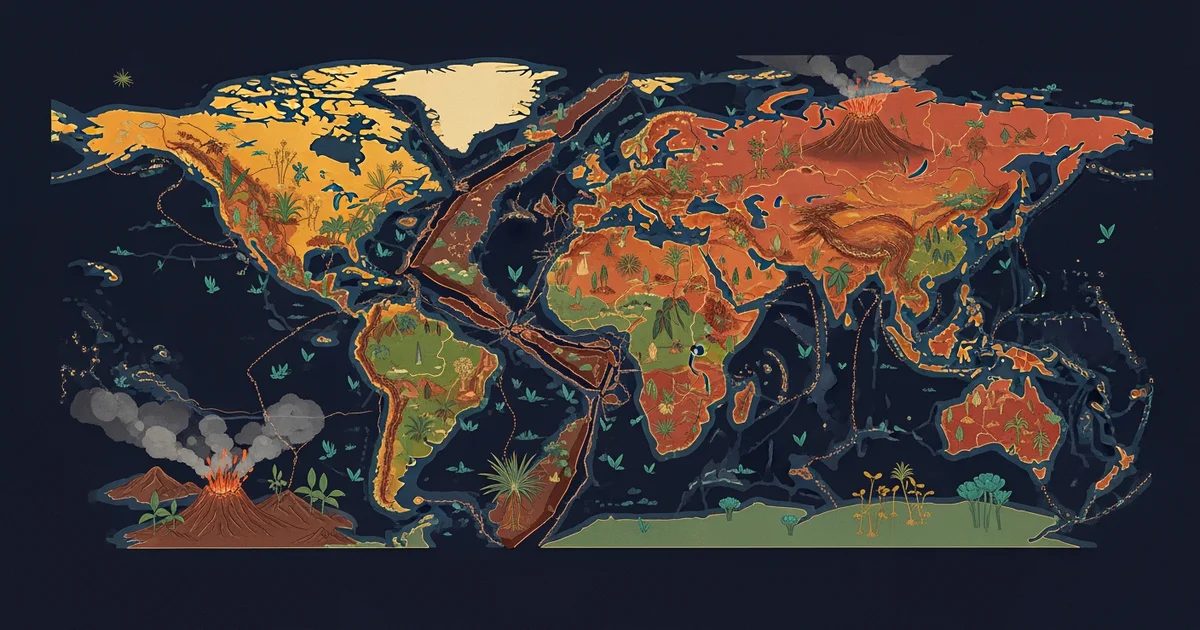
As these groups continue to evolve in their separate zones, their DNA sequences begin to show significant differences. The accumulation of these differences eventually leads to reproductive isolation. This means that even if the physical barrier were removed, the two groups would remain distinct. They have essentially become strangers to each other, despite their shared ancestry. The history of our planet is written in these patterns of separation. Every mountain range and ocean basin acts as a silent witness to the divergence of life. By mapping these barriers, we can reconstruct the movements of tectonic plates and the shifting climates of the ancient world. Understanding this process helps us see that the Earth is not just a stage for life, but an active participant in the story of evolution.
Vicariance events drive the formation of new species by imposing physical barriers that force populations to evolve independently in response to their unique environments.
The next Station introduces endemism patterns, which determine how these isolated species remain restricted to specific geographic areas over time.