
Mapping the Living World
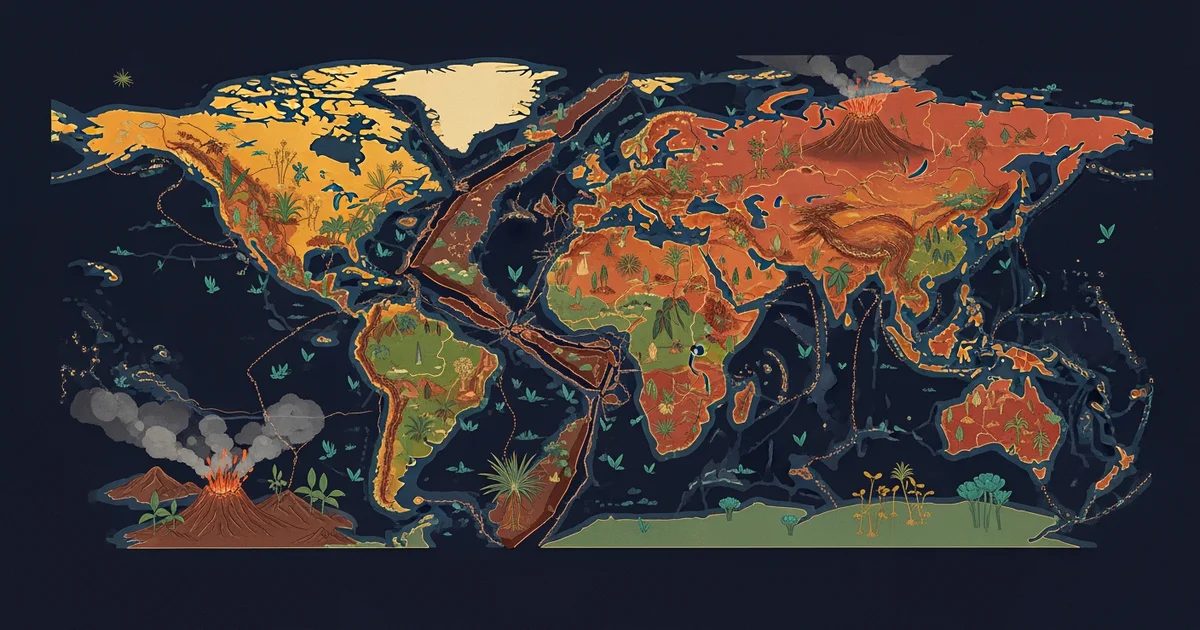
Imagine you are holding a map of the world that shows exactly where every single species lives today. You might notice that animals in distant lands often look like cousins, even if they never meet in the wild. This strange pattern is not just a coincidence of nature, but a clue about how our planet has changed over millions of years. By studying where life exists, we can start to piece together the history of the entire world.
The Scope of Biogeography
Biogeography serves as the scientific study of the distribution of species across space and time. It looks at why certain plants or animals live in specific areas while other regions remain empty of those same creatures. Think of the Earth like a massive, complex jigsaw puzzle where the pieces are constantly shifting their positions over deep time. Just as a shopkeeper tracks which items sell best in different neighborhood stores, scientists track where life thrives to understand the global environment. This field connects biology with geography to explain the living patterns we see on our modern maps.
Key term: Biogeography — the scientific study of how species are distributed across different locations on Earth.
When we look at the world, we see that climate and physical barriers play a huge role in shaping these patterns. Mountains, oceans, and deserts act like walls that keep populations separate for very long periods. Over time, these groups adapt to their unique surroundings, which eventually leads to the birth of new and distinct species. This process is similar to how different regions develop unique local languages because people stay in their own areas for many generations. By mapping these boundaries, researchers can predict how life might change when those barriers shift or disappear entirely.
Patterns of Life and Earth History
Understanding these distributions requires us to look at the history of the ground beneath our feet. The continents were not always in their current spots, and they have moved slowly across the globe for eons. As landmasses split apart or collide, they carry their resident species along for the ride like passengers on a moving ship. This explains why we find fossils of the same creatures on continents that are now separated by thousands of miles of water. The map of life is a direct reflection of the physical journey our planet has taken throughout its long existence.
| Factor | Impact on Species | Example Influence |
|---|---|---|
| Climate | Sets survival limits | Temperature and rain |
| Barriers | Prevents movement | Oceans and mountains |
| History | Shapes distribution | Moving continents |
The following list highlights why this study remains essential for our understanding of the natural world:
- Species dispersal explains how plants and animals move to new areas when environmental conditions shift, allowing populations to expand into previously empty territories.
- Environmental filtering determines which organisms survive in a specific habitat by matching their unique traits to the local temperature and food availability.
- Evolutionary isolation ensures that groups separated by physical barriers develop unique characteristics that differentiate them from their ancestors living in other regions.
By learning these core principles, you will gain a complete view of how the Earth and its inhabitants have evolved together as one interconnected system.
The patterns of life across our planet act as a living record that reveals the hidden history of the Earth.
This foundation allows us to explore how the movement of land and changes in climate have shaped every living thing we see today.