
Earth History Foundations
Imagine the world map as a giant jigsaw puzzle that never stops shifting its pieces. Beneath your feet, the solid ground moves slowly like a heavy raft drifting across a deep ocean. These massive movements change the shape of continents and the paths of oceans over millions of years. This slow motion acts as a primary driver for how life spreads and changes across our globe. You can think of the Earth as a massive, slow-moving factory that constantly rearranges its assembly lines. When the factory floor changes shape, the workers must adapt to new conditions or find new areas to survive. This process creates the unique patterns of life we see in different regions today.
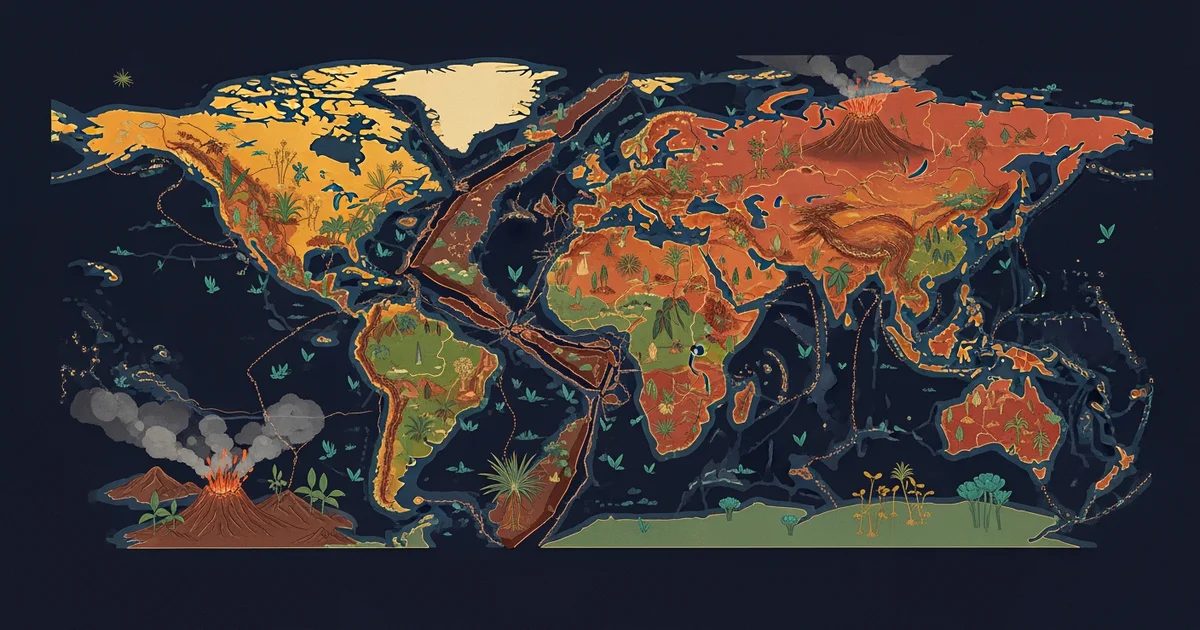
The Engine of Continental Drift
The outer shell of our planet consists of large, rigid slabs known as tectonic plates that float on a softer layer. These plates do not stay in one place, but they move because of intense heat rising from deep inside the core. This heat creates currents that push and pull the plates in different directions over vast stretches of geological time. When two plates collide, they can force the earth upward to create mountains or drag it down to form deep trenches. These physical barriers act like walls in a building, separating groups of animals and plants from one another for millions of years. As populations become isolated, they evolve in unique ways to suit their specific surroundings.
Key term: Tectonic plates — the massive, shifting sections of the Earth's outer shell that constantly reshape the surface of our planet.
Consider how an economic shift might force a business to relocate its offices to different cities. Just as a company must adjust to new local laws and resources in a new city, species must adjust to new climates when their landmass moves. If a continent drifts toward a colder pole, the creatures living there must grow thicker fur or change their food habits. If the land moves toward the equator, they must deal with higher heat and different water sources. This constant adjustment is the hidden force behind the diversity of life on Earth.
Geological Time and Biological Change
Geological time scales operate on a level that is hard for humans to grasp because our lives are so short. We see the world as a static place, but the history of the Earth tells a story of constant, restless change. When we study the distribution of fossils, we can see how groups of organisms were once connected before continents drifted apart. These patterns prove that the land was once joined in different configurations than what we see on modern maps. The movement of these landmasses serves as a primary filter for which species can travel and which ones remain trapped.
| Process | Action | Resulting Change |
|---|---|---|
| Plate Collision | Mountains rise | New climate zones |
| Continental Drift | Land separates | Isolated evolution |
| Seafloor Spreading | Ocean widens | Migration barriers |
This table shows how simple geological shifts lead to complex biological outcomes across the surface of the planet. When landmasses collide, they create new habitats that allow for rapid growth and competition among different species. Conversely, when landmasses drift apart, the populations on each side begin to drift apart genetically as well. This isolation is a key ingredient in the creation of new species over long periods of time. The history of the Earth is written in the rocks and the bones of those who lived before us.
Understanding these foundations helps us see why certain animals live only in specific parts of the world today. It is not an accident that similar plants exist on continents separated by vast oceans of water. These plants share a common history from when those landmasses were once joined in a single, larger territory. By mapping these ancient connections, scientists can reconstruct the lost geography of our world. This work reveals the deep history that shapes every living thing we observe in the present day.
The physical movement of Earth's landmasses acts as a primary mechanism that isolates populations and forces them to adapt to new environments over geological time.
Next, we will explore how these geological shifts create distinct climatic influence zones that determine where specific life forms can thrive.