
Endemism Patterns
Imagine a rare plant growing only on one mountain peak, completely isolated from every other forest on Earth. This unique distribution pattern highlights how life adapts to specific, restricted environments over long periods of time. We call this phenomenon endemism, where a species exists naturally in only one defined geographic location. Understanding why some life forms stay trapped in small areas while others spread across continents reveals much about our planet. These patterns of life act as a living map of Earth's complex and changing history.
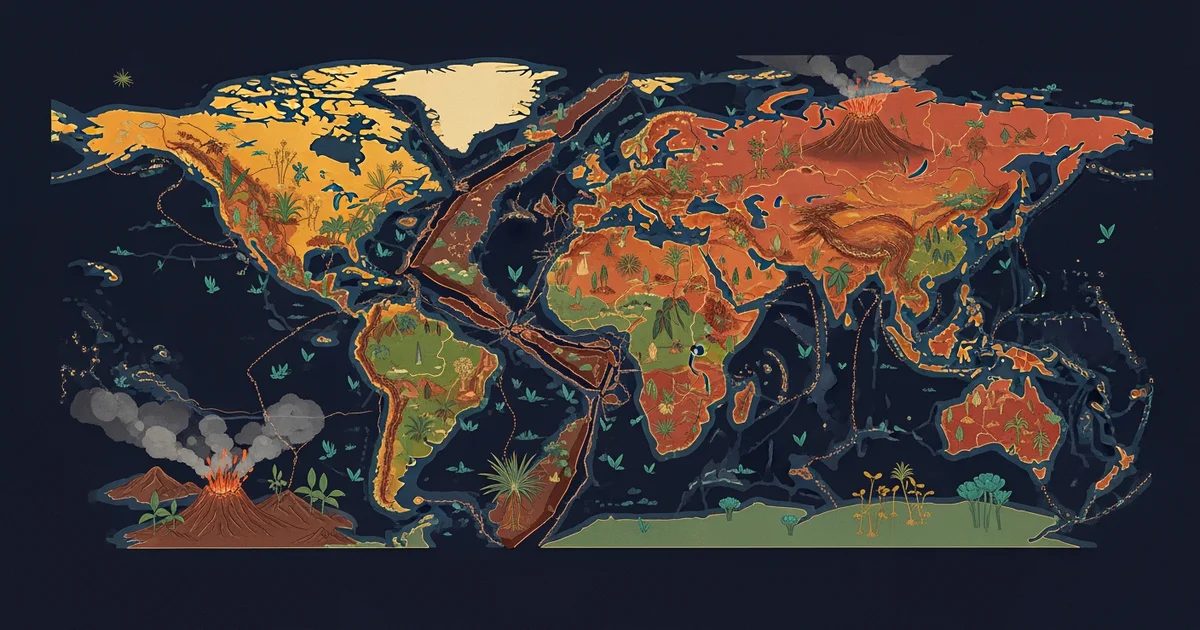
Drivers of Geographic Isolation
Geographic barriers often force populations to evolve in isolation, creating the conditions necessary for regional uniqueness. When a mountain range rises or an island forms, it effectively cuts off a group from its parent population. This separation prevents gene flow, which means the isolated group must adapt to its specific local environment. Think of this like a small business operating in a niche market with no outside competitors. Because they cannot rely on external resources or new ideas from elsewhere, they must innovate to survive within their own borders. Over time, these local adaptations become permanent traits that define the entire population.
Key term: Endemism — the ecological state of a species being native to a single, defined geographic location.
Environmental stability also plays a massive role in maintaining these unique populations over many thousands of years. If a region remains relatively consistent in climate, species can specialize deeply to fit those specific conditions. This specialization makes the species highly efficient at surviving in their home but often makes them unable to thrive elsewhere. You might compare this to a high-performance race car designed only for one specific track. While the car is incredibly fast on that one circuit, it would fail to function on a standard public road. This trade-off between specialization and flexibility is a core driver of why endemism occurs in certain places.
Patterns of Regional Distribution
Geologists and biologists categorize these areas of high uniqueness based on how the species arrived or stayed there. Some regions act as museums, preserving ancient life forms that have gone extinct in most other places. Other areas act as cradles, where new species form rapidly due to the high number of available ecological niches. We can compare the different types of endemism based on the age and origin of the resident species:
| Type of Endemism | Primary Mechanism | Evolutionary Age |
|---|---|---|
| Paleo-endemism | Relict survival | Very ancient |
| Neo-endemism | Recent divergence | Very young |
| Pseudo-endemism | Human activity | Modern timeline |
These categories help researchers track how life responds to shifting landscapes and climate changes. Paleo-endemism occurs when a formerly widespread group shrinks into a small, stable refuge. Neo-endemism happens when rapid changes in a new habitat trigger the quick birth of new, local species. Finally, pseudo-endemism often results from human movement or artificial barriers that mimic natural isolation. By studying these three patterns, we gain a clearer view of how Earth shapes the distribution of living things.
Evolutionary history dictates that the longer a region remains isolated, the more distinct its inhabitants will become. This process is not random, as it relies on the interaction between geological stability and the biological capacity for change. When a species becomes endemic, it effectively marks that location as a unique chapter in the history of life. These pockets of diversity are essential for understanding how life persists through global shifts. Every endemic species serves as a biological record of the specific forces that built its home.
Endemism represents the biological result of long-term geographic isolation and environmental specialization within a confined, stable region.
The next Station introduces historical biogeography, which determines how these patterns of life reflect the movement of continents over time.