
Information Paradox
Imagine dropping your favorite book into a deep, dark furnace where the pages vanish instantly. If the fire destroyed every single letter and word, you would never know what that story contained. This situation mirrors a strange puzzle in space where gravity might erase the history of everything it consumes. Scientists struggle to understand if the universe keeps a record of matter that falls into a black hole. When we consider how gravity exerts such massive force, we must ask if this force acts as a permanent eraser. This tension between the laws of physics creates a deep mystery for modern space researchers.
The Conflict of Physical Laws
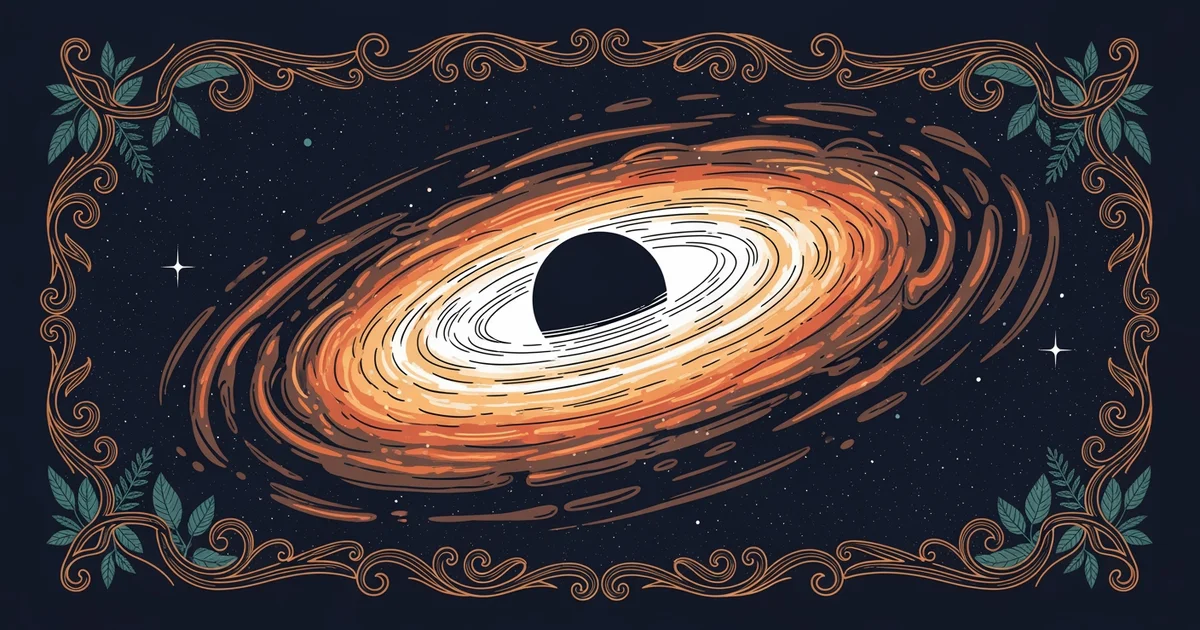
Gravity behaves like a cosmic vacuum that pulls everything toward a single point of infinite density. According to the rules of general relativity, this point hides behind an event horizon where light cannot escape. However, the laws of quantum mechanics suggest that information about physical states must remain preserved throughout time. If a black hole eventually evaporates through radiation, the matter inside seems to disappear without leaving a trace behind. This loss of data violates a core principle of physics which states that the history of particles must be recoverable. We face a problem where two reliable pillars of science contradict each other completely.
Key term: Information Paradox — the theoretical conflict where quantum mechanics requires information to be preserved, while general relativity suggests black holes destroy it.
To visualize this, think of a library that burns down while the books turn into smoke and ash. If you could collect every particle of smoke and piece of ash, you should reconstruct the original books. The laws of quantum physics claim this reconstruction is always possible in theory. If a black hole traps matter and then disappears, the information seems to vanish from the universe forever. This loss of data is exactly what the Information Paradox describes as a fundamental failure of our current models. We must determine if the information hides on the surface or leaves the universe entirely.
Exploring Possible Solutions
Researchers propose several ways to resolve this conflict without breaking the laws of nature we hold dear. Some suggest the information gets encoded onto the surface of the black hole like a hologram. Others argue that the information leaks out slowly as the black hole loses its mass over time. We can compare these theories to see how they handle the data stored within a collapsed star.
| Theory | Mechanism | Result for Data |
|---|---|---|
| Holographic | Surface encoding | Data stays on edge |
| Leakage | Hawking radiation | Data escapes slowly |
| Destruction | Singularity point | Data is lost forever |
These models help us organize our thoughts on how gravity interacts with the tiny particles that make up all matter. If the holographic theory is correct, the interior of a black hole might just be a projection of surface data. This would mean that the gravitational force we studied in earlier stations is not just a pull but a complex storage system. We must look at how Hawking radiation acts as a potential carrier for this hidden information during the final stages of a black hole.
When we look back at gravitational waves, we see how space ripples when massive objects collide or merge together. These waves carry energy away from the event, but they do not solve the mystery of the missing data. The Information Paradox remains the ultimate test for our understanding of how gravity and quantum mechanics work together in the dark. We need to find if the universe is a closed system that keeps all its secrets safe forever. If we cannot recover the information, we might need a new way to describe the fabric of reality itself. Future research will focus on the boundary where these two worlds meet to see if we can finally unlock the truth.
The Information Paradox highlights a fundamental disagreement between gravity and quantum mechanics regarding whether physical data is truly destroyed or merely hidden.
The next step involves looking at how future technology will help us observe these extreme environments to test our current theories.