
Fortifications and Siege Walls
TL;DR: Ancient fortifications survived by using a "sandwich" construction technique: dense outer masonry shells filled with loose rubble to absorb and dissipate the kinetic energy of siege weaponry.
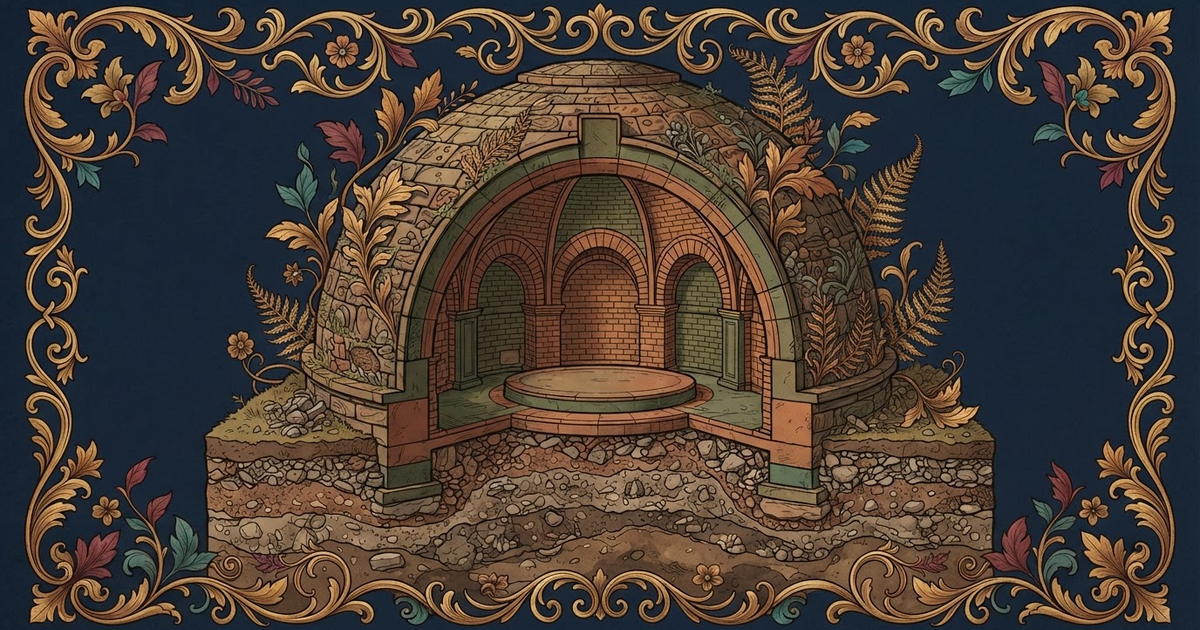
The Physics of Impact
In our previous stop, we looked at how builders spanned rivers and valleys to connect civilizations. But once a city was connected, it needed to stay secure. When you think of a castle or city wall, you might imagine a solid, monolithic block of stone. If that were true, a heavy battering ram would shatter it like a glass vase. Instead, ancient engineers treated a wall like a shock absorber. When a heavy ram strikes a wall, it transfers a massive amount of kinetic energy in a fraction of a second. A rigid, solid wall has nowhere for that energy to go, so it cracks. To solve this, engineers used .
This layering acts as a mechanical buffer. The outer layer of cut stone—the —takes the initial hit. Because it is backed by loose, shifting material rather than a rigid core, the wall can "give" slightly. The energy of the impact is dispersed through the friction of the rubble shifting against itself. It is the architectural equivalent of a crumple zone in a modern car.
The Anatomy of a Siege-Resistant Wall
Building a wall that can withstand a siege isn't just about height; it is about depth and distribution. A thin wall, no matter how high, is a liability. Engineers focused on creating a cross-section that could handle lateral pressure.
Consider the mechanics of the wall cross-section:
- Outer Skin: High-quality, tightly fitted stone designed to deflect projectiles and resist weathering.
- The Core: A mixture of crushed rock, lime mortar, and gravel. This layer is the "secret sauce" of defensive engineering. It prevents the wall from vibrating apart during a sustained bombardment.
- Inner Skin: A secondary wall that provides structural stability, ensuring the whole assembly doesn't bulge outward under the weight of the fill.
By building in these stages, engineers created a composite structure that was far stronger than the sum of its parts. If a section of the outer skin was breached, the inner core remained dense enough to prevent an easy collapse, effectively forcing the enemy to spend weeks digging through stone rather than simply knocking it down.
Managing the Force of Gravity and Siege
Beyond just absorbing impacts, walls had to manage their own weight. If the rubble core was too loose, it would exert outward pressure, causing the wall to "belly" and eventually burst. Builders countered this by incorporating . These act like stitches in a quilt, holding the two faces of the wall tight against the core.
When we look at the history of these structures, we see a constant arms race. As siege engines like the became more powerful, engineers didn't just make walls thicker; they made them more complex. They added towers to create angles of fire, allowing defenders to shoot at the sides of attackers who were trying to approach the base of the wall. This was the birth of active defense: the wall was no longer just a shield; it was a platform for counter-attack.
It is easy to look at a pile of old stones and see only decay, but these walls were once high-tech machines designed to convert the raw, destructive force of a siege into harmless heat and friction. The next time you walk past a stone fence, look for the tie-stones and the irregular seams—you are seeing the remnants of a defensive technology that kept entire cultures alive.
Ancient fortifications survived by utilizing a layered, composite structure that dissipated the kinetic energy of impacts through internal friction rather than relying on rigid, brittle strength.
Now that we understand how these walls held their ground against the most powerful weapons of their time, we are ready to move inside the city walls to see how architects designed spaces for the public to gather, celebrate, and watch the spectacle of life. We are heading to the theaters to see how they mastered the mechanics of sound and sight.