
Vaults and Domes in Practice
TL;DR: The Pantheon stays standing because its builders were master weight-managers, using heavy, dense rock at the base and progressively lighter, porous volcanic materials toward the top to prevent the dome from crushing itself under its own gravity.
The Gravity Problem
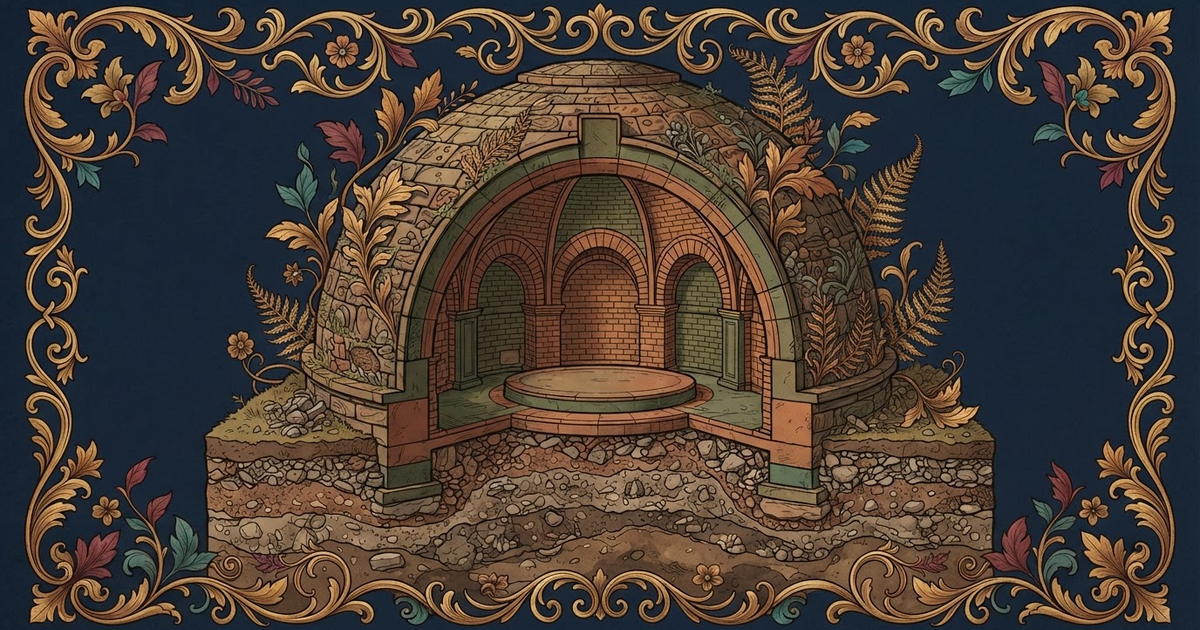
In our last stop, we looked at how columns and Greek proportions provided a steady, vertical rhythm to architecture. But once you move from a flat roof to a curved ceiling, the rules of the game change entirely. A doesn’t just push down; it pushes out. If you build a massive dome, the weight of the structure naturally wants to spread the walls apart, leading to a total collapse. The Pantheon in Rome is the ultimate case study in solving this. It is a massive, unreinforced concrete dome that has survived nearly two millennia. It didn't survive by accident; it survived because the builders understood that the greatest enemy of a monument is its own mass.
The Secret of Density Grading
To keep a dome from collapsing, you have to manage the load. If the top of the dome is too heavy, the structure will buckle inward or crack under the strain of its own weight. The Roman engineers achieved a brilliant feat of material science by practicing what we call density grading. They didn't just pour one type of concrete. As the dome rose higher, they swapped out the heavy, dense materials used at the foundation for lighter, more porous aggregates.
At the base, they used heavy basalt and broken bricks to provide a solid, immovable foundation. As the curve climbed, they transitioned to lighter volcanic stones like tuff, and finally, at the very top near the oculus—the iconic hole in the center—they used incredibly lightweight, porous pumice. By reducing the weight of the material as the dome reached for the sky, they effectively "tricked" gravity. The dome became lighter the higher it got, which significantly reduced the outward thrust against the supporting walls.
Engineering the Geometry
Beyond just the materials, the shape itself is a mechanical masterpiece. The walls of the Pantheon are thick, acting like a giant ring that keeps the dome from spreading. Inside the dome, you will notice recessed squares called . These aren't just for decoration. By scooping out that concrete, the builders removed hundreds of tons of dead weight without sacrificing the structural strength of the arch. It is a perfect marriage of aesthetic beauty and mechanical necessity.
When you stand inside, you aren't just looking at a room; you are looking at a living diagram of forces. The dome is essentially a series of arches rotated 360 degrees, and by thinning the shell and lightening the mixture, the Romans created a structure that balances its own weight perfectly. They turned simple volcanic ash and lime into a monument that defied the limitations of their time, proving that if you understand the physics of your materials, you can build a mountain that floats.
The Pantheon remains standing because its builders systematically reduced the density of the concrete as the structure grew taller, minimizing the downward pressure and outward thrust that would otherwise cause a dome to fail.
Now that we have mastered how to hold up a roof that covers a massive space, we have to address how to cross the gaps that nature puts in our way. Next, we head out to the rivers and valleys to see how the same principles of arches and weight management allow us to span the impossible.
Want this with sources you can check?
Premium Learning Paths for Architecture & Design are researched against open-access libraries — PubMed, arXiv, government databases, and more — with their distinctive claims cited to real sources and independently checked.
See what Premium includes