
Relativistic Time Dilation
Imagine you are standing on a train platform watching a high-speed bullet train zoom past you at incredible velocity. If you could see inside the train, you would notice that every clock on that moving vehicle appears to be ticking much slower than your own watch.
The Fundamental Nature of Time
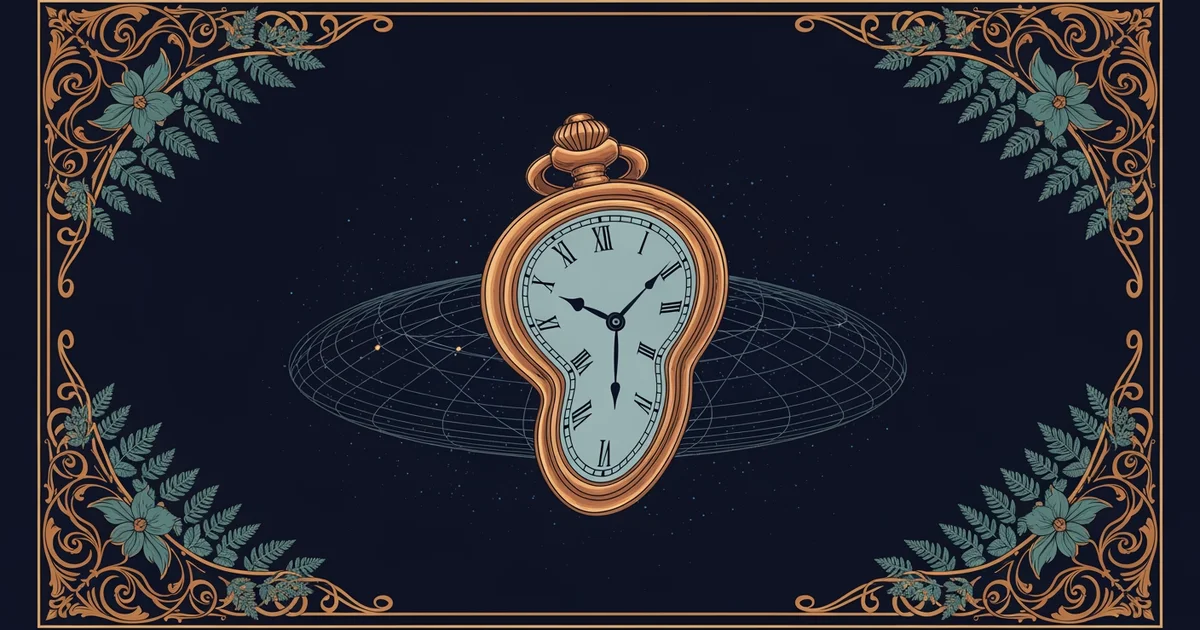
Time is not a rigid constant that ticks forward at the same rate for everyone in the universe. Instead, time behaves like a flexible fabric that stretches or shrinks depending on how fast an observer is moving through space. This phenomenon is known as relativistic time dilation, which suggests that motion through space directly affects the passage of time. When an object moves closer to the speed of light, which is denoted as , the internal clock of that object slows down relative to a stationary observer. This means that if you were to travel on a spaceship at near-light speeds, you would experience time passing normally, yet you would return home to find that many years had passed for those you left behind. The universe keeps two sets of books, one for the moving traveler and one for the stationary observer, because speed changes the fundamental rhythm of local existence.
Key term: Relativistic time dilation — the physical effect where time passes more slowly for an object moving at high velocity compared to a stationary observer.
This concept is similar to how a bank account functions when you move money between different currencies with varying exchange rates. If you earn money in a currency that is slowing down in value, you end up with less total time compared to someone who stays in a stable currency zone. Just as exchange rates dictate your buying power, your velocity dictates your temporal budget for the universe. The faster you move through space, the more of your personal budget you must spend on spatial distance, which leaves less of that budget available for the forward flow of time. This trade-off is a fixed rule of our physical reality that applies to all moving systems regardless of their size or composition.
Quantifying the Effects of Velocity
To understand how these differences manifest, we must look at the mathematical relationship between the stationary frame and the moving frame of reference. The degree of slowing is determined by the Lorentz factor, which is calculated using the following equation involving velocity and the speed of light :
When an object remains stationary, the velocity is zero, and the factor equals one, meaning time flows at a normal, standard rate. As the velocity increases toward the speed of light, the denominator becomes smaller, which causes the total value of the factor to increase significantly. This increase signifies that the interval of time measured by the moving observer is stretched out compared to the stationary frame. You can see how this growth impacts the passage of time in the table below:
| Velocity as % of | Lorentz Factor | Time Dilation Effect |
|---|---|---|
| 0% (Stationary) | 1.00 | No change observed |
| 50% of light speed | 1.15 | 15% slower than base |
| 90% of light speed | 2.29 | Over twice as slow |
| 99% of light speed | 7.09 | Seven times slower |
This table demonstrates that the effects of time dilation become extreme as you approach the speed of light. At lower, everyday speeds, the impact is so small that human senses cannot detect it, which is why we perceive time as a constant flow. However, for particles moving near light speed, these differences are massive and easily measured by modern scientific equipment. The universe essentially forces a trade-off between speed and the duration of events within a specific frame.
Our perception of time is only a local experience that depends entirely on our own velocity through the vast cosmic landscape. Because we exist on a planet moving at relatively slow speeds, we rarely encounter the strange stretching of moments that define the high-speed universe. Even so, the laws of physics remain consistent for everyone, whether they are sitting still or racing across the stars at near-light speed. Every observer is correct within their own frame, yet they will disagree on the duration of events once they compare their findings after the journey concludes. This realization changes our understanding of history and the future, as it proves that there is no single universal clock that governs every event across the entire cosmos.
Time dilation reveals that the duration of an event is not absolute but depends entirely on the relative velocity between the observer and the measured system.
But what does it look like in practice when we consider how brain chemistry might influence our perception of this physical reality?