
Entropy and Temporal Order
Imagine you drop a glass on the floor and it shatters into many small, sharp pieces. You will never see those pieces jump back together to reform the original glass shape. This everyday event shows us that time seems to have a clear direction, moving forward from order toward chaos. While the laws of physics that govern individual atoms are reversible, our large-scale world follows a strict path that never runs backward. This mysterious difference between the tiny world of particles and our own experience of time is a central puzzle in modern physics.
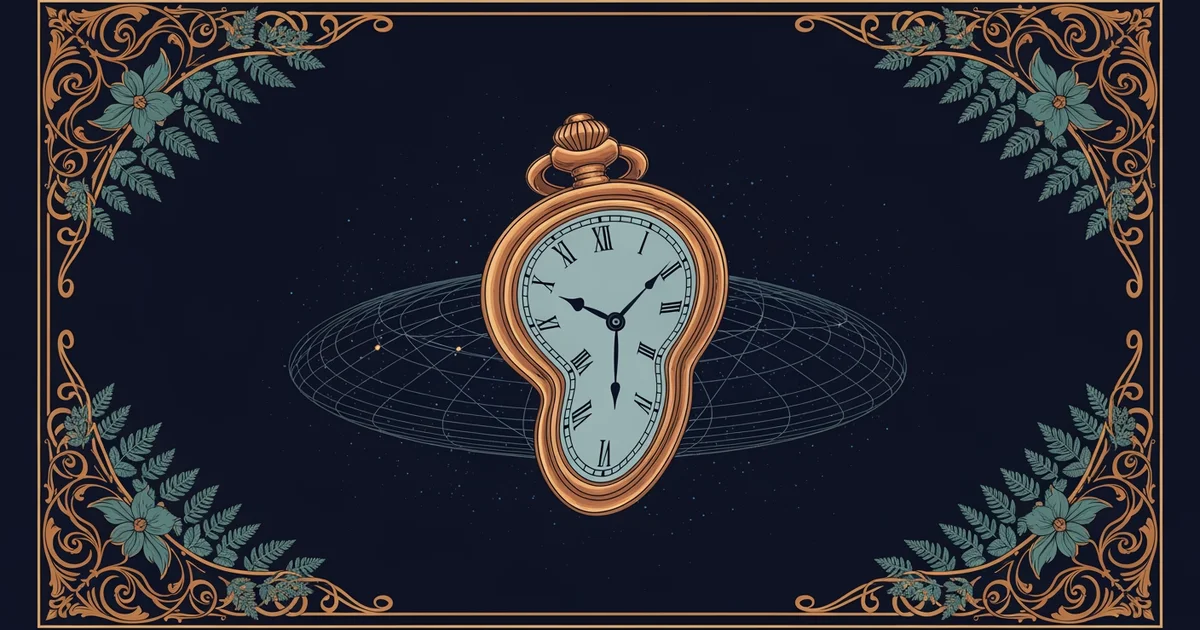
The Nature of Thermodynamic Irreversibility
At the smallest level, the laws of physics do not care about the direction of time. If you film a single particle colliding with another and play the video in reverse, the interaction still follows the standard laws of motion. This is called microscopic reversibility, meaning that individual physical events look perfectly natural regardless of the direction. However, when you observe a large collection of particles, the situation changes quite drastically because of the sheer number of possible states. As a system grows larger, the probability of it returning to a previous state becomes so low that it is effectively impossible. This transition from individual symmetry to collective one-way flow is the core of why we perceive time moving forward.
Key term: Entropy — a measure of the disorder or randomness within a physical system that tends to increase over time.
Think of this process like managing a large library where books are perfectly sorted by subject. If you allow random visitors to browse the shelves without any rules, the books will eventually become disorganized and scattered throughout the room. It takes significant effort to put them back in order, but almost no effort to create total chaos. In this analogy, the organized library represents a state of low entropy, while the messy room represents high entropy. Because there are millions of ways to be messy but only one way to be perfectly organized, the system naturally moves toward disorder.
Connecting Entropy to Temporal Flow
When we look at the universe, we see that it is constantly moving toward states of higher entropy. This concept is often called the arrow of time, as it provides a thermodynamic reason for why the past differs from the future. The universe began in a state of extremely low entropy, and it has been spreading out and becoming more disorganized ever since. Because this process is statistically inevitable, we experience the passage of time as a sequence of events that lead to more chaos. Our internal sense of time is likely linked to these physical processes that occur within our brains.
| Process Type | Reversibility | Entropy Change | Scale of Observation |
|---|---|---|---|
| Particle Collision | Highly Reversible | Near Zero | Microscopic |
| Heat Diffusion | Irreversible | Always Increases | Macroscopic |
| Chemical Reaction | Irreversible | Increases | Macroscopic |
We can summarize the relationship between physical systems and the flow of time through these observations:
- Microscopic events involve very few particles and show no preference for the direction of time because their energy states are easily swapped.
- Macroscopic processes involve trillions of particles, making the probability of returning to an ordered state so small that it never happens in reality.
- The constant increase of global entropy acts as a cosmic marker, ensuring that the future always contains more disorder than the past.
By understanding that entropy dictates the direction of change, we can see why time feels like a one-way street. We are essentially living in a universe that is unfolding from a highly structured beginning toward a much more scattered and random final state. This progression provides the framework for our perception of cause and effect, as effects always follow causes in a world where entropy must increase. Without this fundamental shift toward disorder, the distinction between yesterday and tomorrow would simply vanish into a static, unchanging present.
The arrow of time emerges because physical systems naturally evolve from organized states into more probable, disordered states that cannot be reversed.
The next Station introduces the Predictive Brain Model, which determines how our minds interpret these entropic signals to anticipate future events.