
Dopamine and Time Scaling
Imagine you are waiting for a slow computer screen to load a new page. While you stare at the frozen bar, the seconds seem to stretch into minutes of boredom. If you suddenly find a fascinating video, that same duration of time appears to vanish in an instant. This common experience happens because your brain processes incoming data at different speeds depending on your internal state. You are not just observing time, but actively constructing it through your neural chemistry.
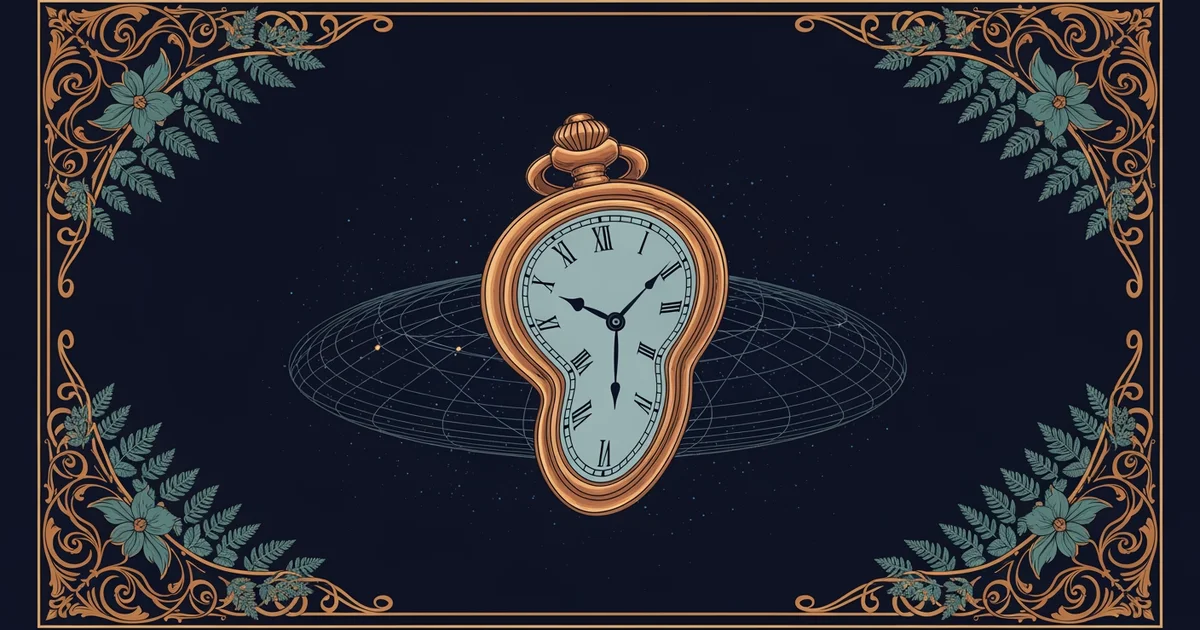
The Neurochemistry of Temporal Scaling
When your brain encounters new or exciting information, it releases a chemical messenger known as dopamine. This substance acts like a high-speed processor that increases the rate at which your neurons fire signals. As the frequency of these electrical pulses rises, your brain captures more detail within a single second of physical reality. Think of this process like a camera taking high-frame-rate video footage of a fast car race. Because the camera records more frames per second, the resulting playback reveals every tiny movement in slow motion. Your brain does the same thing when it is flooded with this chemical, making a short duration feel much longer than it actually is.
Key term: Dopamine — a neurotransmitter that influences the speed of neural processing and modulates our subjective experience of time passage.
Conversely, when your brain encounters familiar or routine tasks, the release of this chemical slows down significantly. With fewer signals to process, your internal clock skips over the fine details of the moment. This makes the time feel as if it is passing much faster than the clock on the wall suggests. You can view this phenomenon through the lens of a budget manager who tracks your limited mental energy. When you are bored, the brain spends its resources sparingly, which causes the perceived duration of the event to compress significantly. Your internal ledger of time is therefore not a fixed constant, but a flexible account that expands and contracts based on your current focus.
Neural Processing and Subjective Duration
Because the brain relies on these chemical signals to mark the passage of time, your perception is inherently linked to your environment. When you engage in high-dopamine activities, your system shifts into a state of heightened awareness and increased data collection. This creates a subjective expansion of time where you feel you have experienced more within a shorter window. The following table illustrates how different levels of this neurotransmitter affect your perception of time during various daily activities:
| Activity Type | Neurotransmitter Level | Subjective Time Perception |
|---|---|---|
| Routine Chores | Low | Time seems to speed up |
| Learning Skill | Moderate | Time flows at normal rate |
| Novel Adventure | High | Time feels deeply expanded |
This fluctuation explains why childhood summers feel like they last for years compared to adult years. Children encounter novel experiences constantly, which triggers regular spikes in their chemical processing speed and creates dense memories. Adults often fall into predictable patterns, which lowers the frequency of these spikes and makes months seem to blur together. By understanding this, you can see that your sense of time is a byproduct of how much information your brain chooses to record.
If you want to stretch your perception of time, you must introduce novelty into your daily life. New environments or difficult tasks force your brain to increase its processing rate to handle the fresh input. This does not change the physical laws of the universe, but it changes how you experience them. Your brain is essentially a biological clock that adjusts its tick rate based on the richness of the data it receives. By managing your exposure to new stimuli, you gain a small amount of control over your subjective lifespan.
Subjective time perception functions as a biological variable that expands during high-stimulation events and contracts during routine, low-stimulation periods.
But how does this biological clock transition into the specialized states of consciousness where time seems to disappear entirely?