
Computational Modeling
When NASA engineers prepare to launch a deep space probe, they cannot test the spacecraft in the actual vacuum of space before the mission begins. Instead, they rely on complex digital environments to mimic the harsh conditions that the machine will encounter once it leaves the safety of Earth. This process of using computational modeling allows scientists to predict how gravity, radiation, and extreme temperatures will impact delicate hardware during a long journey. By translating physical laws into digital code, researchers can run thousands of scenarios to ensure the mission succeeds without risking expensive equipment in the real world.
The Logic of Digital Experiments
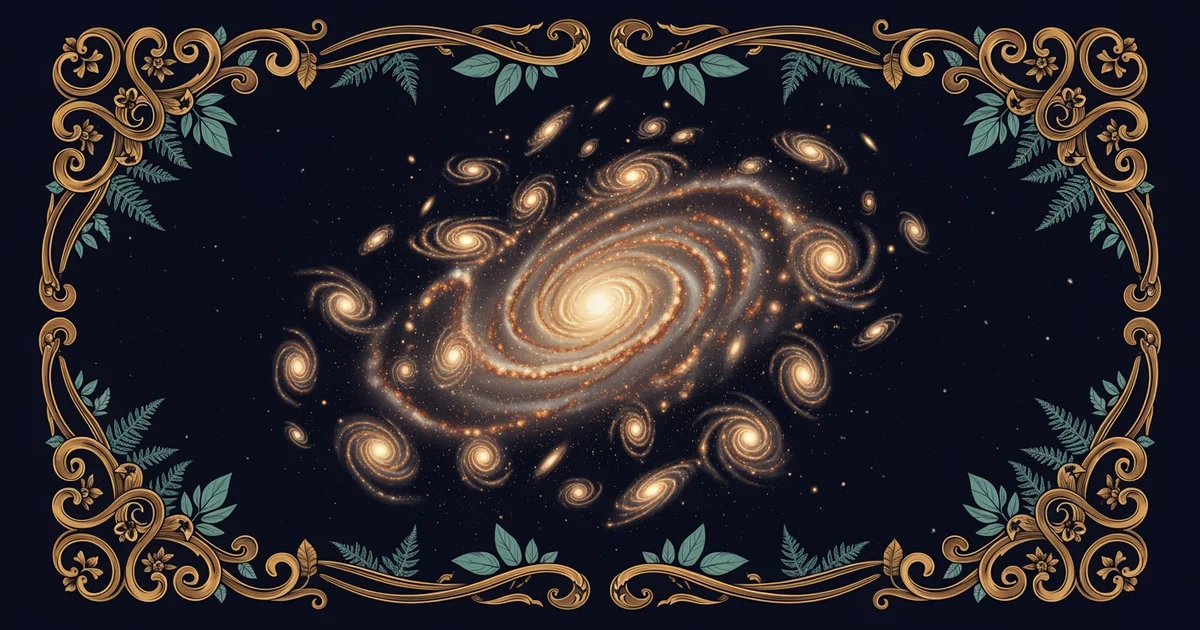
Computational modeling functions much like a high-stakes flight simulator for the entire universe. Scientists define the initial state of a system, such as a massive cloud of gas, and then apply mathematical rules to see how it changes over time. This approach allows us to observe processes that would otherwise take millions of years to unfold in the night sky. Just as a bank uses statistical models to predict how interest rates might change during a market crash, astrophysicists use algorithms to calculate how dark matter pulls gas into dense clusters. This is the application of the gravitational dynamics discussed in Station 11, now scaled up to simulate the formation of entire galactic structures.
Key term: Algorithm — a precise set of mathematical instructions that a computer follows to solve a specific problem or simulate a complex physical process.
When we build these models, we must break down the universe into tiny, manageable pieces called grid cells. Each cell tracks variables like temperature, density, and velocity as the simulation progresses through time. If the resolution of these cells is too low, the simulation might miss the subtle interactions that trigger the birth of a new star. High-resolution models require massive computing power to track every particle, which represents a significant challenge for researchers. We balance this by focusing computer resources on the specific areas where the most interesting physics occurs, such as the turbulent centers of forming galaxies.
Challenges in Cosmic Simulation
Even with the fastest supercomputers, our models are still approximations of a much more complex reality. We often encounter limitations when trying to represent the vast range of scales involved in cosmic evolution. Consider the following factors that researchers must carefully balance to keep their simulations accurate:
- Numerical precision ensures that rounding errors do not accumulate over time, which would otherwise lead to a completely unrealistic outcome for the simulated galaxy.
- Boundary conditions define how the edge of the simulation interacts with the rest of the universe, preventing artificial reflections that could distort the internal data.
- Feedback loops account for the energy released by early stars, which pushes away surrounding gas and prevents the formation of even more stars.
These factors determine whether a model successfully mimics the universe we see through our telescopes. If the feedback loops are too strong, the simulation might show galaxies that stop growing prematurely. If they are too weak, the model might produce galaxies that are far too massive compared to what we observe in the real world. Finding the correct balance is an iterative process that requires constant comparison between simulated data and actual images from space observatories. This constant refinement is what turns a simple math equation into a powerful tool for discovery.
Interpreting Simulation Data
| Simulation Component | Purpose | Data Output |
|---|---|---|
| Initial Conditions | Setting the stage | Starting density |
| Gravity Solver | Calculating forces | Velocity vectors |
| Hydrodynamics | Tracking gas flow | Pressure maps |
By analyzing these outputs, we can trace the history of the cosmos back to its earliest moments. We are essentially watching a movie of the universe that we have directed ourselves using the laws of physics as our script. This allows us to test theories about dark energy and dark matter that we cannot yet measure directly with current technology. Every successful run brings us closer to understanding how the tiny, uniform cloud of the early universe transformed into the diverse collection of stars and planets we see today. We are building the bridge between abstract theory and observable reality through the power of digital computation.
Computational modeling uses mathematical algorithms to simulate cosmic evolution, allowing us to test physical theories by observing how virtual systems change over vast timescales.
But these simulations often fail to capture the subtle quantum effects that influence the very first moments of the universe's rapid expansion.