
Integrated Sensory Systems
Imagine you are walking through a busy city street while trying to drink a hot cup of coffee. Your eyes track the moving traffic to ensure safety while your hands feel the warmth of the cup and your ears register the distant sound of sirens. This complex task requires your brain to combine data from different senses into one coherent experience. This process is known as multi-sensory integration and it keeps people safe during everyday activities. Without this seamless blending of inputs, the world would feel like a fragmented series of disconnected events.
The Mechanism of Unified Perception
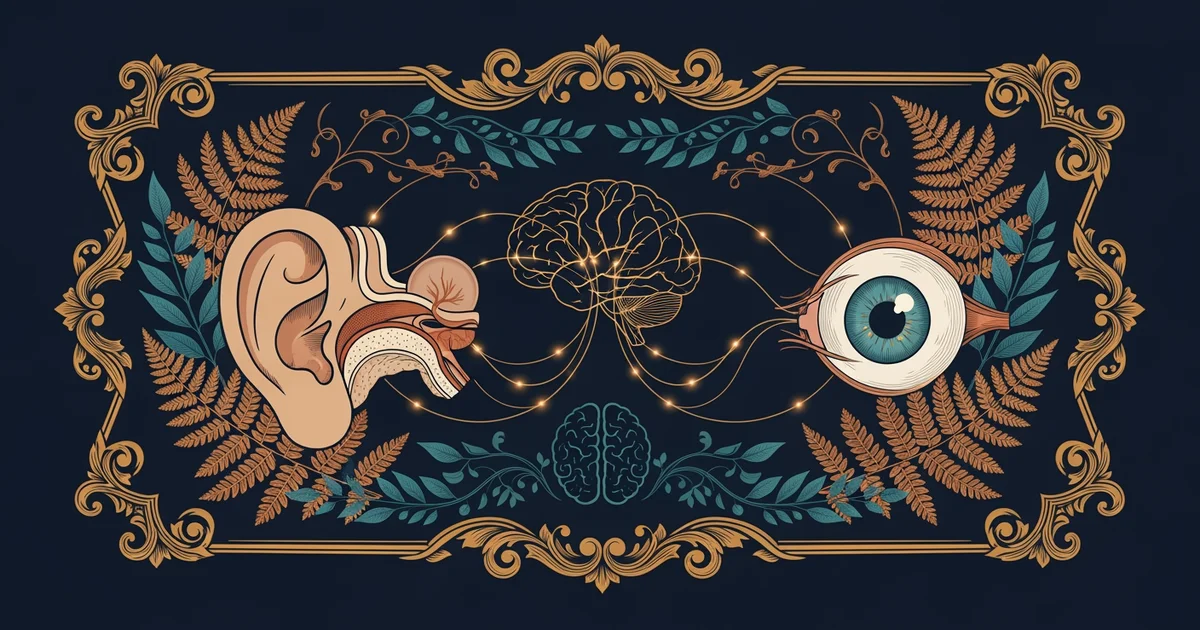
When your body encounters the world, it does not process information in isolated silos. Sensory organs constantly send raw data to the brain where specialized regions work together to build a complete picture of reality. For instance, the brain takes visual cues about an object's size and combines them with auditory feedback to determine distance. Think of this like a large corporation managing various departments that must share data to make a final decision. If the accounting department never talked to the sales team, the company would struggle to function or grow. Your brain acts as the central office that synthesizes these reports to ensure your actions remain accurate and efficient.
Key term: Multi-sensory integration — the process by which the brain combines information from multiple senses to create a unified and accurate perception of the surrounding environment.
This integration allows for faster reaction times when you encounter potential dangers in your path. Research suggests that the brain prioritizes signals that arrive from multiple sources simultaneously to confirm a threat. If you hear a loud crash and see a falling object at the same time, your brain triggers a physical response much faster than if you only heard the noise. This synergy represents a survival advantage that humans developed over many generations. By pooling data, the nervous system reduces the chance of errors during high-stakes situations.
Coordination Across Sensory Systems
Previous stations explored technological aids that help restore lost sensory input, but these tools succeed only when the brain can integrate them into existing systems. The success of a prosthetic device or a hearing aid depends on how well the brain maps new signals onto its internal model of the world. The following table highlights how different senses work together to create a reliable understanding of spatial orientation and safety:
| Sensory Combination | Primary Function | Outcome for the Individual |
|---|---|---|
| Vision and Balance | Spatial mapping | Maintains stable posture |
| Touch and Vision | Object recognition | Identifies texture and shape |
| Auditory and Visual | Distance judgment | Tracks moving objects safely |
These interactions demonstrate that the brain is not a passive receiver of data. Instead, it actively constructs a reality that helps individuals navigate their environment with precision. When one sense becomes impaired, the brain often increases its reliance on the remaining senses to maintain this equilibrium. This adaptability shows the resilience of the nervous system when facing environmental changes or physical challenges. Scientists continue to investigate how the brain decides which sensory inputs to trust when signals conflict or provide contradictory information.
As you consider the foundation question of how senses translate the physical world into electrical signals, you can see that the final product is a collaborative effort. The electrical impulses from your eyes, ears, and skin meet in the brain to form a single stream of consciousness. This raises a significant question for future study: how does the brain determine which sensory input is the most important when multiple signals arrive at the same time? Understanding this hierarchy of importance remains a major goal for researchers working in the fields of neuroscience and health sciences. The mystery of how we perceive a coherent world from chaotic signals remains an open challenge for current experts.
The brain creates a reliable reality by synthesizing diverse sensory signals into a single, unified experience that guides behavior and ensures survival.
The next stage of this learning path will examine how emerging research aims to decode these complex neural patterns to improve human health.
This content is educational only and does not constitute medical advice. Always consult a qualified healthcare professional for personal health decisions.