
Introduction to Sensory Systems
Imagine you are walking through a dark room and your hand brushes against a cold, sharp metal edge. Your brain instantly identifies the object as a knife and pulls your hand away before you even consciously think about the danger. This rapid response happens because your body constantly monitors the world through specialized biological systems. These systems turn physical events into information that your brain can actually understand and use for survival. Without this constant flow of data, your body would have no way to react to the environment around you.
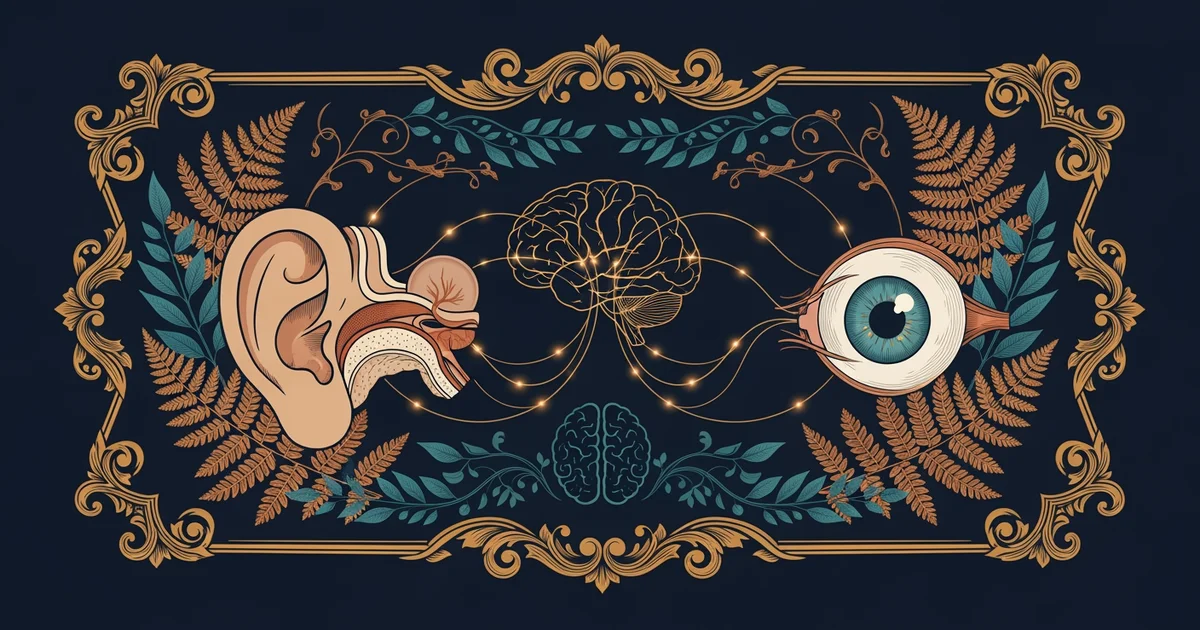
The Function of Biological Sensors
Every moment of your day, specialized cells called receptors act as the primary gatekeepers for all incoming information. These cells sit in your skin, eyes, ears, and other organs, waiting for specific changes in the world to occur. Think of these receptors like professional scouts working for a large corporation. They do not make the final decisions, but they gather critical facts from the field and send them back to the headquarters. If a scout fails to report a change, the headquarters remains unaware of the situation, leaving the entire organization vulnerable to external threats.
Key term: Receptors — specialized biological cells that detect physical stimuli from the environment and convert them into electrical signals.
Once a receptor detects a change, it must translate that event into a language your brain speaks fluently. This process is called transduction. Imagine you are trying to send a letter to a friend in a country that speaks a different language. You must translate your message into their native tongue so they can read it. Similarly, your eyes turn light waves into electrical impulses, and your ears turn air vibrations into those same signals. This translation is essential because the brain only processes electricity, not physical light or sound waves.
Processing Sensory Information
After the signals travel through your nerves, they reach specific areas of the brain designed to interpret the data. This interpretation is not just a passive recording of events, but an active construction of your personal reality. The brain organizes these signals into patterns that help you navigate your daily life with speed and accuracy. The following table illustrates how different receptors handle distinct types of environmental input to keep you safe:
| Receptor Type | Primary Function | Typical Input | Signal Destination |
|---|---|---|---|
| Photoreceptors | Light detection | Visual scenes | Occipital lobe |
| Mechanoreceptors | Pressure sensing | Touch or sound | Parietal lobe |
| Chemoreceptors | Chemical analysis | Taste and smell | Frontal cortex |
These systems work together to ensure you perceive the world as a unified experience rather than a collection of separate parts. Research indicates that the brain integrates these signals in milliseconds, allowing for smooth coordination between what you see and how you move. If one system fails, the brain often compensates by relying more heavily on the other inputs available. This flexibility demonstrates how resilient the human body is when facing challenges in the physical world.
Integration and Response
- Detection occurs when a receptor identifies a change in the environment, such as a drop in temperature.
- Conversion follows immediately as the receptor changes that physical stimulus into a small electrical current.
- Transmission moves the electrical signal along nerve pathways toward the central processing center of the brain.
- Interpretation happens when the brain identifies the signal and decides if an action is required for safety.
By completing this full path, you will learn how the nervous system coordinates these signals to create your total experience of reality. This content is educational only and does not constitute medical advice. Always consult a qualified healthcare professional for personal health decisions.
Sensory systems function by converting physical environmental changes into electrical signals that the brain interprets to build our reality.
The next station explores how these electrical signals travel through the nervous system to connect your senses with your brain.