
Auditory Processing Basics
Imagine standing near a busy city street where the constant hum of traffic creates a rhythmic vibration you can feel in your chest. Your ears function in a similar way by capturing invisible waves of pressure from the air and turning them into meaningful signals for the brain. Sound begins as physical movement in the atmosphere, and your body acts as a highly sensitive receiver designed to translate these movements into electrical language. Understanding this process requires looking at how the ear collects and transforms energy at every stage of the journey.
The Path of Sound Energy
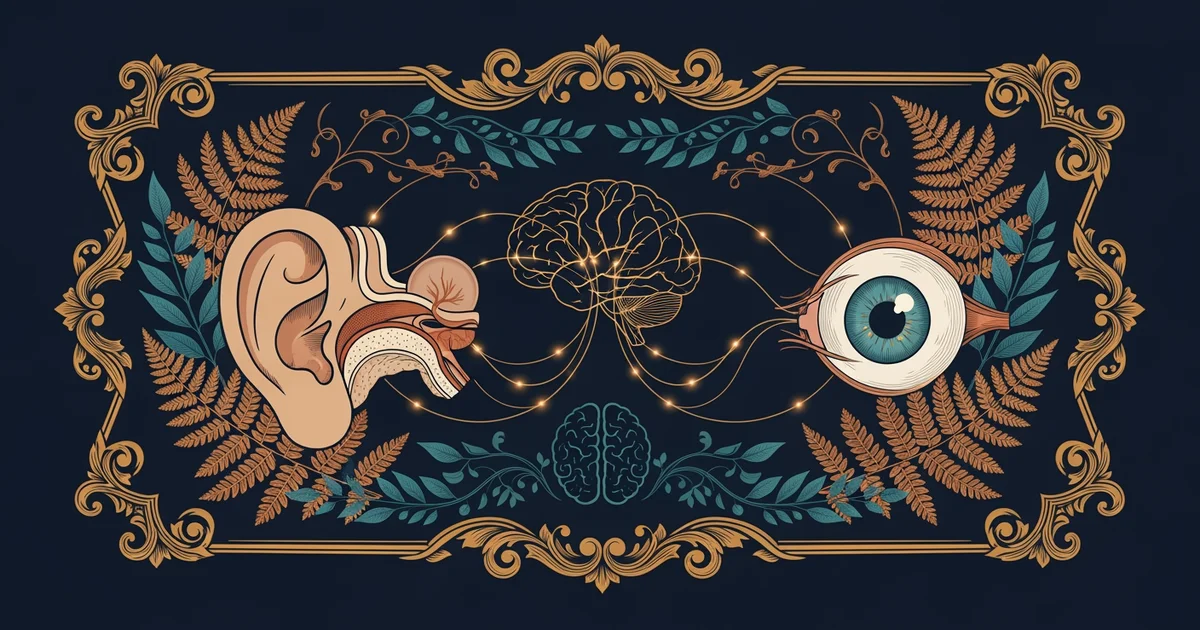
Sound travels through the air as waves of compressed molecules that hit the outer ear. The ear canal funnels these waves toward the eardrum, a thin membrane that vibrates in response to the incoming pressure. When the eardrum moves, it pushes three tiny bones in the middle ear that amplify the force of the vibration. Think of this process like a mechanical lever in a factory that multiplies a small amount of force into a much larger physical output. This amplification ensures that even very quiet sounds create enough force to move the fluid inside the inner ear.
Key term: Cochlea — the spiral-shaped structure in the inner ear that converts physical vibrations into electrical signals for the brain.
Once the vibration reaches the inner ear, it enters the cochlea, which is filled with fluid. The physical energy of the sound waves creates ripples in this fluid that travel along a specialized membrane. Tiny hair cells sit on this membrane and move whenever the fluid ripples pass over them. These hair cells act like a security gate that only opens when the right vibration frequency pushes against them. When these cells bend, they trigger an electrical charge that travels through the auditory nerve toward the brain.
Transforming Waves into Data
Individual sounds are distinguished by how they vibrate the fluid inside the cochlea. High-pitched sounds create ripples at the base of the spiral, while low-pitched sounds travel further toward the tip. The brain receives these distinct signals and interprets them as different tones, pitches, and volumes. This mapping system allows the human body to identify specific sounds even when multiple sources exist in the environment at once. Without this precise spatial organization, the brain would struggle to separate a human voice from background noise.
The following table outlines the physical stages of sound as it moves through the auditory system:
| Stage | Part of Ear | Physical Action |
|---|---|---|
| Capture | Outer Ear | Funneling air pressure waves |
| Transfer | Middle Ear | Amplifying force via bone movement |
| Conversion | Inner Ear | Creating fluid ripples on hair cells |
| Output | Auditory Nerve | Sending electrical signals to the brain |
Each step in this chain serves a unique purpose for maintaining sensory accuracy. If the bones in the middle ear fail to amplify the pressure, the fluid in the cochlea remains still. If the hair cells in the cochlea cannot bend, the electrical signal never reaches the brain. Every component must function in perfect sequence to ensure that the physical world of sound remains accessible to your conscious mind. By studying these mechanical steps, researchers learn how to address hearing loss and improve sensory technology for people with auditory challenges.
Now that you understand the mechanical journey of sound, it is clear that hearing is a physical process of conversion. The brain relies on these electrical pulses to build a coherent map of the environment around you. This system works constantly to keep you informed about potential threats or social cues in your surroundings. Future technologies continue to build on this knowledge to create better hearing aids and cochlear implants for those who need them. This content is educational only and does not constitute medical advice. Always consult a qualified healthcare professional for personal health decisions.
Auditory processing is the mechanical translation of atmospheric pressure waves into electrical signals through a series of physical vibrations within the ear.
The next Station introduces chemical senses, which determines how smell and taste signals are processed by the brain.