
Articulatory Phonetics Basics
When you speak, your tongue moves like a dancer across a stage to create sounds. You might not notice these movements, but they turn simple air into the complex language you use every day.
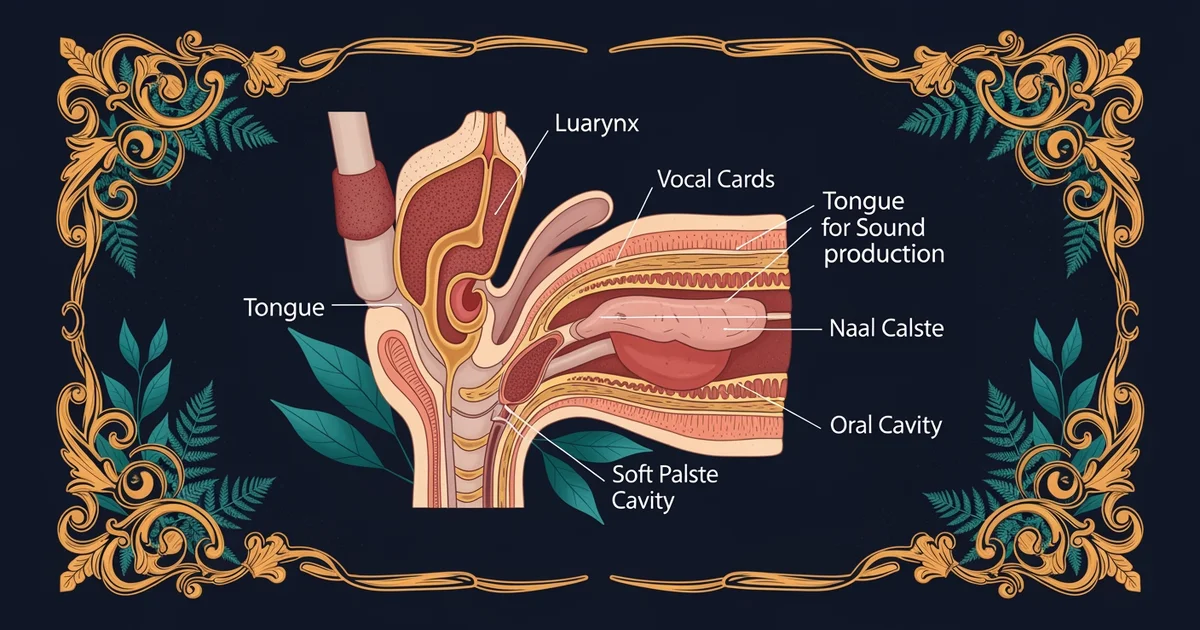
The Anatomy of Speech Production
Articulatory phonetics is the study of how humans use their bodies to produce speech sounds. To understand this, imagine your vocal tract is a musical instrument that you play with your mouth. The lungs provide the air, which acts as the power source for your internal instrument. This air flows upward through the throat and reaches the various chambers of your oral cavity. Your tongue, lips, and teeth then shape this air into specific sounds. Without these precise physical adjustments, your speech would be nothing more than a steady stream of unfiltered breath. By changing the shape of your mouth, you create different resonant patterns that define specific consonants. Every sound you make requires a coordinated effort between several different parts of your upper body.
Key term: Articulatory phonetics — the scientific study of how human vocal organs produce the specific sounds used in spoken language.
Your mouth contains several active and passive structures that work together during the production of speech. The active articulators move to touch or approach other parts of the mouth, while passive articulators remain still. The tongue is the most flexible and active part of this system, capable of reaching many different areas. The lips are also highly active, as they can round or press together to block airflow. The teeth and the roof of the mouth serve as the primary passive targets for these movements. When these parts interact, they create the distinct shapes that our ears recognize as language. This mechanical process is the foundation of all spoken communication across every human culture on earth.
Classifying Consonants by Placement
Linguists classify consonants based on where the obstruction occurs within the vocal tract, which is known as the place of articulation. Think of this process like a highway toll booth that regulates traffic flow by opening or closing specific lanes. If you close your lips, you create a barrier that forces the air to stop briefly before it releases. If you touch your tongue to your teeth, you create a different kind of restriction that changes the sound. By mapping these points of contact, we can categorize every consonant sound based on its physical origin. This system allows us to describe the mechanics of speech with great accuracy and logical consistency.
We can organize these sounds based on the specific anatomical locations involved in their production:
- Bilabial sounds occur when you press both lips together to stop or restrict the airflow, which creates sounds like the letters p, b, or m.
- Labiodental sounds happen when you place your bottom lip against your upper teeth to create friction, which results in sounds like f or v.
- Alveolar sounds are made when you touch the tip of your tongue to the ridge just behind your upper teeth, forming sounds like t, d, or s.
- Velar sounds involve the back of your tongue touching the soft part of the roof of your mouth, which generates sounds like k or g.
This classification system helps us see that speech is simply a series of physical gestures. Each gesture has a specific goal and a specific anatomical target that must be hit perfectly. When you learn a new language, you are essentially training your muscles to perform these gestures in new ways. By practicing these placements, you gain control over the complex machinery inside your own mouth. This physical awareness is the first step toward mastering the sounds of any language you wish to speak.
The physical placement of your tongue, lips, and teeth determines the specific consonant sound produced by obstructing airflow.
The next Station introduces vowel quality and tongue height, which determines how the shape of your oral cavity changes the resonance of your voice.