
The Nature of Human Speech Sounds
Imagine you are standing in a busy train station while a crowd of people talks at once. You hear a chaotic mixture of grunts, whistles, and sudden shrieks that blend into a wall of noise. Suddenly, a clear voice cuts through the din to announce a train arrival in your native language. Your brain instantly separates that specific human speech from the background clutter of mechanical sounds and random cries. This process demonstrates the remarkable way humans filter raw physical vibrations into complex, meaningful communication systems every single day.
The Physics of Sound Production
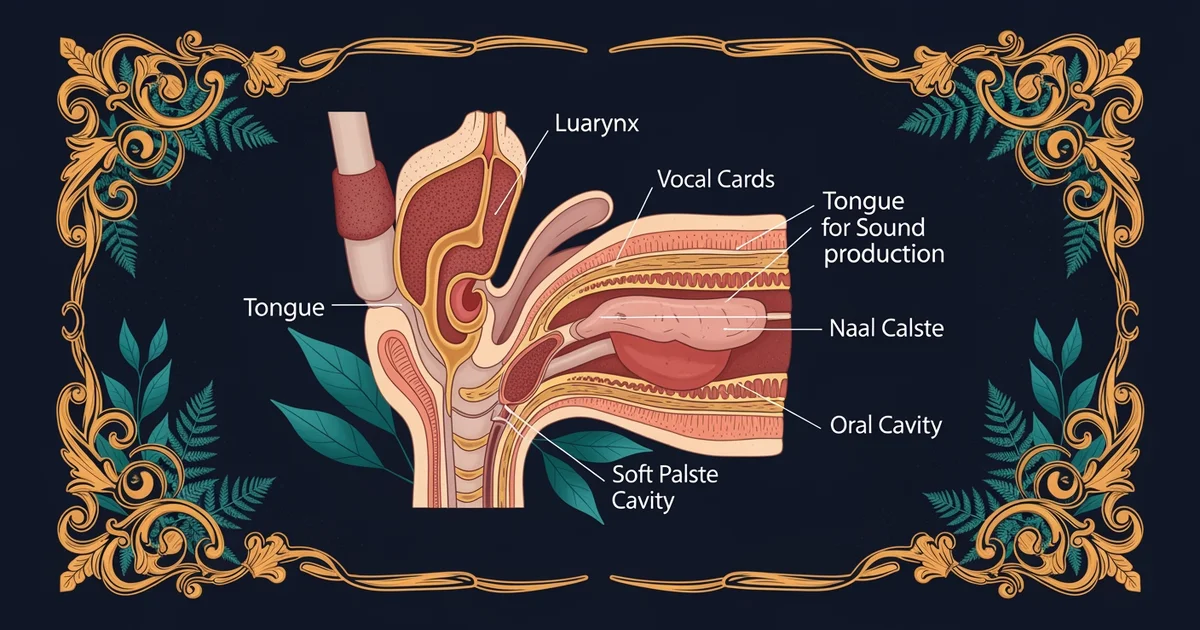
When we speak, we create physical disturbances in the air that travel toward the ears of a listener. These disturbances start as airflow moving from the lungs through the narrow space of the vocal cords. As the air pushes through, it forces these cords to vibrate rapidly and create a series of pressure waves. These waves represent the raw material of speech before they ever take on the shape of words. Much like a musician tuning a guitar string, we adjust the tension of our muscles to change the pitch and volume of these waves. Without these precise physical movements, we would only produce simple, unstructured noises rather than the intricate patterns that form our spoken language.
Key term: Phonetics — the scientific study of the physical properties of human speech sounds and their production.
Once the air leaves the vocal cords, it travels through the throat and mouth to be shaped. We use our tongue, teeth, and lips to block or redirect the airflow in very specific ways. Think of this process like water flowing through a garden hose that has various attachments at the end. If you place your thumb over the opening, you change the shape of the stream and the sound it makes. Similarly, moving your tongue against your teeth creates a different sound than letting air flow freely through your open lips. These physical adjustments turn generic vibrations into the distinct sounds we recognize as parts of words.
Distinguishing Speech from Noise
While all speech is sound, not all sounds qualify as human speech in a linguistic sense. Speech requires a structured system where specific physical movements correspond to intended meanings shared by a community. Raw noise lacks this organization because it does not follow the predictable patterns needed to convey information between two people. When you hear a car horn or a crashing plate, your brain identifies the sound but finds no underlying message or grammatical structure. Speech, by contrast, relies on the listener recognizing these patterns as meaningful units that build toward sentences and complete thoughts.
To better understand how we classify these sounds, we can look at the physical traits that separate them from mere noise:
- Intentionality refers to the purposeful arrangement of sound waves to create distinct patterns that others can decode as language.
- Patterning involves the consistent repetition of specific sound shapes that allow listeners to identify words despite different speakers.
- Meaningfulness occurs when a listener maps a physical sound wave to a specific concept or object in their mental vocabulary.
| Sound Type | Physical Source | Linguistic Purpose | Recognition Level |
|---|---|---|---|
| Raw Noise | Random impact | None | Immediate |
| Speech | Vocal tract | Communication | Pattern-based |
| Signal | Mechanical | Warning | Instinctual |
By comparing these categories, we see that speech is a highly specialized use of physical energy. We do not just make noise to fill the air; we use our bodies as instruments to encode ideas into a format that others can decode. This ability to turn physical vibrations into shared understanding forms the absolute foundation of human interaction. As we move through this path, you will learn how these tiny, physical sound units combine to build the entire structure of human language.
The ability to communicate depends on our capacity to transform raw physical air pressure into structured, meaningful patterns that others can interpret.
We will now explore how these physical sounds function as the building blocks for the complex systems of language.