
Coastal Migration Routes
Imagine you are standing on a vast beach looking out at the endless horizon of the ocean. Early humans likely viewed the water as a highway rather than a barrier to their movement. While many researchers once focused on inland paths, the coastal migration theory suggests that early groups moved along the edges of the continents. These people traveled by following the shoreline, where they found steady food sources like shellfish and seaweed. This method allowed them to expand rapidly while staying close to reliable resources that supported their families. By walking along the coast, they maintained a consistent environment that felt familiar even as they moved across thousands of miles. This strategy turned the dangerous unknown into a series of reachable destinations along the water.
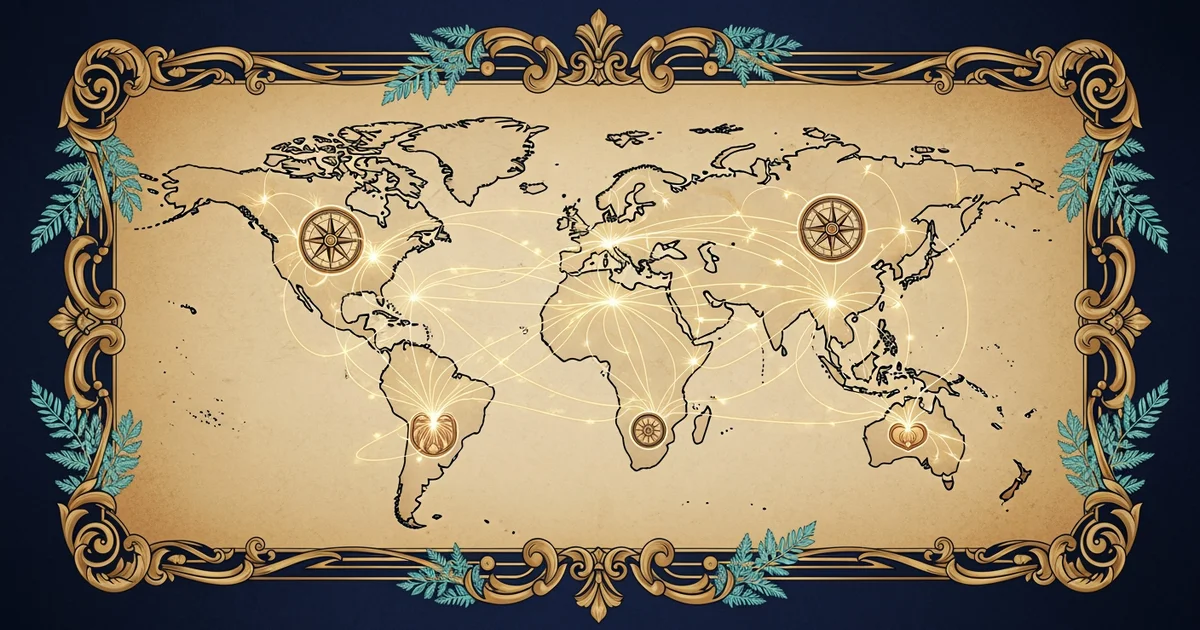
The Logic of Shoreline Expansion
When we compare this to inland travel, we see how the coastal route offered a major advantage for survival. Inland paths often required groups to adapt to new climates, strange plants, and unknown predators in rapid succession. Moving along the coast, however, provided a stable diet that rarely changed as they crossed different regions. Think of the coast like a long, well-stocked grocery store that runs along the entire length of a highway. You do not need to pack a massive supply of food because you know that fresh items are available at every stop. This constant access to resources meant that early humans could move forward without the heavy burden of carrying excess supplies across difficult terrain.
Key term: Coastal migration — the theory that early humans expanded their range by travelling along shorelines to utilize marine resources like shellfish and seaweed.
This pattern of movement contrasts sharply with the challenges faced by groups who moved deep into the interior of continents. Inland expansion required high levels of planning and the ability to hunt large animals in diverse, often harsh environments. Coastal groups avoided these specific pressures by keeping their feet in the sand and their eyes on the tide. This approach acted as a natural filter for their success by favoring those who understood the rhythm of the sea. By staying near the water, they reduced the risk of starvation and maintained a steady pace of discovery that helped them populate distant lands much faster than those who stayed inland.
Comparing Migration Patterns
To understand why this model gained popularity, we should look at the primary differences between coastal and inland expansion strategies. The following table highlights how these two methods impacted the survival and speed of early human groups.
| Feature | Coastal Migration | Inland Expansion |
|---|---|---|
| Primary Diet | Seafood and algae | Land animals and plants |
| Resource Stability | High and predictable | Low and seasonal |
| Movement Speed | Fast and steady | Slow and cautious |
| Environmental Risk | Lower exposure | Higher exposure |
Using this table, we can see that coastal travel offered a safer path for groups that wanted to explore new territories. The predictable nature of the tide provided a reliable safety net that land-based hunting could not always guarantee. These coastal explorers likely developed specialized tools for harvesting marine life, which allowed them to thrive in varied climates. While inland groups struggled to find new game, coastal groups simply moved to the next beach where the resources were just as plentiful. This constant cycle of movement and harvest allowed them to cross vast distances while keeping their population healthy and active.
The coastal migration theory explains that early humans moved rapidly across the globe by following shorelines that provided consistent food and stable living conditions.
The next Station introduces the Neolithic Revolution, which determines how early humans transitioned from these nomadic coastal lifestyles to settled farming communities.