
Technological Requirements
Imagine trying to collect tiny, valuable coins from the bottom of a dark, freezing swimming pool while wearing thick mittens. You cannot see the floor, the water pressure is crushing, and your hands are too clumsy to grab the metal. This is exactly how engineers feel when they design machines for deep sea mining. They must build equipment that survives extreme pressure while working with the precision of a surgeon. Without the right technology, the ocean floor remains an unreachable vault that hides its mineral riches from the world above.
The Engineering Challenge of Deep Environments
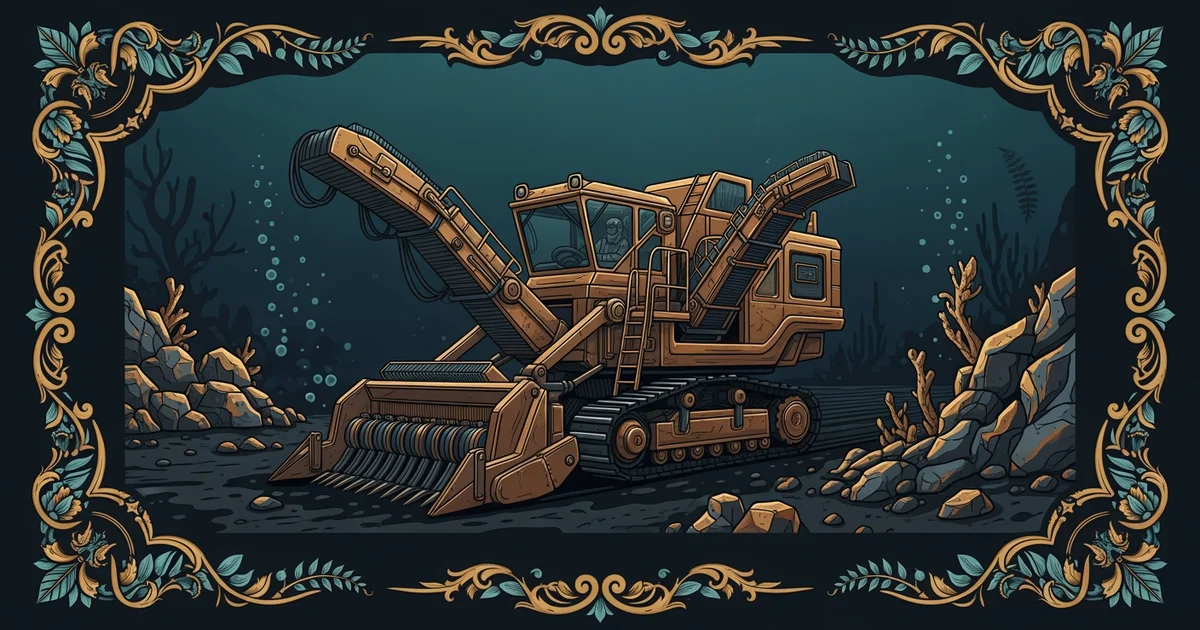
Because the deep ocean floor sits miles beneath the surface, engineers must solve the problem of immense water pressure. At these depths, the weight of the water above is so great that it would instantly crush a normal submarine like an empty soda can. To prevent this, mining machines use thick, reinforced steel hulls and specialized hydraulic systems that balance internal and external pressures. Think of these machines like a deep-sea vacuum cleaner that must operate while submerged in a storm that never ends. The machines need to be heavy enough to stay on the seabed, yet light enough to maneuver across soft, muddy sediment without sinking or getting stuck.
Key term: Remote Operated Vehicles — unmanned, tethered robotic machines that are controlled by operators on a surface ship to perform complex tasks underwater.
These Remote Operated Vehicles act as the eyes and hands of the mining crew on the surface. They carry high-definition cameras and sensitive sensors that map the terrain before any mining begins. By using these robots, companies can identify where the richest mineral deposits are located without putting human divers at risk. The robots also perform maintenance on other mining equipment, acting like a mobile repair shop that can fix broken parts in the middle of the dark ocean. Their ability to transmit live data allows teams to make split-second decisions that ensure the safety of the entire operation.
Collecting Minerals with Precision Tools
Once the site is ready, the actual collection process requires specialized harvesting tools that minimize damage to the surrounding environment. These harvesters move slowly across the seafloor, using rotating heads to gently lift mineral nodules from the sediment layer. The collected material is then pumped through long, flexible pipes to a support ship waiting on the surface. This process relies on a complex network of power cables and data lines that connect the seafloor equipment to the ship. If any part of this link fails, the entire operation stops immediately, which shows how fragile the connection to the surface really is.
To manage these tasks, engineers rely on a specific set of technological components that ensure stability and efficiency:
- Hydraulic suction systems provide the force needed to lift heavy minerals through miles of piping while separating them from the surrounding seafloor mud.
- Acoustic positioning arrays use sound waves to track the exact location of every machine, ensuring that robots do not collide or drift away from their assigned mining zones.
- Modular power distribution units allow the surface ship to send steady electricity down to the seafloor, keeping the robotic systems running for weeks at a time without needing a return trip.
| Technology Type | Primary Function | Operational Challenge |
|---|---|---|
| Robotic Harvesters | Collecting minerals | Navigating soft mud |
| Suction Pumps | Transporting ore | Preventing pipe clogs |
| Sensor Arrays | Mapping terrain | Low visibility levels |
By using these tools, mining companies hope to reach minerals that are essential for modern electronics. However, the cost of building and maintaining this technology is extremely high, which forces companies to find ways to make the process faster and more reliable. The goal is to create a closed loop where the machinery collects only what is needed, leaving as much of the natural habitat undisturbed as possible. As technology improves, the precision of these machines will likely increase, potentially reducing the impact on the deep-sea floor while increasing the amount of material recovered.
Successful deep sea mining relies on highly specialized robotic equipment that can withstand immense pressure while maintaining the precision required to harvest minerals without destroying the surrounding ocean floor.
The next Station introduces economic drivers, which determines how the high cost of this technology influences global mining decisions.