
Tidal Friction and Rotation
Imagine you are spinning on a smooth office chair while holding heavy weights in your outstretched hands. As you pull those weights inward toward your chest, you spin faster because your mass is now concentrated closer to your axis. Earth experiences a similar effect, but the moon acts as a constant, invisible brake on our planet. This process, known as tidal friction, subtly alters the speed at which our world rotates on its axis every single day.
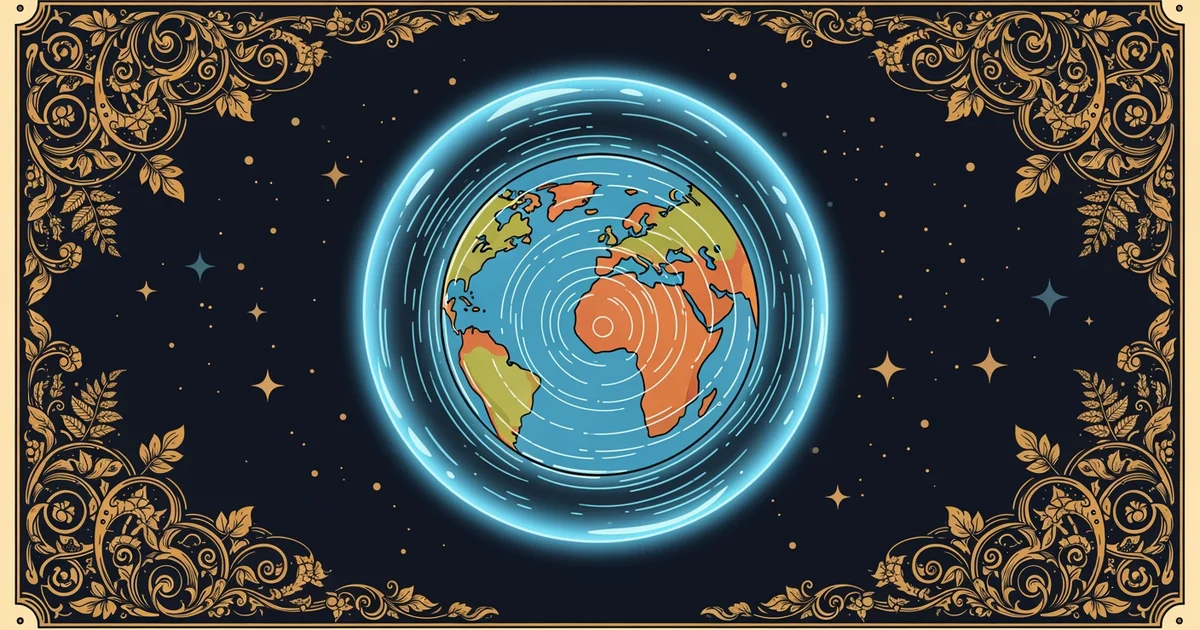
The Mechanics of Lunar Drag
Gravity from the moon creates a bulge of water on the side of Earth facing it. Because Earth rotates faster than the moon orbits our planet, this water bulge moves ahead of the moon. The moon pulls back on this leading tidal bulge with its own gravitational force, creating a drag effect. Think of this interaction like a person trying to walk through a thick, viscous pool of water while wearing heavy boots. The water resists the person's movement, forcing them to expend more energy to maintain their original pace. Similarly, the moon exerts a persistent gravitational tug on Earth’s oceans, which acts as a physical drag against our planet's rotation.
This interaction creates a constant transfer of angular momentum from Earth to the moon over long periods. As Earth loses rotational energy to this drag, the moon gains that energy, causing its orbit to expand slowly. This means the moon moves further away from us by a few centimeters each year. The process is extremely gradual, yet it has profound implications for how we measure time on our planet. Our days are not fixed; they are slowly stretching as the Earth's rotation loses its momentum to the lunar gravitational influence.
Key term: Tidal friction — the dissipation of rotational energy caused by the gravitational interaction between a planet and its orbiting satellite.
Quantifying the Shift in Time
Scientists measure this historical change by looking at ancient records of eclipses and coral growth patterns. These data points show that Earth's rotation has slowed significantly over millions of years. To understand how these forces change our environment, consider the following impacts on our planet's daily cycle:
- The length of a day increases by about two milliseconds every century as tidal drag continues to slow our rotation.
- Ancient days were much shorter than twenty-four hours because the Earth once spun much faster than it does today.
- The moon currently drifts away from Earth at a rate of roughly four centimeters per year due to this momentum transfer.
This slowing process is not uniform because various geological factors influence the friction levels. Shallow seas and continental shapes affect how the tidal bulge moves across the globe. When the moon pulls on these bulges, the energy loss is higher in areas where water is shallow and confined. This creates a complex map of energy dissipation that scientists must calculate carefully to model past time.
| Feature | Effect on Rotation | Influence Level |
|---|---|---|
| Deep Oceans | Minimal Friction | Low |
| Shallow Seas | High Friction | Significant |
| Tidal Bulges | Energy Transfer | Constant |
This continuous interaction ensures that the moon and Earth remain locked in a slow, rhythmic dance of energy exchange. While the change feels invisible to us, it serves as a reminder that our planet is part of a larger, dynamic system. The forces shaping our environment are not just local; they are cosmic exchanges that dictate the very length of our days. As we look at the sky, we see an object that is not just a light in the dark, but a powerful engine that is actively reshaping the rotation of our home world.
The moon exerts a constant gravitational pull on Earth's oceans that acts as a brake, gradually slowing our planet's rotation and lengthening the duration of our days.
But what does it look like in practice when we observe the sky and notice the shifting position of the stars?