
Crevasse Formation
Imagine you are walking across a massive, frozen parking lot that is slowly shifting and cracking under your feet. When the surface of a glacier encounters obstacles or changes in speed, the ice reacts like brittle glass rather than flowing liquid. This tension creates deep, vertical gashes known as crevasses that challenge even the most experienced explorers. These features are not random accidents but are predictable results of the physical forces acting upon the ice mass. Understanding these mechanics reveals how glaciers behave as dynamic systems rather than static blocks of frozen water.
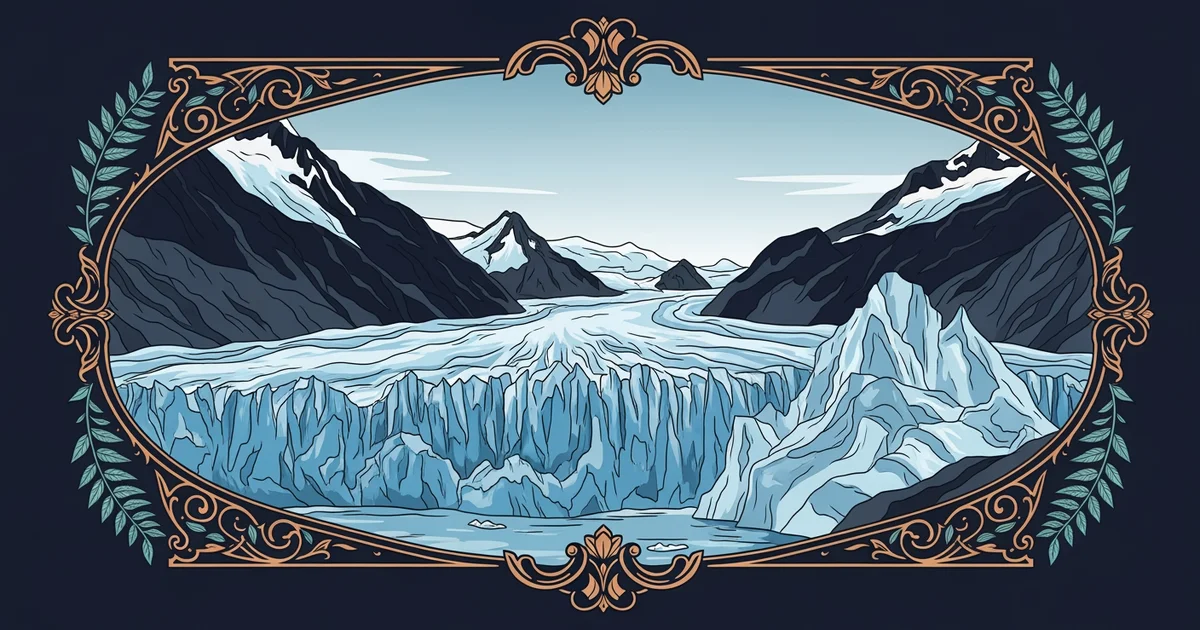
The Mechanics of Brittle Failure
Glacial ice behaves differently depending on the depth and the pressure applied to the frozen structure. Near the surface, the ice remains cold and brittle because it lacks the weight required to make it plastic. When a glacier moves over an uneven bed, the upper layers must stretch to cover the changing terrain below. Because the ice cannot stretch like rubber, it reaches its tensile limit and snaps apart suddenly. This process is similar to how a thick piece of chocolate snaps cleanly when you bend it too far. The resulting crack allows the glacier to accommodate the new shape of the rocky floor without requiring the entire mass to deform at once.
Key term: Crevasse — a deep, open crack in the upper layer of a glacier caused by stress and movement.
When we look at the way glaciers move, we see that the velocity of the ice varies across the width of the channel. The ice in the center of the glacier often moves faster than the ice near the rocky walls. This speed difference creates a shearing effect that pulls the ice apart along the edges of the glacier. These features are known as marginal cracks, and they often point inward toward the direction of the glacier flow. By observing these patterns, scientists can map the internal stresses that drive the movement of the entire frozen river.
Predicting Topographical Stress Patterns
Topography plays a major role in determining where these dangerous gaps will appear on the surface of the ice. When a glacier moves over a steep slope, the ice must accelerate to maintain its flow, which stretches the surface layers. This stretching force creates transverse cracks that run across the entire width of the glacier path. You can predict these locations by identifying sudden changes in the elevation of the valley floor beneath the ice. The following factors contribute to the specific patterns we observe in active glacial fields:
- Splaying cracks form when a glacier widens, causing the ice to fan out and create radiating gaps.
- Longitudinal cracks occur when the glacier encounters a bottleneck, forcing the ice to compress and split.
- Bergschrund features appear at the very top of a glacier where the moving ice pulls away from the mountain.
These patterns provide a visual history of the forces that have shaped the ice during its journey downward. By analyzing the orientation of these cracks, researchers can determine the exact direction of glacial flow and the hidden obstacles located deep beneath the surface. This mechanical analysis turns a chaotic landscape into a readable map for those studying the movement of our planet's frozen reserves.
| Feature Type | Primary Cause | Visual Pattern |
|---|---|---|
| Transverse | Steep slope | Cross-wise gaps |
| Marginal | Friction | Edge-angled gaps |
| Splaying | Widening path | Fan-shaped gaps |
Using this table, one can quickly categorize the stress patterns observed during field surveys. Each gap represents a point where the internal tension exceeded the structural integrity of the ice. Observing these features allows us to understand the hidden architecture of the glacier without needing to see the rock bed directly. The ice acts as a mirror for the hidden terrain, reflecting the obstacles and slopes that govern its path toward the sea. As the climate changes, these patterns help us track how glaciers respond to new environments and shifting pressures.
Glacial crevasses serve as visible indicators of internal stress patterns caused by the interaction between moving ice and the uneven topography beneath it.
But what happens when these cracks reach the edge of the glacier and interact with the open ocean?