
Glacial Movement Patterns
Imagine a massive river of solid ice that flows slowly down a steep mountain slope. Even though the ice feels like a hard rock, it behaves like thick syrup over long periods. This movement defines the life cycle of every major glacier on our planet today. Understanding why these frozen giants shift helps us track how landscapes change over many decades.
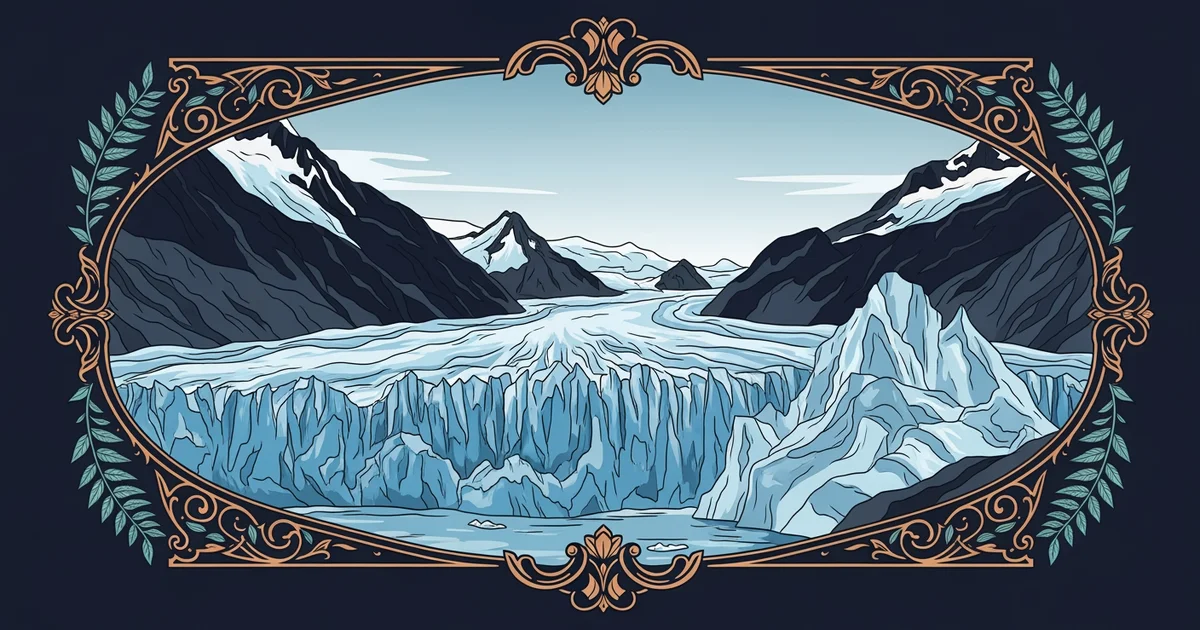
The Mechanics of Glacial Flow
Glaciers move because gravity pulls the heavy mass of ice downhill toward lower elevations. As snow piles up at the top, the weight creates immense pressure on the bottom layers. This pressure forces the ice to deform and slide across the rugged bedrock surface below. Think of a glacier like a giant jar of honey sitting on a tilted table. The honey stays in one shape until gravity slowly pulls it downward into a new position. The ice behaves in a similar way because it remains under constant stress from its own weight. This process turns solid ice into a flowing material that shapes the valleys around it.
Key term: Internal deformation — the process where ice crystals slide past each other under extreme pressure to allow the glacier to flow downhill.
Internal deformation happens deep within the glacier where the pressure remains high enough to move crystals. Near the surface, the ice stays brittle and often cracks to form deep crevasses. These surface cracks do not reach the bottom where the ice moves like a liquid. Scientists measure this movement by tracking how fast the surface ice shifts over time. When the ice moves faster in the middle than at the edges, it shows the friction between the ice and the valley walls. This friction slows down the outer parts of the glacier while the center moves more freely.
Factors Influencing Velocity
Several environmental factors change how fast a glacier travels across the rocky ground each season. The slope angle, the amount of meltwater, and the temperature of the underlying bedrock all play roles. Meltwater acts like a lubricant between the ice and the rock floor beneath it. This lubrication reduces friction and allows the glacier to slide much faster than it would otherwise. During warm summers, the increased water flow often causes a noticeable surge in the speed of the ice. We can compare these movement patterns across different types of glaciers found in various climates.
| Glacial Type | Main Movement Driver | Typical Velocity | Primary Influence |
|---|---|---|---|
| Alpine | Gravity and slope | Very slow | Bedrock friction |
| Tidewater | Water lubrication | Moderate speed | Ocean temperature |
| Polar sheet | Internal pressure | Extremely slow | Ice thickness |
These patterns show that glaciers are not static features of the landscape but dynamic systems. The speed of a glacier depends on how much water sits at the base of the ice. If the base remains frozen to the rock, the glacier moves only through slow internal deformation. If the base stays wet, the glacier can slide over the surface with much greater speed. Understanding these differences allows researchers to predict how glaciers react to changing global temperatures over time. Each glacier acts as a unique system that responds to its specific local environment and climate conditions.
Glacial movement occurs through a combination of gravity-driven deformation and basal sliding facilitated by water lubrication.
The next Station introduces ice sheet stability, which determines how these movement patterns affect global sea levels.