
Climate Forcing
When the massive glaciers retreated from the Great Lakes region thousands of years ago, they left behind deep scars that define our modern landscape. This profound transformation shows how shifting environmental patterns dictate the physical shape of our home planet over vast geological time frames.
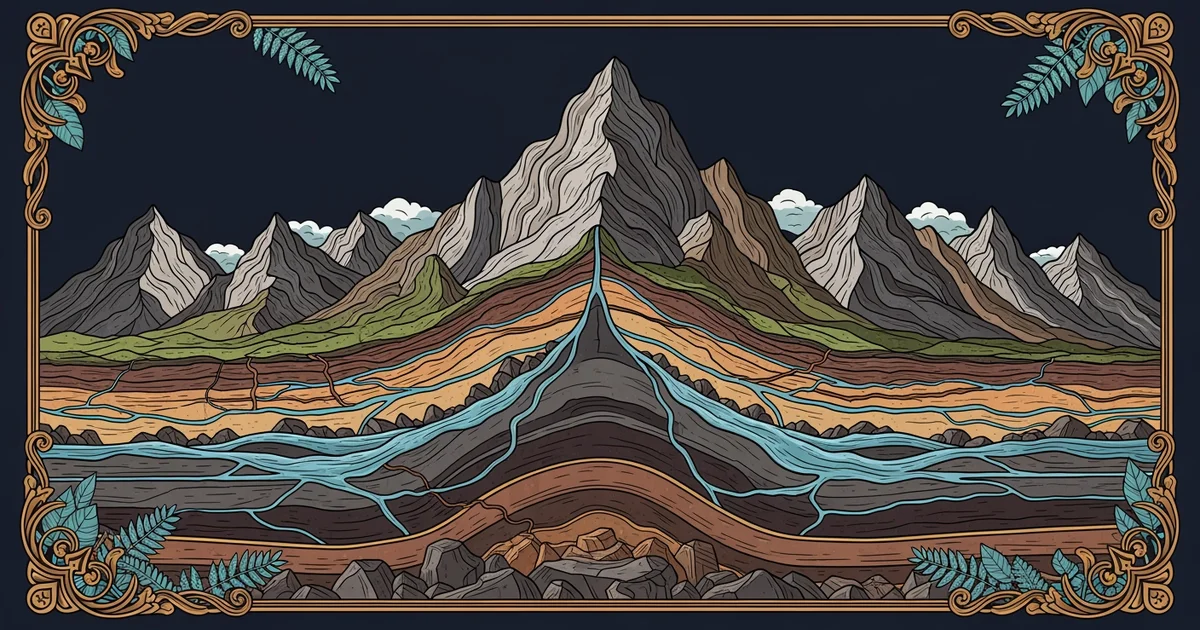
The Engine of Surface Change
Natural systems rely on a delicate balance of energy inputs to maintain the stability of mountains, rivers, and coastal plains. Climate forcing acts as the primary driver for these changes by altering the total energy available to shape the crust. Think of this process like a household budget where income dictates your ability to renovate a home. When the climate warms, the planet receives more energy, which accelerates the weathering of rock and the movement of sediment across the surface. Conversely, cooling periods act like a restricted budget that slows down chemical reactions and locks water away in ice. These cycles of energy availability determine whether a river carves a deep canyon or stays stagnant for millennia. By shifting the energy balance, the climate forces the Earth to constantly reorganize its physical features into new configurations.
Key term: Climate forcing — the change in the net energy balance of the Earth system which causes the climate to shift and drives long-term geological evolution.
Because these forces operate on massive scales, the impact on landforms is rarely immediate or obvious to a casual observer. We must view the landscape as a dynamic record of past energy states that are still playing out today. The transition from a glacial to an interglacial state provides the most dramatic examples of this power in action. During these shifts, the sudden release of water and the movement of massive ice sheets reshape entire valleys in a relatively short period. This is an application of the principle of landscape sensitivity discussed in Station 12, where the surface responds to external pressures by finding a new equilibrium state. The land is never truly settled, as it is always preparing for the next shift in the global energy budget.
Mechanisms of Landscape Evolution
Beyond simple temperature shifts, the movement of moisture and wind plays a critical role in how the surface responds to forcing. Different landforms react to these changes based on their composition and their proximity to active energy sources. We can categorize the primary ways that climate forcing influences the physical structure of our world through specific environmental agents.
| Agent | Primary Action | Resulting Landform |
|---|---|---|
| Glaciers | Scouring rock | U-shaped valleys |
| Rivers | Cutting channels | Deep river canyons |
| Wind | Moving sediment | Shifting sand dunes |
These agents do not act in isolation but rather work in concert to redistribute materials across the globe. When a climate shift occurs, the intensity of these agents changes, which fundamentally alters the rate of erosion and deposition. For instance, increased rainfall leads to higher river volume, which then increases the rate at which sediment is transported to the ocean. This process effectively flattens mountain ranges over millions of years by moving mass from high elevations to low basins. The climate acts as the architect, while these agents function as the construction crew that physically moves the dirt to match the new design. Without this constant feedback between the atmosphere and the crust, the surface of our planet would remain static and unchanging.
Understanding these mechanisms allows us to predict how future changes in the energy balance might alter the places where we live today. We are currently observing a rapid shift in these forcing factors, which suggests that our landscapes will continue to evolve in response to these new conditions. The history of the Earth is written in the layers of sediment and the shapes of our mountains, both of which are direct products of these cycles. By studying these past patterns, we gain a clearer view of the forces that will define the future of our physical environment. The connection between the sky and the ground is much tighter than most people realize, as every weather cycle leaves a mark on the land.
The physical shape of our planet is a direct reflection of long-term energy cycles that dictate how natural agents erode and build the landscape.
But this model becomes difficult to apply when human activities begin to override natural climate signals in the modern era.