
Integrated Tectonic Reconstructions
Geologists often find themselves staring at a single piece of rock while wondering how it traveled thousands of miles across the globe. Imagine you are trying to solve a massive puzzle where the pieces have changed shape and color over millions of years. This challenge defines the field of tectonic study, where we reconstruct the ancient movements of entire continents. By looking at the chemical signatures locked inside minerals, we can track how landmasses drifted apart or crashed together in the distant past.
Mapping Movements Through Chemistry
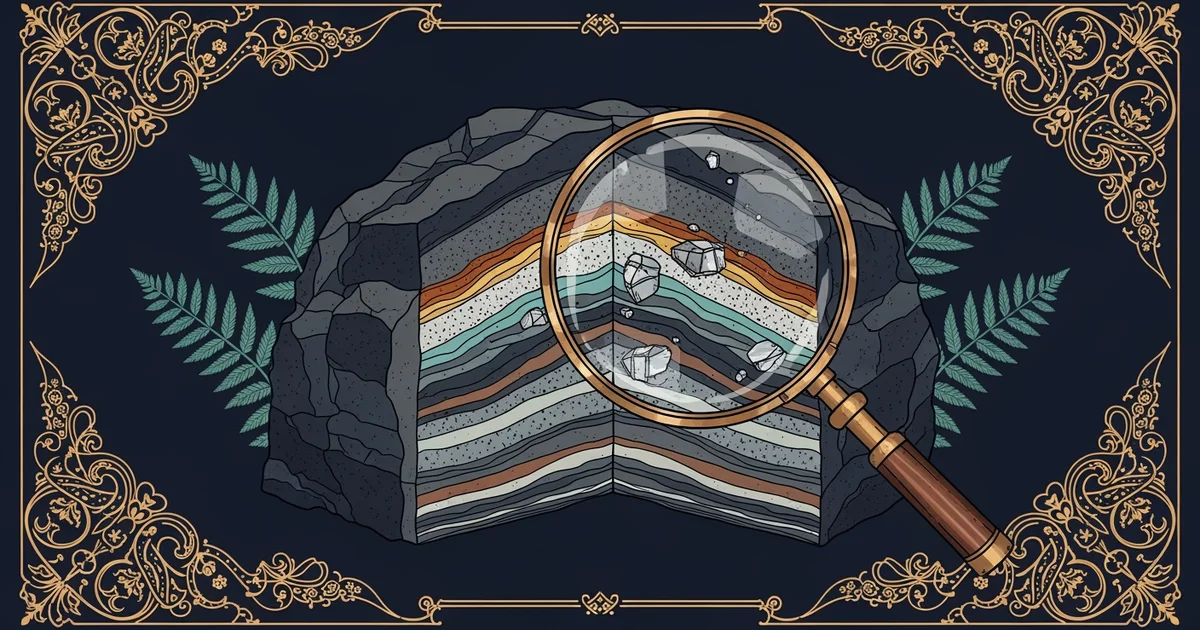
To understand these massive shifts, we rely on geochemical fingerprinting to identify the specific source of volcanic rocks found on different continents. When magma erupts from deep within the Earth, it carries a unique chemical ratio of trace elements that acts like a signature. If we find identical signatures on two continents currently separated by a vast ocean, we can prove they were once joined as a single landmass. This process is similar to matching a torn piece of paper back to its original page by comparing the jagged edges and the specific ink patterns found on the surface. We use these markers to build a map of the ancient world that shows how the crust has moved over time.
Key term: Integrated Tectonic Reconstructions — the process of combining diverse data sets like rock chemistry and magnetic orientation to model historical plate positions.
These models require us to synthesize data from many different fields to create a coherent story of our planet. We often look at the age of the rocks and their magnetic history to see how they shifted relative to the poles. By combining these measurements with the chemical data, we build a reliable timeline of continental drift that explains why certain mountain ranges exist today. This synthesis allows us to see the Earth as a dynamic system rather than a static collection of land and water. Without this integration, we would only have fragments of evidence that fail to show the full scope of geological history.
Connecting Global Data Sets
When we compare these findings, we often notice patterns that link the composition of the crust to the speed of plate movement. The following table highlights how different geochemical indicators help us determine the environment where these rocks originally formed during ancient tectonic events.
| Indicator Type | Chemical Signal | Tectonic Environment | Purpose of Data |
|---|---|---|---|
| Trace Elements | High Titanium | Ocean Floor | Identifying ancient seafloor |
| Rare Earths | Light Enrichment | Continental Crust | Tracking land movement |
| Isotope Ratios | Lead Variation | Subduction Zones | Locating volcanic arcs |
These indicators provide the raw data needed to refine our global models. We can see how the crust has recycled itself over time by looking at these specific chemical signals in the rocks. This practice builds upon our understanding of forensic geology, where we previously learned how to identify the origin of smaller artifacts. Now, we apply those same logic patterns to the scale of entire tectonic plates to see how they interact over geological time. The tension in this field arises because some chemical signals can be altered by heat and pressure, which makes our task of reconstruction even more complex.
We must ask ourselves if we can ever fully resolve the history of the Earth when the evidence is constantly being destroyed and recycled. This remains an open question for researchers who study the deep history of our planet. By looking at how these plates move, we gain a better sense of how the surface of the Earth will continue to evolve in the future. We are essentially reading the chemical diary of the planet to predict the next chapter of its long and turbulent life. Every new sample we analyze adds a line to this story, helping us fill in the gaps of our current tectonic maps.
Synthesizing chemical signatures with physical movement data allows scientists to reconstruct the ancient positions of continents that have drifted apart over millions of years.
Future research into geochemical signatures will likely reveal how deeper mantle movements influence the slow migration of plates across the surface of the Earth.