
Sedimentary Provenance Analysis
Imagine finding a single grain of sand on a beach that tells the story of a mountain range which vanished millions of years ago. This process of uncovering the history of Earth through tiny sediment grains is known as sedimentary provenance analysis. It acts like a detective investigation where we trace the journey of rocks from their birth in high mountains to their final resting place in deep basins. By identifying the origin of these particles, geologists can reconstruct the lost geography of our ancient planet.
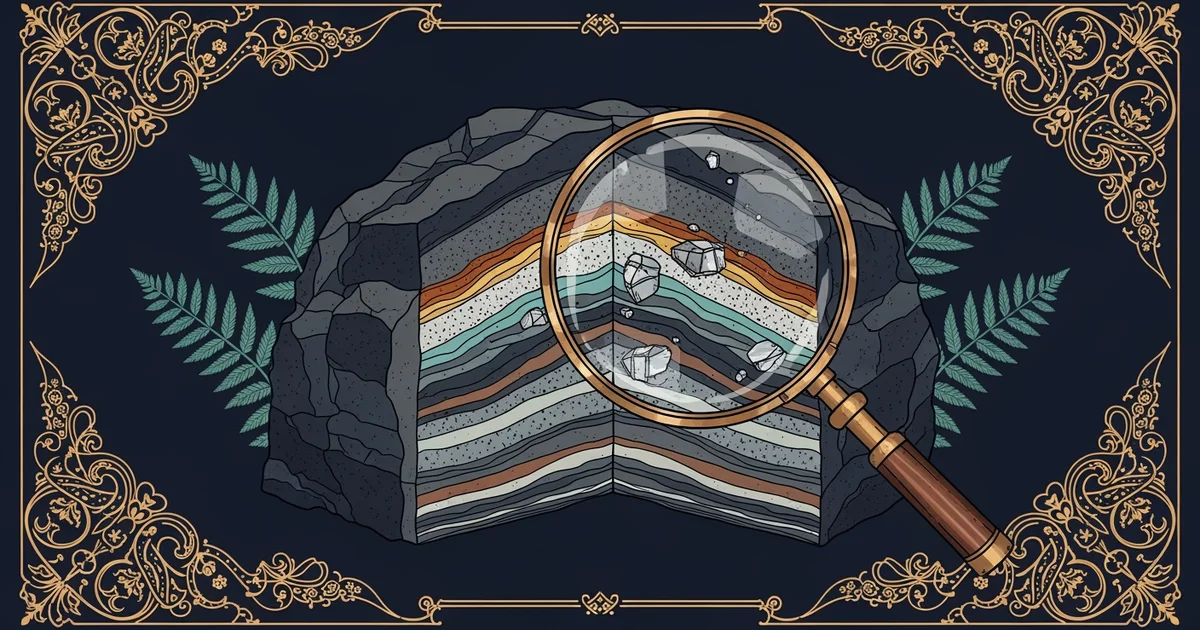
Tracking the Journey of Sediment
When water flows down from high mountain peaks, it carries broken rock fragments known as sediment toward lower valleys. Each grain of sand carries a chemical signature that acts like a passport stamp from its home mountain range. We study these grains to understand how rivers once flowed across landscapes that no longer exist today. Think of this like examining the mud on someone's boots to determine exactly which hiking trail they walked earlier that afternoon. The mud contains unique minerals that only appear on specific paths, just as sand grains contain unique chemical clues from their parent rock. By matching these internal clues to known geological sources, we can map out the ancient river systems that shaped our world.
Key term: Detrital zircon — a durable mineral grain that retains chemical information about its original volcanic or metamorphic source rock for billions of years.
To perform this analysis, researchers often look at the age and composition of these specific minerals found within the sediment. These grains are incredibly tough and survive the long trip from the mountain to the sea without changing their core identity. We use lasers to measure the radioactive elements trapped inside them, which reveals the exact age of the rock where the grain first grew. This data allows us to build a timeline of when specific mountains were pushed up and when they began to erode away. It is a precise method for turning a handful of loose sand into a detailed map of Earth's past tectonic activity.
Reconstructing Ancient Landscapes
The way we interpret these findings requires us to think about the movement of water and land over vast scales of time. We compare the data from different layers of rock to see how the landscape changed as the climate or tectonic plates shifted. This comparison helps us understand if a river stayed in one place or if it moved across the continent over millions of years. The following table shows how different geological sources produce distinct signals in the sediment we collect today:
| Source Type | Chemical Signal | Typical Grain Age | Movement Pattern |
|---|---|---|---|
| Volcanic Arc | High Zirconium | Very Young | Rapid Erosion |
| Old Shield | Low Zirconium | Very Ancient | Slow Weathering |
| Metamorphic | Mixed Elements | Intermediate | Steady Transport |
By looking at these patterns, we can tell if the sediment came from a nearby mountain or if it traveled across an entire continent. This helps us decide where to look for natural resources that often hide in these ancient river channels. The history of the Earth is written in the grains of sand beneath our feet, provided we know how to read the chemical language they speak.
- First, we collect sand samples from the river basin to begin our study.
- Next, we separate the heavy minerals from the lighter sand particles using density.
- Then, we use a mass spectrometer to date the individual grains of zircon.
- Finally, we plot these ages on a map to identify the source mountain range.
This systematic approach ensures that we do not misidentify the origins of the sediment we study. Every step provides a clearer picture of how the surface of the planet has shifted throughout deep time.
Sedimentary provenance analysis uses the chemical and physical signatures of individual mineral grains to trace the path of sediment from its original mountain source to its final depositional site.
The next Station introduces trace element behavior, which determines how specific chemical markers survive the intense heat and pressure of deep burial.