
Continental Drift and Evolution
Imagine you are holding a giant jigsaw puzzle of the world that keeps shifting under your feet. The land beneath us is not static but moves across the hot mantle of our planet.
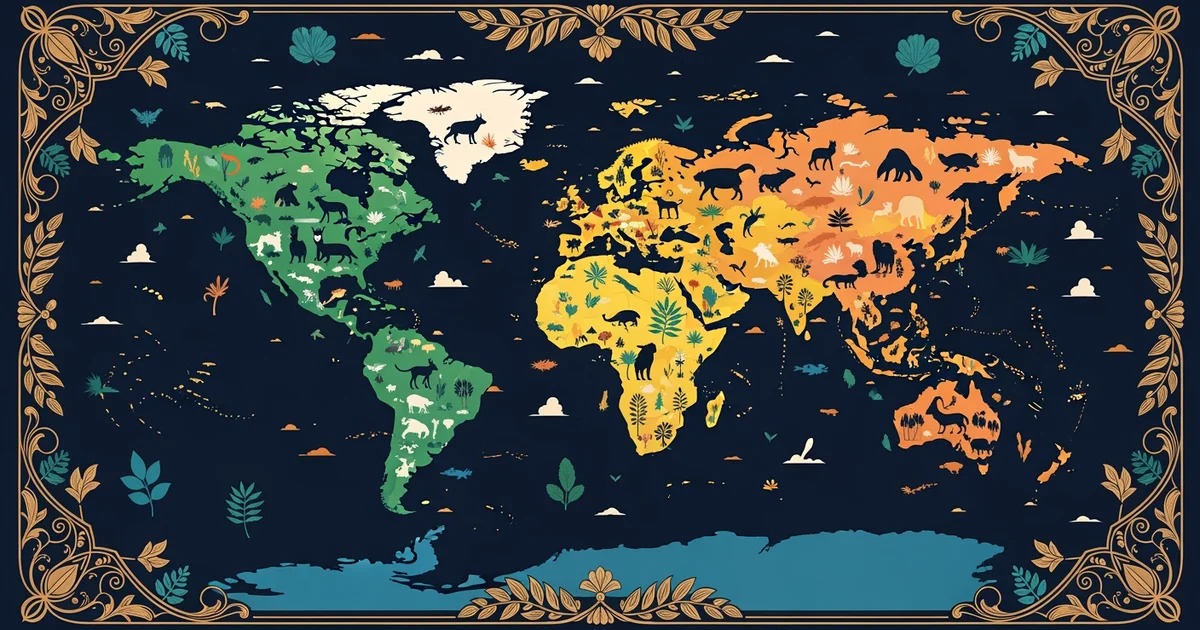
The Mechanism of Shifting Continents
Geologists use the term continental drift to describe how massive land masses move over millions of years. Think of these continents like giant rafts floating on a slow-moving river of molten rock. When these rafts push against each other, they create mountains or trigger massive volcanic events. When they pull apart, they form deep oceans that separate species from each other forever. This movement acts like a slow-motion conveyor belt that rearranges the entire map of our living planet. Just as a river separates two sides of a forest, the opening of a new ocean separates populations of plants and animals. Once separated, these groups stop mixing and begin their own unique paths of change. This slow separation is the primary reason why species on one continent often look different from those on another.
Key term: Plate Tectonics — the scientific theory that describes the large-scale motion of the plates making up Earth's outer shell.
Over vast periods, this physical separation forces evolution to take very different directions for isolated groups. If a group of lizards is trapped on a drifting island, they must adapt to that specific environment. They cannot breed with their cousins on the mainland, so their traits drift apart over time. This process creates a unique biological signature for every land mass on the planet today.
Connecting Ancient Shifts to Modern Species
We see the results of these ancient movements when we compare animals living on distant shores. For example, similar flightless birds exist in South America, Africa, and Australia despite the massive oceans between them. These birds share a common ancestor that lived when all these lands were joined together.
| Feature | Result of Separation | Impact on Species |
|---|---|---|
| Ocean Basin | Deep water barrier | Prevents migration |
| Mountain Range | High altitude zone | Creates climate shift |
| Rift Valley | New land edge | Forces rapid adaptation |
When land masses drift, they move into different climate zones, forcing species to change or face extinction. A forest-dwelling animal might find itself in a desert as its continent moves toward the equator. This constant change explains why we find fossils of tropical ferns in cold regions today. The land moved, but the fossils stayed behind as a record of that ancient journey.
- The continents shift slowly over time, changing the climate of every region they touch.
- Species become trapped on isolated land masses, which forces them to evolve in unique ways.
- We can track these ancient movements by comparing the DNA and fossils of modern animals.
Understanding this process helps us see that geography is not just a static stage for life. Geography is an active participant in the story of how every species survives and changes. The next time you look at a world map, remember that those shapes are temporary. They are merely snapshots of a long, slow dance that has been happening for billions of years. This dance dictates where every creature lives and why they possess the specific traits we see today.
The movement of tectonic plates physically isolates populations, forcing them to evolve along distinct paths that match their changing environmental conditions.
The next Station introduces altitudinal zonation, which determines how elevation and mountain height influence the distribution of life on our planet.