
Defining The Biogeographic Realm
Imagine you are traveling across the world and notice that the birds in Australia look nothing like the birds in your own backyard. You might wonder why nature decided to put such different creatures in these distant places instead of mixing them all together equally. This mystery of life distribution is the foundation of how we understand the natural world. It explains why specific environments host unique groups of plants and animals that evolved in isolation over millions of years.
Understanding Biological Boundaries
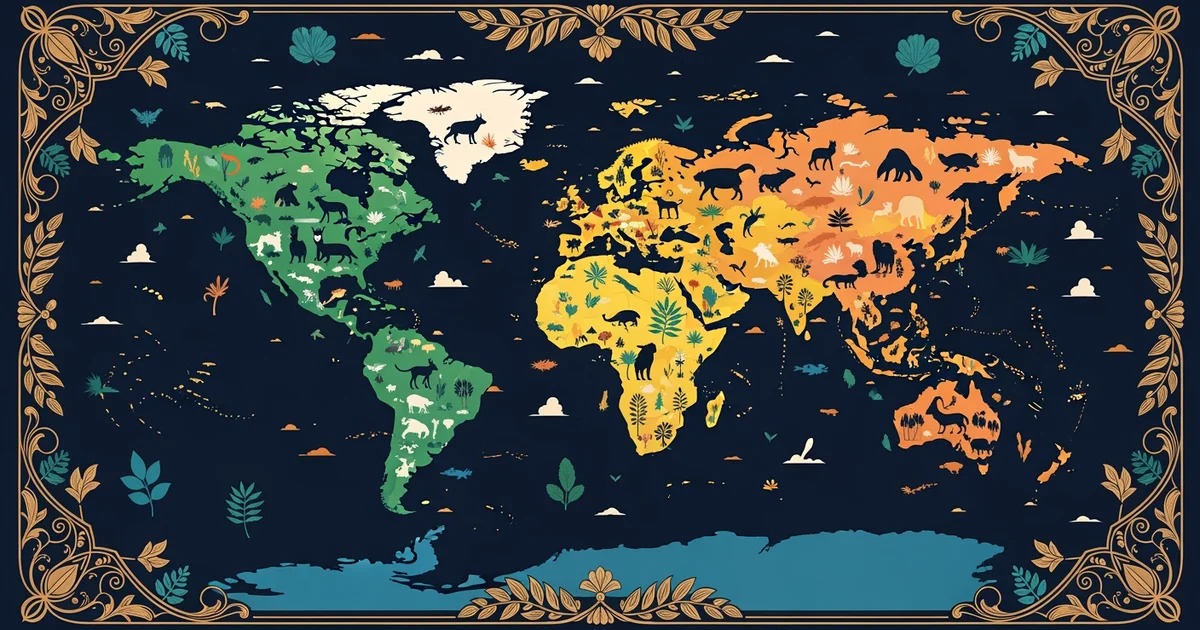
Scientists use the term biogeographic realm to describe these massive regions where species share a common evolutionary history. Think of these realms like the different zones in a large, international airport terminal where passengers from specific regions gather before their flights. Just as travelers from similar cultural backgrounds tend to congregate in certain lounges, species within a realm share a unique heritage that separates them from neighbors in other parts of the world. These boundaries are not usually marked by fences or walls but by physical obstacles like vast oceans or towering mountain ranges.
Key term: Biogeographic realm — a large geographic region where plants and animals have evolved in relative isolation over a long period.
These realms act as biological containers that protect and nurture specific types of life forms that cannot easily cross into other zones. When a species is trapped within a realm by a deep ocean or a desert, it must adapt to the local climate or face extinction. This process creates a distinct signature of life that defines the character of that entire continent or region. Over time, these isolated groups develop traits that help them survive in their specific home, leading to the incredible variety we see today.
Classifying Earth's Major Regions
To better understand how these regions function, we can look at how they differ based on their unique species composition and historical development. The following list highlights how different factors shape the life found within these major global zones:
- The Nearctic realm includes most of North America and features species that adapted to shifting ice ages and varied temperate climates over many centuries.
- The Neotropical realm covers South and Central America, boasting the highest level of biodiversity due to its vast tropical rainforests and long-term isolation from other landmasses.
- The Palearctic realm spans across Europe and northern Asia, acting as a massive land bridge that allowed species to migrate and mix across huge distances.
- The Afrotropical realm encompasses sub-Saharan Africa, where unique mammals and plants evolved alongside stable, ancient landscapes that provided consistent resources for millions of years.
These regions represent the primary stages where the drama of evolution plays out for every living organism on our planet. By looking at these zones, we can predict which types of animals might thrive in a specific area based on their ancestral roots. This knowledge helps us protect endangered species by ensuring they stay in environments that match their historical needs. Understanding these patterns is like reading a map of life that reveals the hidden history of every creature you encounter.
| Realm | Primary Geography | Key Evolutionary Factor |
|---|---|---|
| Nearctic | North America | Glacial movement |
| Neotropical | South America | Long-term isolation |
| Palearctic | Eurasia | Large land connectivity |
| Afrotropical | Sub-Saharan Africa | Stable ancient habitats |
This table shows how geography dictates the evolutionary path for life in each zone. When we compare these areas, we see that the physical shape of the earth is the main driver for where life settles. By studying these differences, we gain a clear picture of why our world contains such a diverse array of living things. This path will give you a complete understanding of how our planet functions as a single, interconnected biological machine by the time you finish all fifteen stations.
Biological realms are large geographic areas where physical barriers have forced species to evolve in isolation, creating distinct patterns of life across the planet.
By exploring how these regions formed, we will move on to see how climate drivers of life dictate the specific conditions within each of these zones.