
Protozoan Life Cycles
Tiny organisms often hide in plain sight, yet they orchestrate complex survival strategies that define the microscopic world. Imagine a traveler who must change outfits and travel modes to survive across different climates, ensuring they reach their final destination safely.
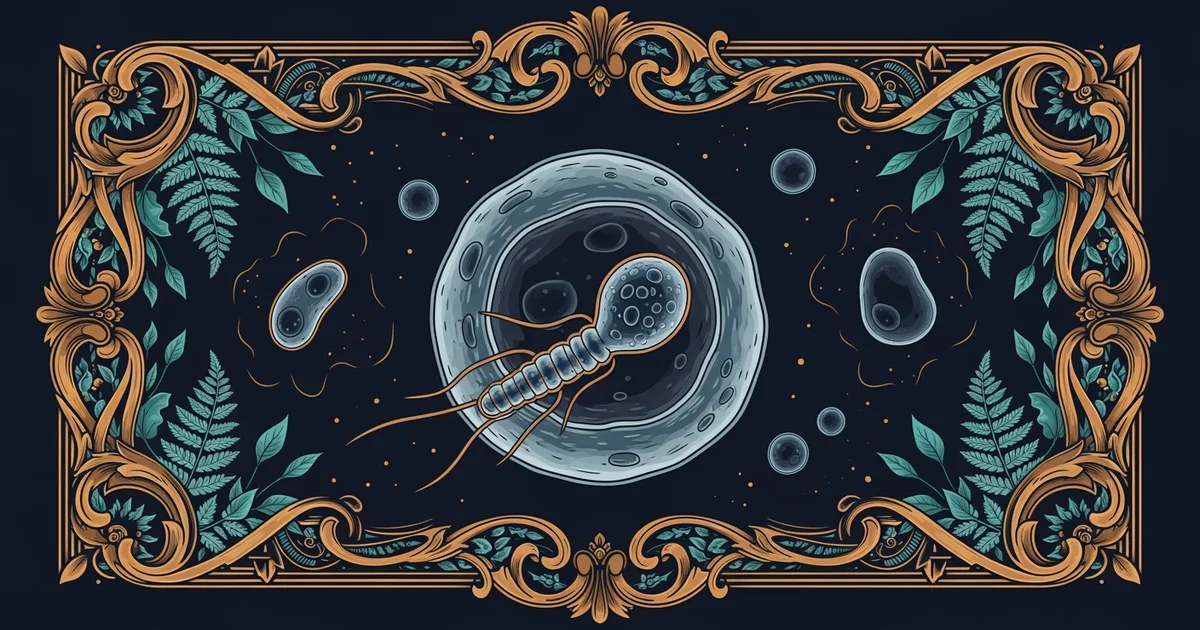
The Stages of Protozoan Development
Protozoan life cycles represent a masterclass in biological adaptation, allowing these single-celled organisms to thrive in diverse and often harsh host environments. These life cycles typically involve a transition between a dormant state and an active, feeding state. The trophozoite acts as the active, mobile, and feeding stage of the organism, which consumes nutrients and reproduces within the host. Once environmental conditions become unfavorable, the organism shifts into a protective shell known as a cyst. This transition is similar to a business owner closing a shop during a recession to save resources until the market improves. By entering this dormant state, the organism survives outside the host for extended periods, waiting for a new opportunity to infect a vulnerable host.
Key term: Life cycle — the sequence of stages that an organism passes through from conception to the production of offspring.
Navigating Complex Host Transitions
Understanding how these parasites move between hosts requires looking at the specific developmental stages that occur inside and outside the body. Many protozoa rely on a specific sequence of transformation to ensure their survival across different biological niches. The life cycle often begins when a host ingests the dormant cyst from a contaminated source, such as water or food. Once the cyst reaches the digestive tract, the harsh acidic environment triggers the release of the active trophozoite. This active form then begins to colonize the host tissues, absorbing nutrients and multiplying rapidly to increase the population. As the host begins to eliminate waste, some trophozoites transform back into new cysts. This cyclical process ensures that the parasite population can spread to new hosts, maintaining its presence in the ecosystem over long periods.
To visualize these developmental shifts, we can examine the standard progression through the environment and the host:
- The dormant cyst stage protects the organism from environmental stress like heat or drying out.
- The ingestion phase occurs when a new host consumes the cyst through contaminated water or food.
- The excystation process happens inside the host gut where the active form finally emerges.
- The trophozoite stage allows the parasite to feed, grow, and reproduce within the host tissues.
- The encystation phase occurs as the parasite prepares to leave the host to find new territory.
Strategies for Environmental Survival
These organisms do not leave their survival to chance, as they utilize specific environmental cues to trigger their developmental changes. When a host environment becomes crowded or nutrient-poor, the parasite senses these chemical signals and initiates the process of encystation. This transition is essential for the organism to endure the external world, where it lacks the constant nutrient supply found inside a host. By forming a thick, resilient wall, the parasite remains viable while waiting for ingestion by a new host. This biological strategy is highly effective, as it allows the parasite to bridge the gap between distinct host populations. Without this ability to switch between active feeding and dormant protection, these organisms would likely perish when separated from their primary environment.
| Stage | Primary Function | Environmental State | Mobility Level |
|---|---|---|---|
| Cyst | Survival/Defense | External/Dormant | Low/None |
| Trophozoite | Feeding/Growth | Internal/Active | High/Mobile |
| Gamete | Reproduction | Internal/Sexual | Moderate |
This table demonstrates how the parasite balances its needs by shifting its form based on the immediate environmental requirements. The active trophozoite stage demands high energy for movement and reproduction, while the dormant cyst prioritizes long-term endurance. By alternating between these states, the protozoan manages to survive in a world that is otherwise hostile to its delicate cellular structure. This constant cycle of transformation is the secret to their widespread success in many different types of habitats across the entire planet.
The survival of protozoan parasites depends entirely on their ability to switch between active feeding stages and dormant protective stages based on environmental conditions.
The next Station introduces Helminth Classification, which determines how larger parasitic worms function.