
Convergent Evolution
Imagine two separate companies designing identical umbrellas without ever speaking to one another during the process. Both firms conclude that a folding metal frame covered by waterproof fabric provides the best protection against rain. Nature often acts like these competing companies by finding the same efficient design solution for different species living in similar environments. This fascinating biological phenomenon demonstrates that environmental pressures shape life in predictable ways over millions of years of history. By observing these patterns, we can better understand the hidden history of life on our planet.
The Logic of Independent Evolution
When unrelated organisms develop similar traits, we call this process convergent evolution. It does not mean that these animals share a recent common ancestor who possessed that specific feature. Instead, it shows that the environment presents a specific problem that requires a functional solution to survive. Think of it like two different inventors building a boat to cross a wide river. They might choose different materials, but both will eventually create a floating vessel because physics dictates how objects move through water. Life works the same way by selecting traits that help organisms thrive in their respective homes.
Key term: Convergent evolution — the independent development of similar features in species that do not share a recent common ancestor.
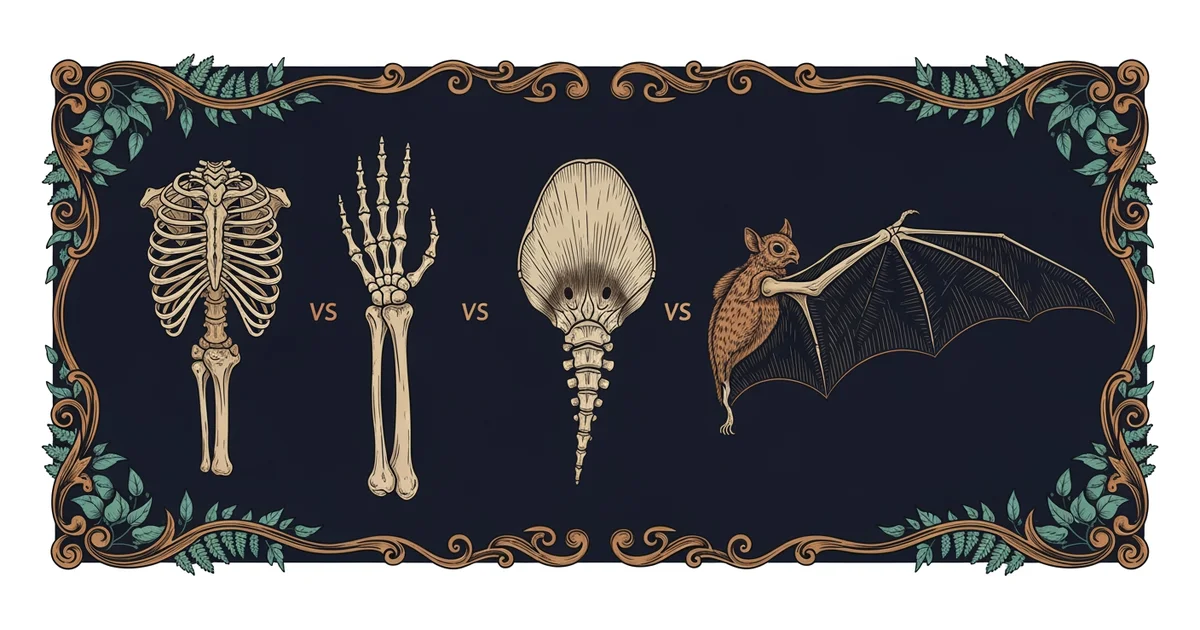
These biological similarities appear across many different groups of animals found in nature. We see this in the way that wings evolved in both birds and bats to solve the problem of flight. While their ancestors were quite different, both creatures needed to navigate the sky to find food and escape predators. Evolution pushed them toward a similar wing structure because that shape works best for generating lift. This is not a coincidence but rather a result of natural selection favoring the most efficient designs for survival.
Comparing Adaptive Traits in Nature
To see how this works, we can compare various animals that evolved similar tools for survival. The following table highlights how different environments drive organisms toward shared physical characteristics to solve daily life challenges:
| Animal Pair | Shared Feature | Environmental Pressure |
|---|---|---|
| Shark and Dolphin | Streamlined body | Moving fast through water |
| Bat and Butterfly | Wing structures | Navigating through the air |
| Cactus and Euphorbia | Thick fleshy stems | Saving water in dry heat |
These examples show that nature repeats successful designs whenever the conditions allow for it. The shark is a fish, while the dolphin is a mammal, yet they look remarkably similar because both must hunt in the ocean. If you need to move quickly through a thick liquid, a torpedo shape is the most efficient choice. Both species arrived at this solution independently because the laws of biology and physics remain the same for everyone. This repetition helps us identify which traits provide the greatest advantage for specific life styles.
We must remember that these shared traits are often just skin deep in terms of their genetic history. While the outer shape might look identical, the internal bone structure often reveals a different story about their origins. A bird wing and a bat wing serve the same purpose, but they are built from different arrangements of bones. This distinction proves that the creatures reached the same destination by taking very different evolutionary paths. Studying these differences allows us to map out the true family tree of life across the globe.
By comparing these body parts, we uncover how life finds clever ways to master every corner of the earth. Evolution is a creative force that constantly tests new designs against the harsh realities of the natural world. When a design works well, it persists across many diverse branches of the tree of life. This process reveals the deep patterns that govern how every living thing adapts to its unique surroundings over time.
Convergent evolution proves that nature frequently arrives at identical functional solutions when different species face the same environmental challenges.
The next Station introduces skeletal system mechanics, which determines how these physical structures allow animals to move through their environments.