
Homology and Analogy
Imagine you are looking at a bird wing and a bat wing side by side. They both help animals fly through the air, but their internal structures tell very different stories about how they evolved. Understanding these differences helps us map the hidden history of life on our planet.
Understanding Evolutionary Roots
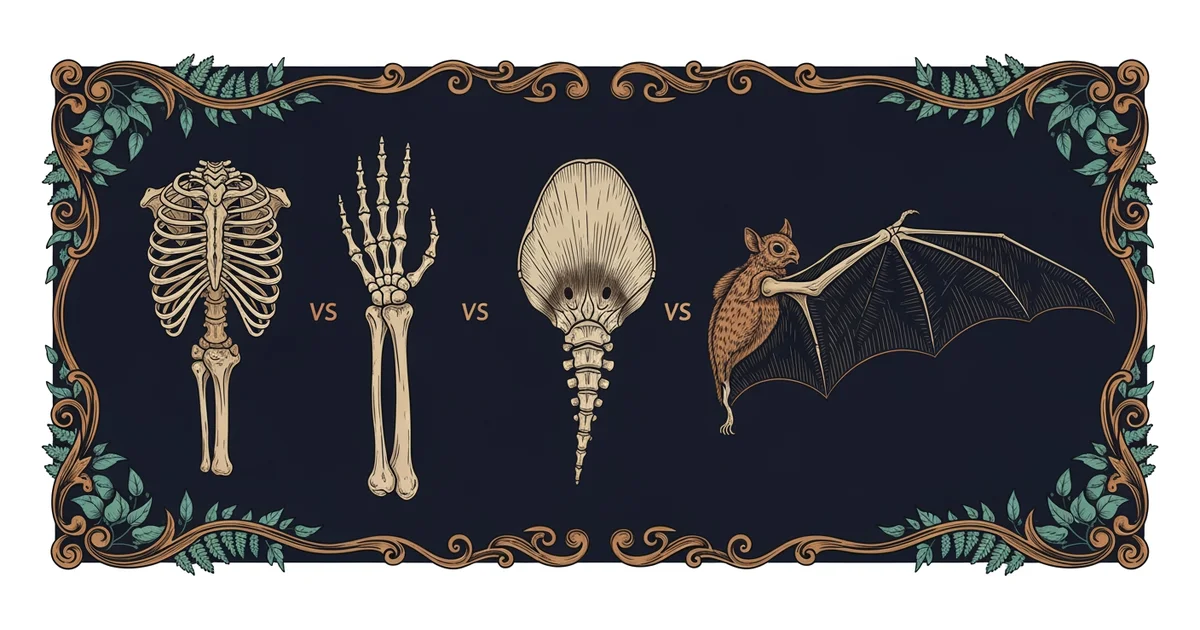
When we look at the skeletons of different animals, we often see body parts that share a similar layout. These structures are known as homologous traits. They exist because two different species share a common ancestor that had that specific bone arrangement. For example, the arm of a human, the flipper of a whale, and the wing of a bird all contain the same basic bone pattern. Even though these limbs perform different tasks like swimming, grasping, or flying, the underlying blueprint remains the same. This shared history acts like a biological family tree that connects diverse species across time.
Think of this like two different car models built by the same company using the same engine chassis. Even though one car is a fast sports model and the other is a heavy truck, they both share a core mechanical foundation. This foundation reveals their common origin. In nature, evolution does not start from scratch every time a new species appears. Instead, it modifies existing structures to suit new environments. By identifying these homologous traits, scientists can trace the branches of life back to where they first split apart.
Analyzing Functional Convergence
Sometimes, animals evolve similar features even when they are not closely related to each other. These features are called analogous traits. They appear when different species face similar environmental pressures and develop the same solution to survive. A classic example is the wing of a butterfly and the wing of a bird. Both wings allow the animals to fly, but they do not share a common ancestor that had wings. Their wings evolved independently because flight is a very useful trait for survival in many different habitats.
Key term: Analogy — the evolutionary process where unrelated species develop similar traits to solve the same environmental challenges.
This process is like two different companies creating a similar product because their customers have the same need. One company might make a plastic water bottle while another makes a glass one. They look similar and hold water, but they are made of different materials and come from different factories. In the wild, nature often finds the same functional answer for different creatures. Comparing these traits helps us distinguish between features inherited from ancestors and features developed for specific survival needs.
| Trait Type | Origin | Reason for Similarity | Example |
|---|---|---|---|
| Homologous | Shared ancestor | Inherited blueprint | Human arm and whale fin |
| Analogous | Independent evolution | Similar environment | Bird wing and insect wing |
| Homologous | Shared ancestor | Common genetic history | Cat leg and bat wing |
We can classify these traits by looking at both the form and the function of the body parts. If the internal bones match, it is likely a sign of shared ancestry. If the internal structure is completely different but the task is the same, it is likely a case of independent evolution. This simple distinction allows us to see how life adapts to change while keeping its deep history intact.
Comparing body parts reveals whether species share a common ancestor or merely adapted to similar environments through independent evolution.
The next Station introduces limb development patterns, which determines how these homologous structures grow during the early stages of life.