
Evolutionary History Basics
Imagine you are looking at a family photo album from several generations ago to spot shared facial features. You might notice your nose shape matches your grandfather, or your eye color mirrors your great-aunt, showing how traits persist through time. Animals possess a similar kind of record stored within their physical bodies, acting as a living history book that reveals their ancient origins. By examining these traits, we can track how different species changed to survive in their unique environments over millions of years.
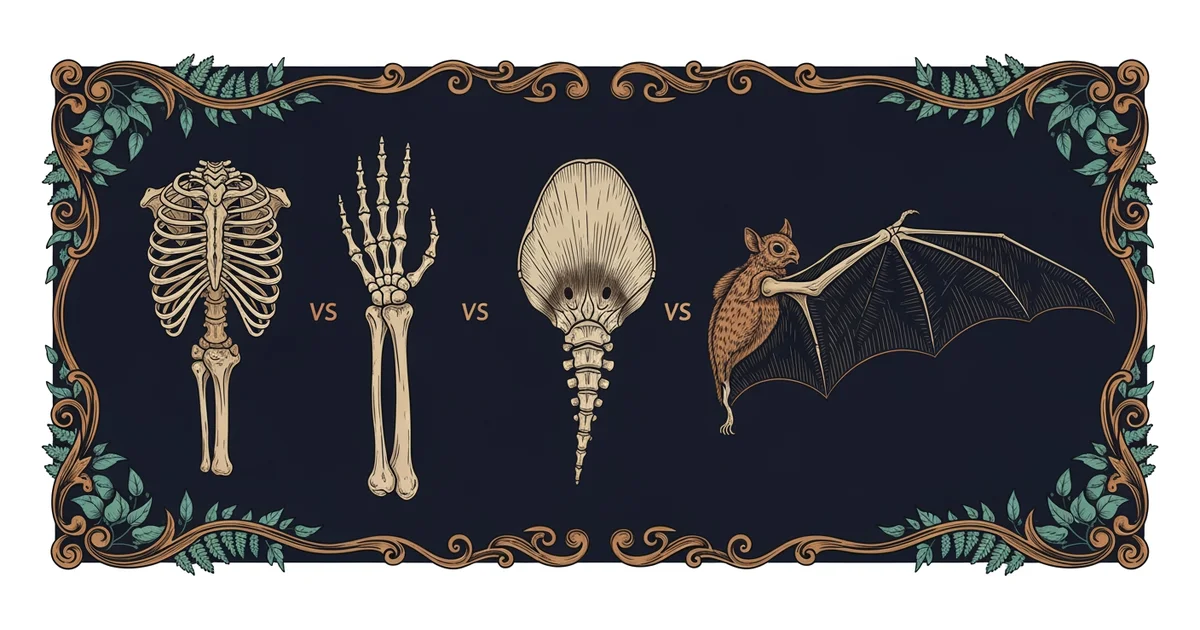
The Blueprint of Ancestral Inheritance
Every living creature carries a set of instructions that dictates its physical form and internal functions. These instructions are passed down through generations, ensuring that offspring resemble their parents while retaining the core structure of their ancestors. When an environment changes, the individuals with traits that offer a slight survival advantage tend to live longer and reproduce more often. Over vast spans of time, these small shifts accumulate until a population looks quite different from the original group. This process of evolutionary lineage explains why certain body parts remain consistent across diverse species, acting as a biological signature of their shared past. Think of it like a company updating its product line while keeping the original manufacturing logo on every single new item.
Key term: Evolutionary lineage — the unbroken series of ancestors that leads from an ancient organism to a modern descendant species.
Just as a business might keep a specific design feature because it works well for the customer, nature keeps physical traits that help an organism thrive. If a species moves into a new habitat, such as from land to water, its body must adapt to handle new pressures like buoyancy and temperature. These adaptations are not random changes but are built upon the pre-existing physical framework of their ancestors. We call these inherited features ancestral traits, which are the fundamental building blocks that define the basic shape and function of an animal's body. These traits are deeply embedded in the genetic code, making them very difficult to remove entirely even when they are no longer useful.
Environmental Pressures and Physical Change
When we compare animals, we must look at how their specific environments forced them to evolve different physical tools. A creature living in the deep ocean faces extreme pressure and darkness, which requires specialized eyes and body shapes compared to a forest dweller. The following list outlines how environmental pressures influence the development of specific physical traits over many generations:
- Energy efficiency demands that animals evolve lighter bones if they need to fly, as heavy skeletons would require too much fuel to lift into the air.
- Temperature regulation requires thick layers of fat or fur for animals in arctic climates, allowing them to maintain internal warmth despite freezing external conditions.
- Movement efficiency dictates the shape of limbs, such as fins for swimming or wings for gliding, ensuring the animal can navigate its home with minimal effort.
These physical adaptations are the result of millions of years of trial and error within the natural world. Every change represents a response to a specific challenge, such as finding food, avoiding predators, or finding a mate in a harsh landscape. By studying these traits, we can infer what life was like for the ancestors of modern animals, even if we never see those ancestors directly. The physical body is essentially a map of the challenges that previous generations faced and successfully overcame. Understanding this connection helps us see that no animal is a finished product, but rather a work in progress that is still responding to the world around it.
Physical traits serve as an enduring record of the environmental challenges and survival strategies that shaped an organism's ancestors over time.
Understanding these ancestral foundations prepares us to explore how different species develop similar tools through homology and analogy.