
Vertebrate Body Plans
Imagine looking at the front wheel of a bicycle and then checking the steering assembly of a car. You will quickly notice that both systems rely on a shared mechanical logic to achieve movement. Vertebrates share this same kind of deep, structural blueprint across every species on the planet. Whether you study a tiny fish or a massive whale, you find the same basic skeletal components in place. This shared architecture serves as the hidden foundation for all life that possesses a backbone. By examining these body plans, we uncover the ancient connections that link every vertebrate creature to a common starting point.
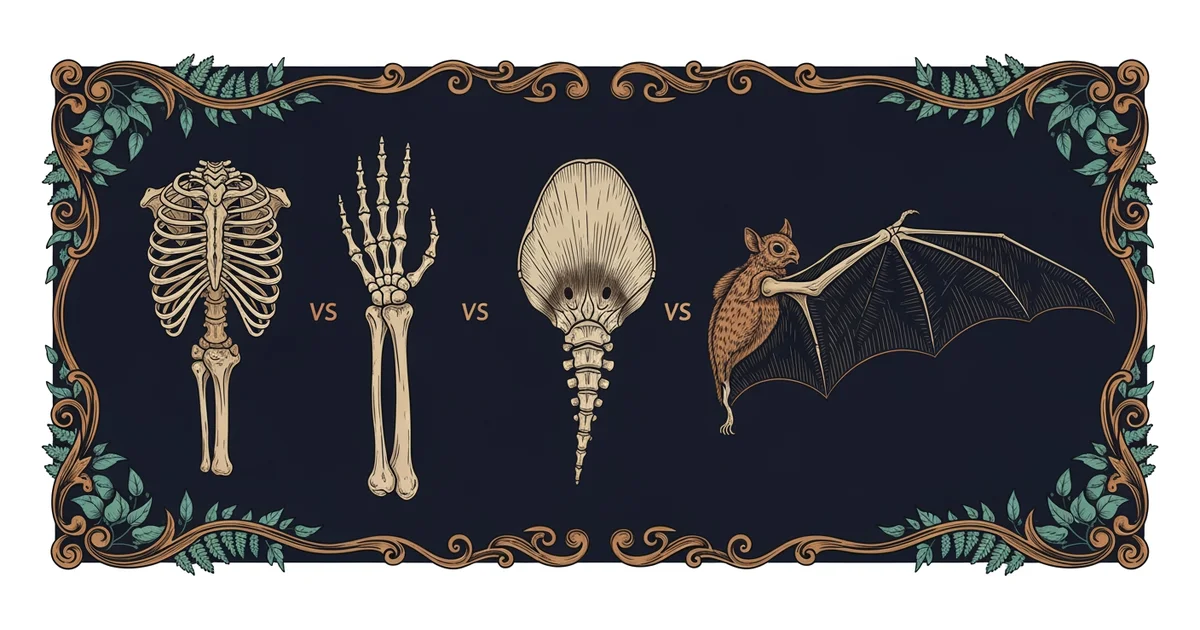
The Architecture of Vertebrate Skeletons
When we look closely at the vertebrate body plan, we see a repeating pattern of bones that defines the entire group. This plan includes a central column of vertebrae that protects the spinal cord and provides structural support. Think of this column like a flexible steel beam in a skyscraper that holds the weight while allowing for movement. Attached to this central axis are the limbs and the skull, which form the rest of the framework. Even though these bones change shape based on the animal's needs, their relative positions remain consistent across species. This consistency proves that evolution works by modifying existing structures rather than inventing entirely new ones from scratch.
Key term: Vertebrate body plan — the shared structural arrangement of a central spinal column and paired limbs found in all animals with backbones.
To understand how these parts relate to one another, we must look at the way limbs are organized in different animals. Every vertebrate limb, from the flipper of a dolphin to the wing of a bat, follows a specific sequence of bone segments. This sequence starts with one large bone, followed by two smaller bones, and ends with a collection of many tiny bones. This arrangement is not random; it is a inherited trait that has persisted for millions of years. Even when an animal does not use its limbs for walking, the underlying bone pattern often remains visible in its anatomy.
Comparing Skeletal Patterns Across Groups
Comparing the anatomy of fish and mammals reveals striking similarities that hint at our shared biological history. While a fish uses its fins to navigate water, the internal support for those fins mirrors the limbs of land-dwelling mammals. We can organize these observations to see how different groups utilize the same basic skeletal components for their specific environments. This structured comparison helps us see that the differences we observe are mostly variations in size and shape rather than fundamental changes in the skeletal plan itself.
| Feature | Fish Anatomy | Mammal Anatomy | Purpose |
|---|---|---|---|
| Central Axis | Spinal column | Spinal column | Support |
| Limb Pattern | Fin bones | Arm/leg bones | Movement |
| Skull Design | Bony plates | Fused bone | Protection |
We can identify three primary ways that vertebrates adapt their shared skeletal blueprint to thrive in diverse habitats:
- The modification of limb bones allows for specialized movement, such as swimming in water, running on land, or flying through the air, while keeping the same basic bone count.
- The scaling of the spinal column provides the necessary rigidity for land animals while offering the flexibility required by aquatic species to propel themselves through dense liquid mediums.
- The adjustment of skull density protects the brain from different environmental pressures, ensuring that sensitive sensory organs remain safe during the daily activities of the animal.
By carefully reviewing these patterns, we learn that the diversity of life on Earth is built upon a limited set of successful designs. Nature does not waste energy creating new parts when it can simply tweak the ones that already function well. This realization changes how we view the animal kingdom, turning a collection of random creatures into a connected family tree. If we understand the rules of this skeletal game, we can predict where to look for clues about an animal's past. The next step is to see how these physical structures record the passage of time and the history of our planet.
The shared skeletal blueprint of vertebrates demonstrates that life evolves by modifying existing structures rather than creating entirely new ones.
Exploring how these skeletal patterns change over time will reveal the evolutionary history of vertebrate life on Earth.