
Introduction to Comparative Anatomy
Imagine looking at the wing of a bird and the flipper of a whale side by side. You might notice that they look very different on the outside because they help these animals move in different ways. If you look closer at the bones inside, you will find they share a very similar design. This simple observation is the starting point for understanding how all life on our planet is connected. By comparing these physical structures, we can trace the hidden history of animals that lived long ago.
The Logic of Structural Comparison
Comparative anatomy is the study of similarities and differences in the structures of different living organisms. When scientists compare these parts, they look for patterns that suggest a shared ancestry between species that seem unrelated today. Think of it like comparing two different models of cars made by the same company over many years. Even if the body styles change to suit different needs, the engine parts often share the same basic layout and connection points. This internal consistency reveals a common design blueprint that has been passed down through generations of evolution.
Key term: Homologous structures — physical features found in different species that share a common evolutionary origin despite having different modern functions.
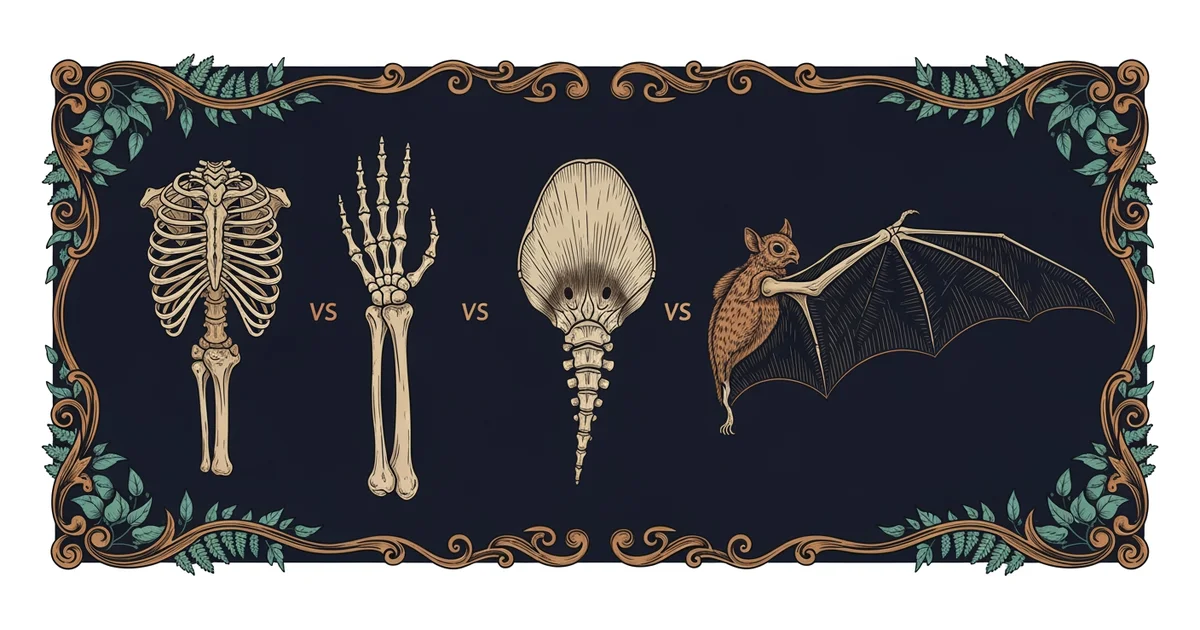
Scientists use these patterns to build a map of how species are related to one another. When we see the same arrangement of bones in a human arm, a bat wing, and a whale flipper, we call these homologous structures. This does not mean these animals are the same, but it shows they inherited their basic bone layout from a common ancestor. Just as a mechanic can identify the lineage of a car by looking at the engine block, biologists identify the lineage of animals by looking at their skeletal framework.
Identifying Biological Patterns
To understand why this matters, we must look at how nature modifies existing tools for new tasks. Evolution does not start from scratch when a new environment presents a challenge to an animal species. Instead, it repurposes what is already there to help the animal survive in its specific habitat. This process of modification explains why a human hand and a cat paw share the same basic bone segments despite their very different uses.
We can organize these observations by looking at how specific body parts serve different roles across various groups of vertebrates:
- The forelimb of a human is adapted for grasping and manipulating objects with precision, which requires a flexible wrist and long, movable fingers.
- The wing of a bat is adapted for powered flight, so the finger bones are elongated to support a thin membrane of skin.
- The flipper of a whale is adapted for swimming, so the bones are shortened and flattened to create a sturdy, paddle-like surface.
These differences show how natural selection shapes the same set of building blocks into tools that serve unique needs. By studying these variations, we learn how life adapts to environmental pressures over millions of years. This approach turns the study of anatomy into a detective story where every bone provides a clue about the past. By the end of this learning path, you will be able to reconstruct the evolutionary history of vertebrates by analyzing their physical body plans and structural adaptations.
Comparing the internal structure of different animals allows us to uncover the shared evolutionary history hidden beneath their diverse outward appearances.
Understanding these structural relationships will prepare you to explore the specific body plans that define different groups of vertebrate animals.