
Limb Development Patterns
Imagine looking at the front limb of a human, a bat, and a whale all placed side by side. While these animals live in different worlds, their arm bones share a surprisingly familiar arrangement that suggests a shared ancient origin. This pattern of bones, known as the pentadactyl limb, appears across almost all land-dwelling vertebrates despite their diverse lifestyles. You might wonder why a bird uses the same basic bone blueprint to fly that a mole uses to dig through dirt. The answer lies in the way evolution modifies existing structures rather than starting from scratch every time a new species appears.
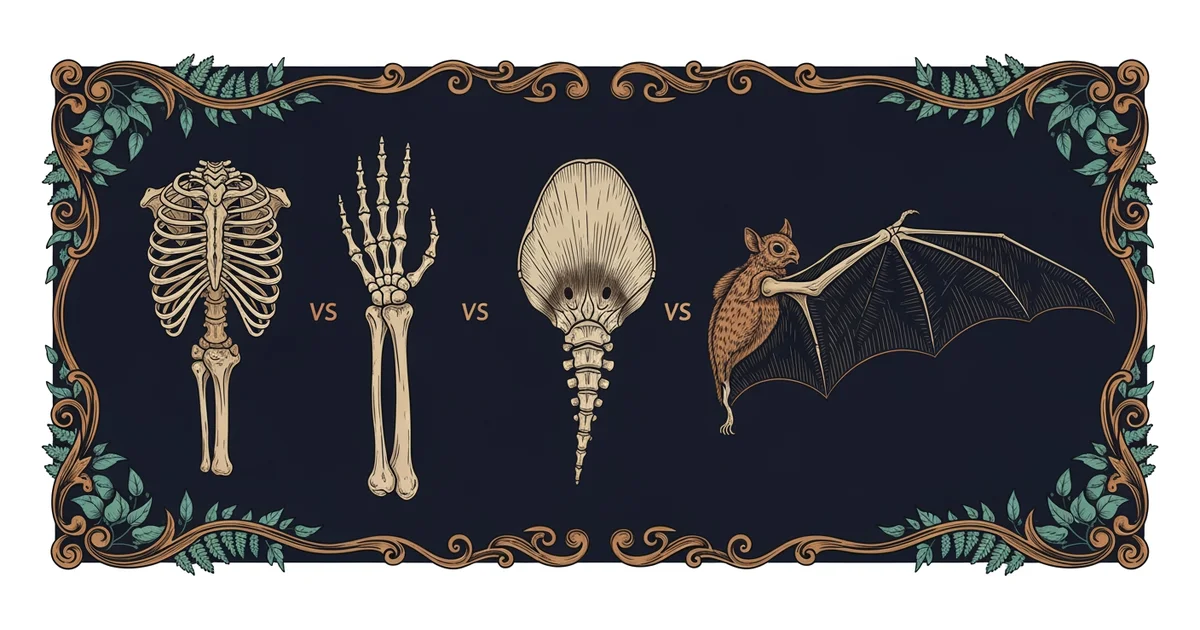
The Shared Blueprint of Vertebrate Limbs
Nature acts like a builder who refuses to throw away perfectly good blueprints when constructing new houses. Instead of designing a unique limb for every environment, evolution takes the standard five-digit layout and tweaks it to suit specific needs. This process is similar to how a car manufacturer might use the same engine block for a small sedan, a heavy truck, and a high-speed racing vehicle. The basic mechanical parts remain the same, but the final shape changes based on how the machine must perform its job. This conservative approach to design explains why your own arm, a bat's wing, and a whale's flipper all contain a humerus, radius, and ulna. These bones are the foundational pieces of the vertebrate skeletal system, and they appear in a consistent sequence across many different groups.
Key term: Pentadactyl limb — the ancestral five-digit skeletal structure found in the forelimbs and hindlimbs of most terrestrial vertebrates.
When we examine these limbs closely, we see that the bones are not just similar in name but also in their relative positions. Every one of these limbs starts with a single upper arm bone, followed by two lower arm bones, and then a complex cluster of wrist and finger bones. This layout is so rigid that it persists even when the digits become fused, elongated, or reduced in size. For instance, the long, spindly fingers of a bat are just modified versions of the same bones found in your own hand. The whale flipper hides these same finger bones inside a thick, paddle-like structure designed for pushing against water. Evolution has stretched, flattened, and thickened these bones, yet the underlying map remains clearly recognizable to anyone who knows where to look for the connections.
Adapting the Structure for Different Environments
The way these limbs function reveals how natural selection prioritizes efficiency over total reinvention. If an animal needs to navigate the air, it does not grow entirely new appendages; it simply lengthens the existing finger bones to support a skin membrane. If an animal needs to swim, it shortens the arm bones to create a rigid, powerful lever for moving through dense liquid. This flexibility allows a single structural plan to support countless ways of moving across the planet. The following table highlights how the standard limb bones are modified for different biological tasks:
| Animal | Primary Limb Function | Structural Modification |
|---|---|---|
| Human | Grasping and tool use | Short, flexible finger bones |
| Bat | Powered flight | Elongated, thin finger bones |
| Whale | Swimming and steering | Short, thick, flattened bones |
By comparing these modifications, we can see that the limb is a compromise between the original ancestral shape and the specific physical demands of the environment. Each species retains the core set of bones because they are already linked to the genetic development pathways that build the entire body. Changing the fundamental number of bones would require a massive shift in how embryos develop, which is often too risky for survival. Therefore, evolution prefers to work within the existing constraints, adjusting the size and density of the bones to match the daily habits of the animal. This is why we see such variety in outward appearance, yet such profound consistency in the internal skeletal architecture of all land vertebrates.
The consistent skeletal pattern of the pentadactyl limb proves that diverse species evolved from a common ancestor that passed its basic body plan down through millions of years.
The next Station introduces vestigial structures, which demonstrate how body parts lose their original function when they are no longer needed for survival.