
Einstein's Legacy in Tech
Your smartphone knows your location because it constantly talks to invisible satellites orbiting high above the Earth. While these signals seem simple, they would fail within minutes without the complex math of physics.
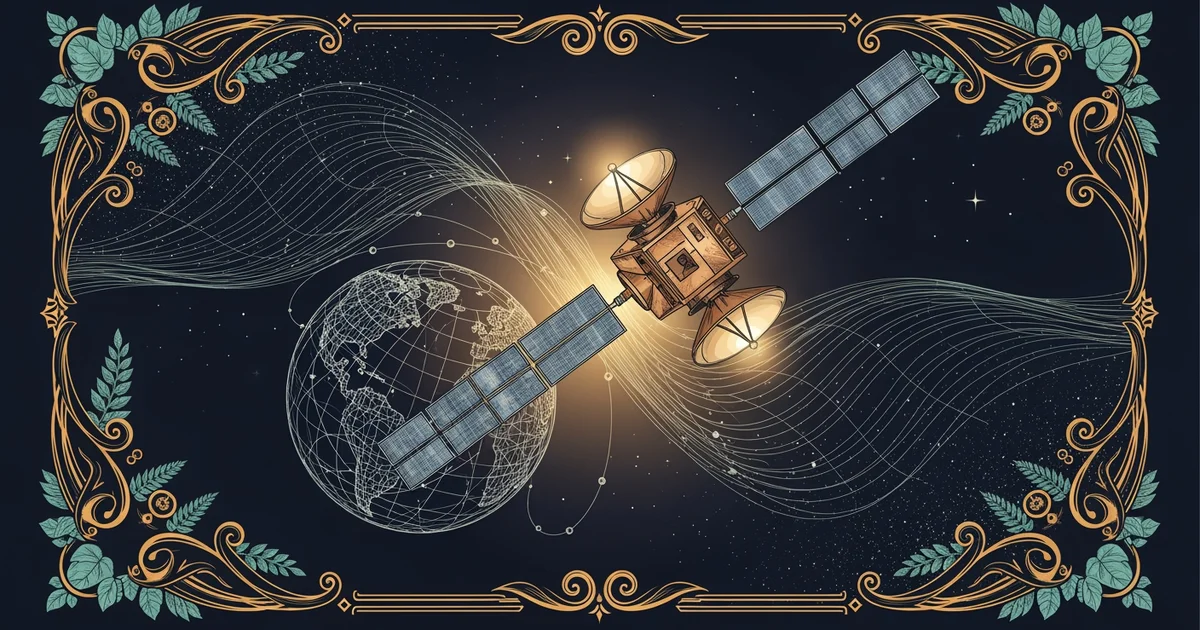
The Gravity of Time
Gravity acts like a heavy blanket that stretches the fabric of space and time itself. Because satellites orbit far from the Earth's massive core, they experience much less gravity than we do. This difference means that time actually ticks faster for a satellite than it does for you on the ground. If engineers ignored this reality, the clocks on those satellites would drift away from our time. Your phone would then calculate your position incorrectly by several miles every single day. We must adjust the satellite clocks to account for this specific General Relativity effect. This theory explains how massive objects like planets warp the flow of time near their surfaces.
Key term: General Relativity — the scientific framework describing how gravity curves space and slows down time near massive objects.
Synchronizing the Cosmic Clock
Think of the satellite system like a massive, global bank account that tracks your location transactions. If the bank's clocks were not perfectly synced, the math for your balance would become chaotic and useless. Satellites carry atomic clocks that are incredibly precise, but they still require constant updates to stay aligned. We bridge the gap between abstract physics and daily utility by applying these corrections to every signal. Without this constant calibration, the entire network would lose its reliability for navigation. The system relies on the Special Relativity principle, which accounts for the speed of the satellites. Since these machines travel very fast, their clocks slow down slightly compared to stationary clocks on Earth. We must combine both gravity and speed effects to keep the system working for users.
| Effect Type | Cause of Change | Impact on Clock | Correction Needed |
|---|---|---|---|
| Velocity | Fast movement | Slows down time | Add time pulses |
| Gravity | Weak gravity | Speeds up time | Subtract time |
| Combined | Net result | Small drift | Constant tuning |
This table highlights how different physical forces pull the satellite clocks in opposite directions. By balancing these two factors, scientists ensure that your device receives accurate timing data every second. It is a perfect example of how high-level physics solves a very practical, everyday problem for people everywhere.
Why Theory Matters for Tech
We must look at how these concepts interact to answer the foundation question of this path. In earlier stations, we learned how devices calculate distance based on the time signals take to arrive. If the timing is wrong, the distance calculation becomes wrong, and your map shows the wrong street. This tension between pure theory and everyday tech shows that science is not just for classrooms. It is the invisible infrastructure that supports our modern, digital, and connected global society. Scientists continue to refine these models to make navigation even more precise for future needs. The legacy of these theories is a world where anyone can find their way with a simple device. We rely on the genius of past thinkers to navigate our complex world with total confidence.
Modern navigation succeeds only because we apply the laws of curved space and time to synchronize satellite clocks with Earth.
Future navigation challenges will require even greater precision as we move toward automated transport and deeper space exploration.