
The Speed of Light Constant
Imagine you are trying to sync two clocks across a vast, empty room. You shout a start signal, but the sound takes time to travel from your lips to the other side. Because sound moves slowly, your clocks will never show the same time unless you account for that delay. This exact problem happens with satellites orbiting Earth far above our heads. They rely on the speed of light, which acts as a universal cosmic limit for all information. If we do not account for how long light takes to travel, our global positioning systems would fail us completely.
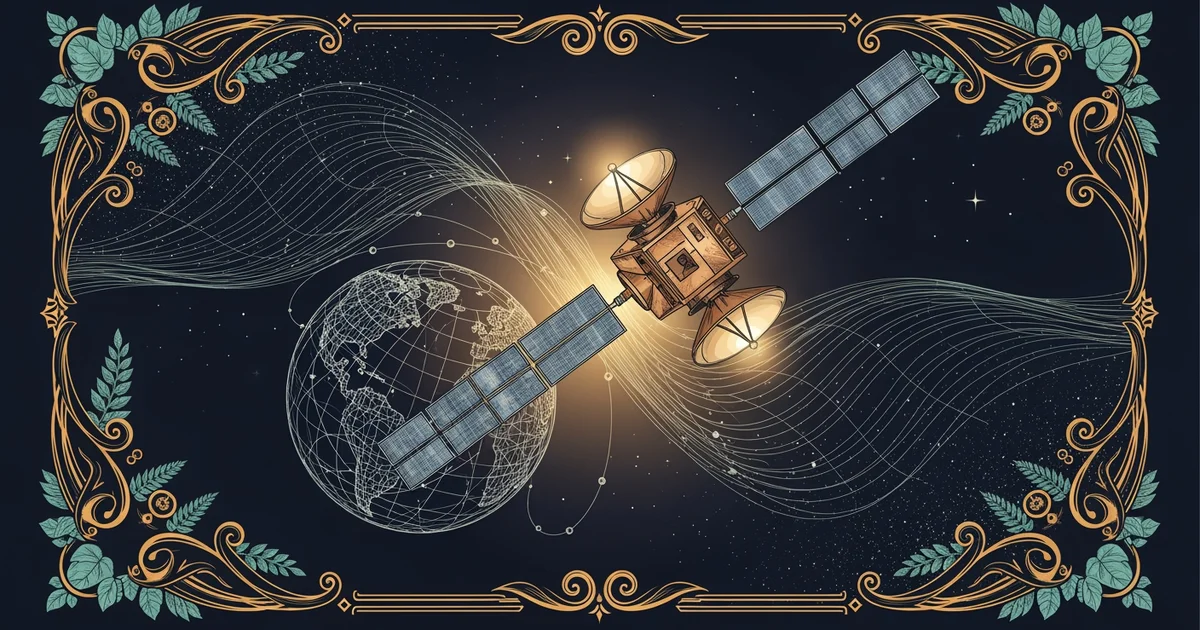
Measuring the Cosmic Constant
The speed of light is a fixed value that we write as . In a vacuum, this light travels at roughly meters per second. This speed is not just a suggestion; it is a fundamental rule of our universe. Think of it like a rigid, invisible highway where every piece of information must travel at the same set pace. If you try to send a signal faster, the laws of physics simply prevent it from happening. By knowing this exact speed, engineers can calculate the distance between satellites and your phone with extreme precision.
Key term: Speed of light — the constant rate of $299,792,458$ meters per second at which all electromagnetic radiation travels in a vacuum.
When you use a map app on your phone, you are actually performing a high-speed math problem. Your device receives signals from multiple satellites that are constantly broadcasting their precise location and time. Because these signals travel at the speed of light, your phone calculates the distance by multiplying that speed by the travel time. If the speed of light were not perfectly constant, these calculations would drift apart within seconds. This would result in your location appearing miles away from where you actually stand.
Calculating Distance Through Time
To understand why this timing matters, we must look at the math behind the signal process. We use a simple formula to determine how far away a satellite is from your receiver. The distance is equal to the speed of light multiplied by the time the signal took to arrive. Because the signals move so fast, even a tiny error in time measurement creates a massive error in your position. Satellites must keep their internal clocks synced to this light-speed reality to remain useful for navigation.
| Signal Source | Speed Constant | Distance Impact |
|---|---|---|
| GPS Satellite | m/s | High precision |
| Ground Station | m/s | Medium precision |
| Radio Beacon | m/s | Low precision |
We can summarize how this constant speed impacts our daily navigation tools through these three core factors:
- Signal delay accounts for the time light spends moving through the vacuum of space before reaching Earth.
- Clock synchronization ensures that every satellite agrees on the exact moment a signal was sent into space.
- Distance calculation relies on the fact that light speed never changes, allowing phones to map your location.
By keeping these factors stable, the system maintains a high level of accuracy for every user on the ground. If the speed of light fluctuated, we would lose the ability to track movement accurately across the globe. We rely on this cosmic constant to bridge the gap between space and our handheld devices. This relationship between light, time, and distance is the foundation of modern global positioning technology. Without this fixed speed, our digital maps would be nothing more than random guesses about where we are located.
The speed of light serves as a universal clock that allows us to measure exact distances between moving objects in space and receivers on the ground.
Now that we understand how light speed defines distance, we will explore how motion affects the way we perceive time itself.